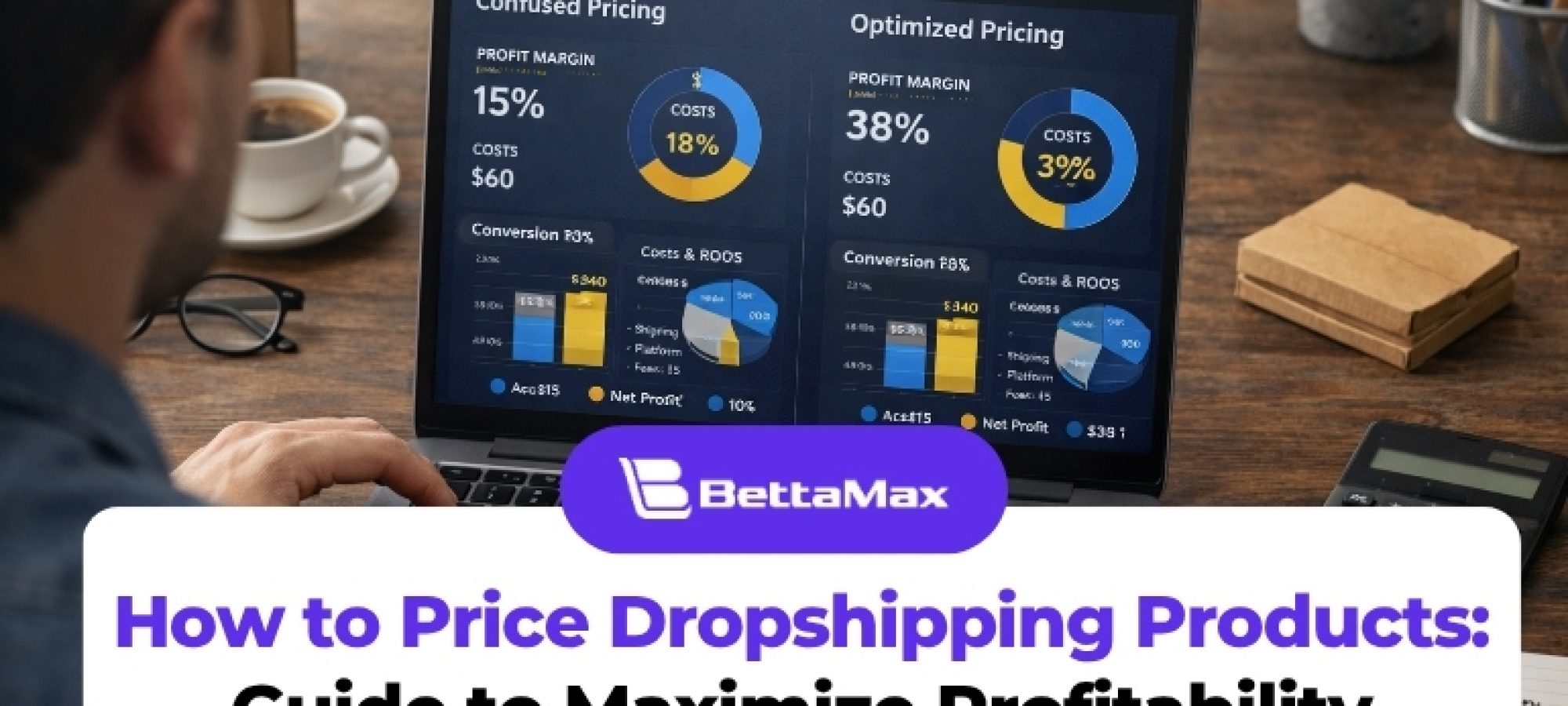

Pricing represents one of the most critical decisions in dropshipping. Set prices too low and you work yourself into unprofitability despite increasing sales volume. Set prices too high and customers perceive products as expensive, abandoning purchases. The difference between successful dropshippers and failing businesses often comes down to strategic pricing – converting sufficient margin to cover advertising costs, operational expenses, and build genuine profit.
Many beginners approach pricing reactively, copying competitors or guessing based on limited analysis. This approach guarantees suboptimal results. The most profitable dropshippers calculate total landed costs methodically, understand market positioning deeply, and test pricing continuously to optimize conversion and profitability simultaneously.
This comprehensive guide reveals how to price dropshipping products strategically, covering calculation methods, proven pricing strategies, and implementation frameworks that have generated extraordinary results for thousands of businesses.
Why Strategic Pricing Matters In Dropshipping
Pricing affects nearly every aspect of business performance. First, improper pricing directly determines profitability. Many dropshippers operate at losses because they fail to account for all costs in pricing decisions. Every cost ignored (payment processing fees, advertising allocation, platform subscriptions, transaction expenses) reduces profit margins untraceably.
Second, pricing influences market positioning. Customers interpret prices as quality indicators. Suspiciously cheap prices signal low quality. Premium prices signal exclusivity and quality. Strategic pricing positions your brand appropriately within target market expectations.
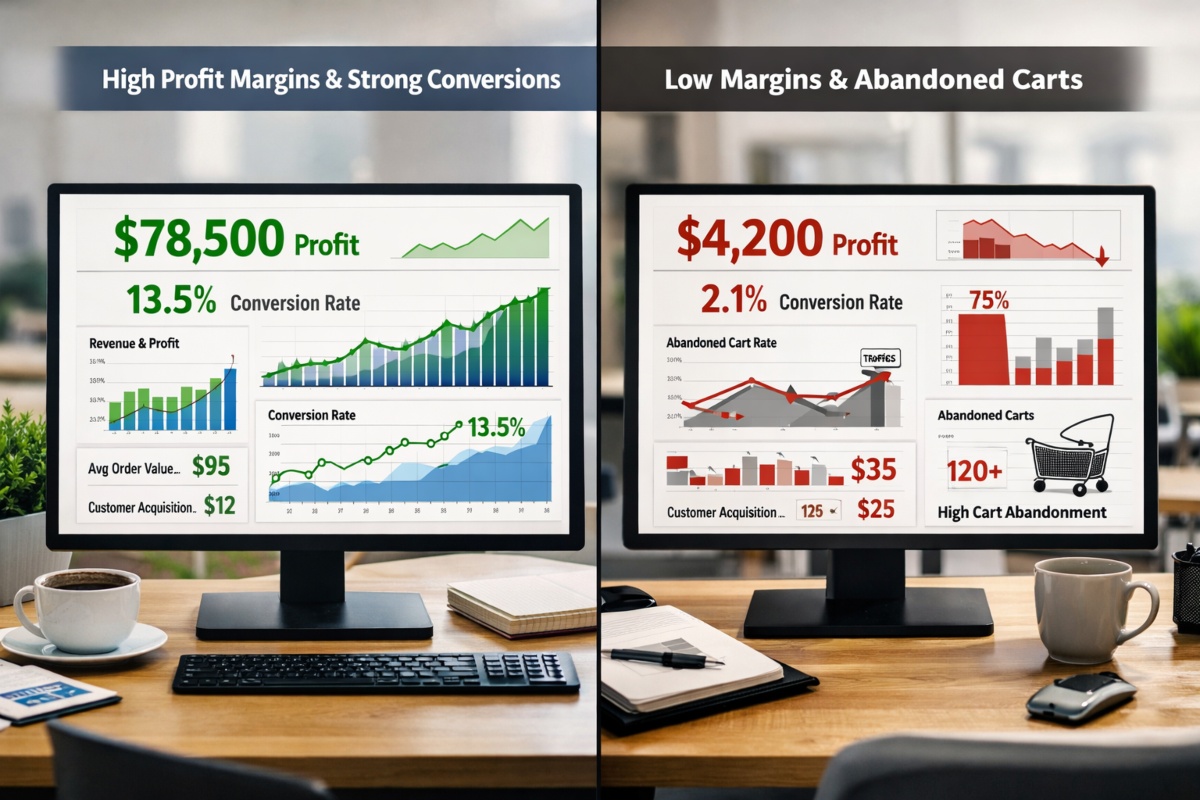
Third, pricing drives customer acquisition cost efficiency. Healthy margins support profitable paid advertising. Thin margins force you to compete on price alone, eliminating advertising budget for customer acquisition. This circular trap catches many dropshippers. Understanding how dropshipping works helps optimize this balance by clarifying operational costs and profit dynamics.
Fourth, pricing psychology dramatically affects conversion rates. Products ending in .99 convert better than round numbers. Bundled pricing increases average order value. Anchor pricing makes discounts appear more attractive. Strategic psychology optimizes conversion simultaneously with margin maintenance.
Step One: Calculate Your True Total Costs
Before setting any price, calculate complete landed costs accurately. This foundational step determines price floor beneath which profitability becomes impossible. Many dropshippers struggle with profitability because they underestimate these costs. Understanding order fulfillment processes and associated costs helps determine accurate pricing. Learning about fulfillment centers and how operational efficiency affects costs provides valuable context for accurate cost calculation.
Direct Product Costs
Product cost represents just the beginning. Your supplier charges specific per-unit prices, but this represents only the manufacturing cost.
Shipping Costs: Crucial to calculate shipping to your customers. If you offer free shipping, you absorb this cost. Typical shipping ranges from one to ten dollars depending on product weight and destination. International shipping costs significantly more – factor realistic shipping expenses rather than optimistic estimates. Many dropshippers use fulfillment services to streamline shipping operations and reduce costs. Learning about fulfillment status and how to calculate fulfillment cost per order helps optimize this major expense.
Payment Processing Fees: Payment processors (Stripe, PayPal, Square) typically charge 2.9% plus $0.30 per transaction. For a thirty-dollar product, this equals approximately ninety cents plus the percentage. These costs compound quickly across transactions.
Platform Fees: Shopify charges twenty-nine dollars (basic plan) to two hundred ninety-nine dollars (advanced plan) monthly. Divide monthly fees by estimated monthly sales. Additionally, payment gateway integrations may charge per-transaction fees (ConvertKit, Klaviyo integration fees, etc.).
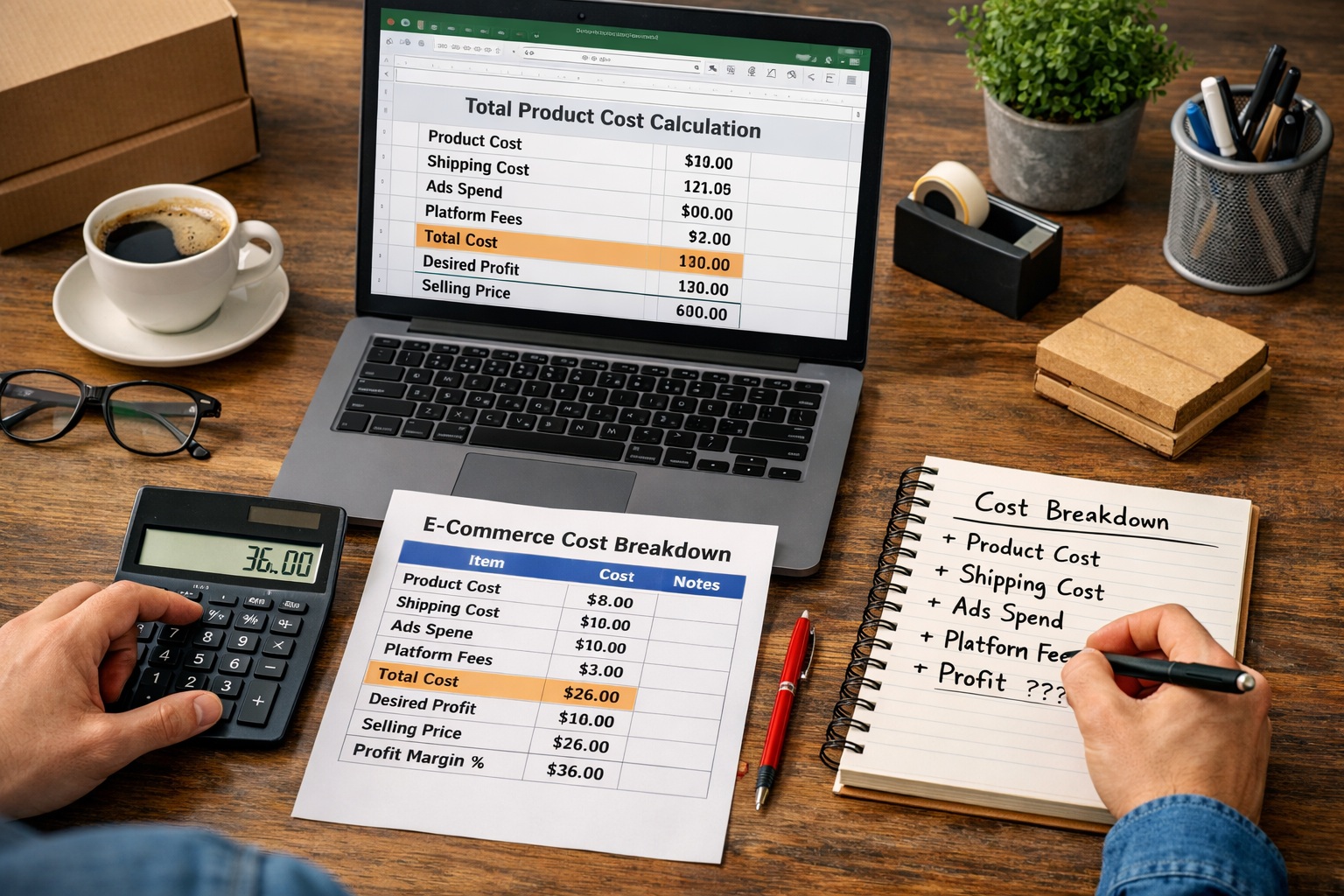
Example Calculation: – Product cost: $8.00 – Shipping to customer: $2.50 – Payment processing (2.9% + $0.30 on $25 price): $1.03 – Platform fee allocation ($29/100 units): $0.29 – Total direct cost: $11.82
Fixed Operating Costs
Beyond per-product costs, recurring fixed expenses affect pricing:
Website Hosting: Domain registration ($12/year), SSL certificates, hosting fees ($10-50/month depending on platform).
Software Subscriptions: Email marketing tools (Mailchimp free, Klaviyo $45+/month), inventory management, customer service tools.
Advertising Allocation: Critical to factor advertising costs into pricing. If you spend one thousand dollars monthly and sell one hundred units, that’s ten dollars per unit in advertising costs. Most successful dropshippers invest heavily in paid advertising. Understanding how to start dropshipping includes realistic budgeting for advertising spend.
Overhead: Virtual assistants, accountants, customer service staff. Even part-time help represents cost allocation.
Calculate allocation: Divide total monthly fixed costs by estimated monthly unit sales. Example: $500 monthly fixed costs ÷ 100 units = $5.00 per unit.
Return Rate Factor
Dropshipping experiences higher return rates than traditional retail (10-25% typical). Every return represents lost profit plus refund processing costs. Understanding what awaiting fulfillment means helps track these issues.
Factor return rate into pricing. If returns average 15%, you effectively need to profit on only 85% of sales. Increase target profit margin accordingly or reduce per-unit pricing slightly to account for inevitable returns.
Step Two: Understand Your Market And Competition
Theoretical cost calculations mean nothing without market validation. Customers will not pay prices disconnected from perceived value regardless of your cost structure.

Competitive Analysis
Research direct competitors and nearby price points. Identify five to ten competitors selling similar products. Document their pricing, positioning, and any unique value propositions. If you’re selling on Shopify, check out other Shopify dropshipping stores. Alternatively, review best dropshipping suppliers to understand competitive landscape and pricing trends across different supplier networks.
Analyze whether competitors position as budget option, value option, or premium option. This positioning explains pricing relative to base costs. Budget competitors operate on high volume and lower margins. Premium competitors justify higher prices through brand, quality, or service.
Most importantly, identify competitor pricing ceiling. Most customers avoid significantly overpriced products. Pricing thirty percent above competitors requires exceptional differentiation to maintain conversion.
Customer Value Perception
Beyond competitor pricing, understand what customers value in your specific market. Some customers prioritize price above all. Others value fast shipping, excellent customer service, or brand reputation.
Survey target customers directly. Ask directly: “What price would make you consider purchasing?” and “What price seems too expensive?” This research reveals acceptable price ranges better than competitor analysis alone.
Test different prices with small advertising budgets. Small Facebook ad tests ($5-10/day) with different product prices reveal conversion rates at various price points. Data beats theory – test rather than guessing.
Step Three: Apply Proven Pricing Strategies
Cost-Plus Pricing With Markup Multiplier
The simplest proven strategy multiplies total costs by appropriate markup factors based on cost tiers:
Products Costing $0-$2: Set minimum price $14.99-$19.99 regardless of cost. These ultra-low-cost products have high perceived value at these price points. Markup multipliers don’t apply logically – fixed pricing works better.
Products Costing $2-$5: Set fixed price range $14.99-$19.99. Cost tiers too narrow for individual multipliers. Consistent pricing in this range simplifies decision-making.
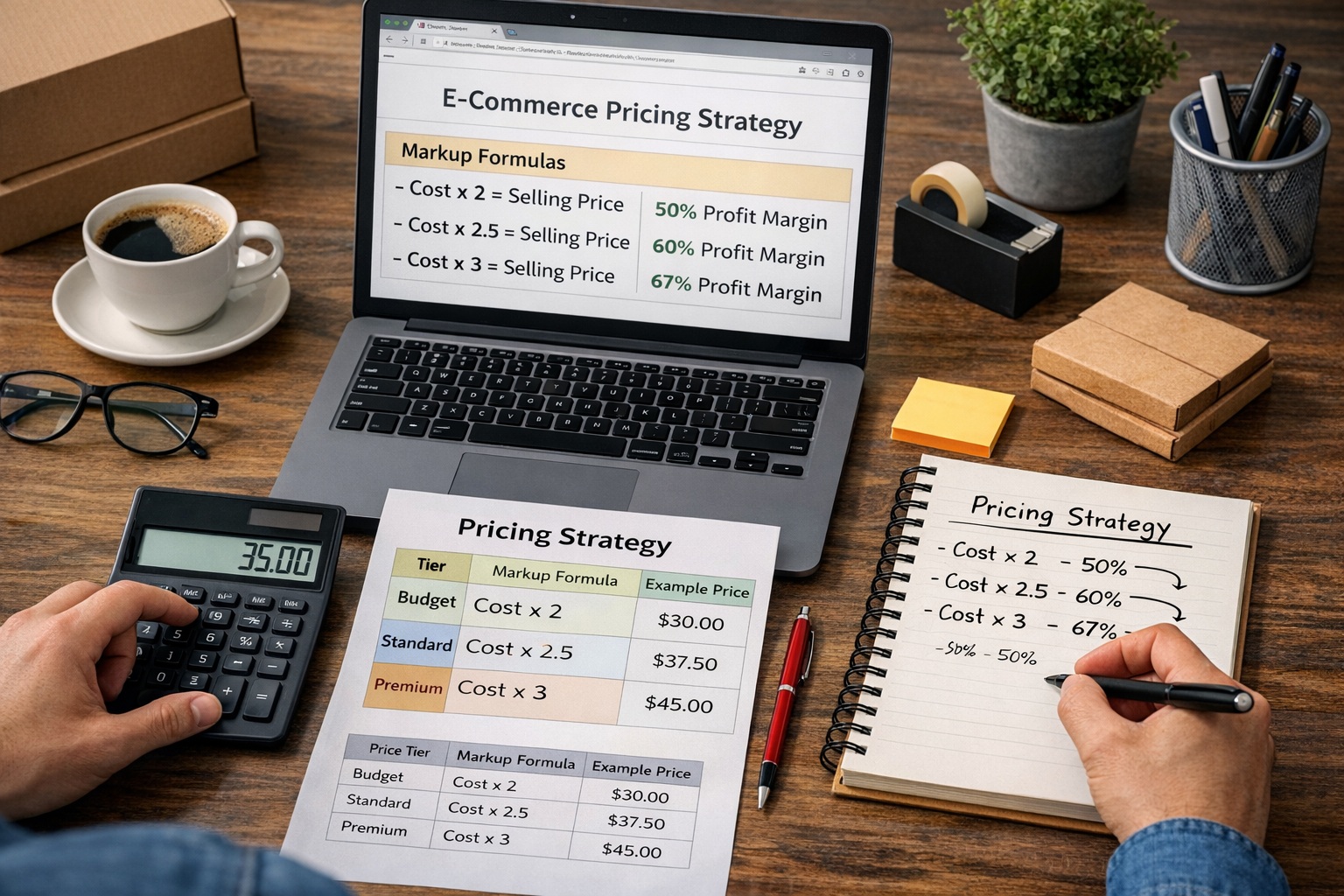
Products Costing $5-$30: Apply 2x multiplier. Product costing $10 sells for $20. Product costing $25 sells for $50. This multiplier covers advertising costs and operations while maintaining healthy margins.
Products Costing $30-$50: Apply 1.75x multiplier. Higher base costs reduce multiplier requirements. Product costing $40 sells for $70.
Products Costing $50-$100: Apply 1.5x multiplier. High-cost items typically have built-in value. Product costing $75 sells for $112.50.
Example Calculation: Total landed cost: $12.82 (including all expenses) Price tier: $5-$30 range → 2x multiplier Selling price: $12.82 × 2 = $25.64 → Round to $25.99
Psychological Pricing Optimization
Apply charm pricing ending prices in .99 or .95. Research consistently shows customers perceive $19.99 as significantly cheaper than $20 despite one-cent difference. Left-digit effect causes customers to focus on first digits when scanning prices.
Example pricing points: $14.99, $19.99, $24.99, $29.99, $39.99, $49.99, $69.99
For luxury goods ($200+), round numbers work better than odd pricing. $200 conveys premium positioning better than $199.99.
Perceived Value Adjustment
If your product offers unique value – better brand, faster shipping, superior quality, better customer service – increase base calculated price by three to ten dollars.
Example: Calculated price $25.99. If your brand reputation or faster shipping justifies premium positioning, increase to $28.99-$29.99.
Validation matters. Only implement perceived value increases if market research and early testing confirm customers accept higher prices.
Tiered Markup Strategy
Apply different markup percentages based on cost tiers optimizing profitability across diverse product ranges:
– Products costing $0-$10: 60-100% markup – Products costing $10-$25: 40-60% markup – Products costing $25-$50: 30-40% markup – Products costing $50-$100: 20-30% markup
This approach maximizes profitability on lower-cost items while maintaining competitiveness on higher-priced products.
Step Four: Set Target Profit Margins
Healthy profit margins determine business sustainability. Understanding how much do dropshippers make depends heavily on achieving healthy margins. Industry data reveals:
Gross Profit Margin: Revenue minus product cost. Typical target: 60% or higher. Example: Product costs twelve dollars, sells for thirty dollars. Gross margin: (30-12)/30 = 60%.
Net Profit Margin: Revenue minus all expenses (product cost, advertising, platform fees, overhead). Typical target: 20-30%. Many beginners confuse gross and net, believing fifteen thousand dollar revenue equals fifteen thousand dollars profit. Net profit after expenses typically represents 20-40% of gross revenue. Learning about order fulfillment rate helps identify operational inefficiencies affecting margins.
Per-Unit Profit: Calculate profit per unit sold after accounting for all costs. Target minimum twenty dollars per unit profit. If profit per unit falls below ten dollars, consider discontinuing product unless volume compensates.
Example analysis: – Selling price: $30 – Product cost: $8 – Shipping: $2 – Payment processing: $1 – Fixed costs allocation: $3 – Total cost: $14, Profit: $16 per unit (Healthy)
Pricing Strategy Distribution For Maximum Success
Market data reveals optimal pricing distribution:
$14.99-$29.99 (Budget Range): 70% of successful products fall here. Customers perceive products as inexpensive, reducing purchase hesitation. Lower risk perception drives higher conversion.
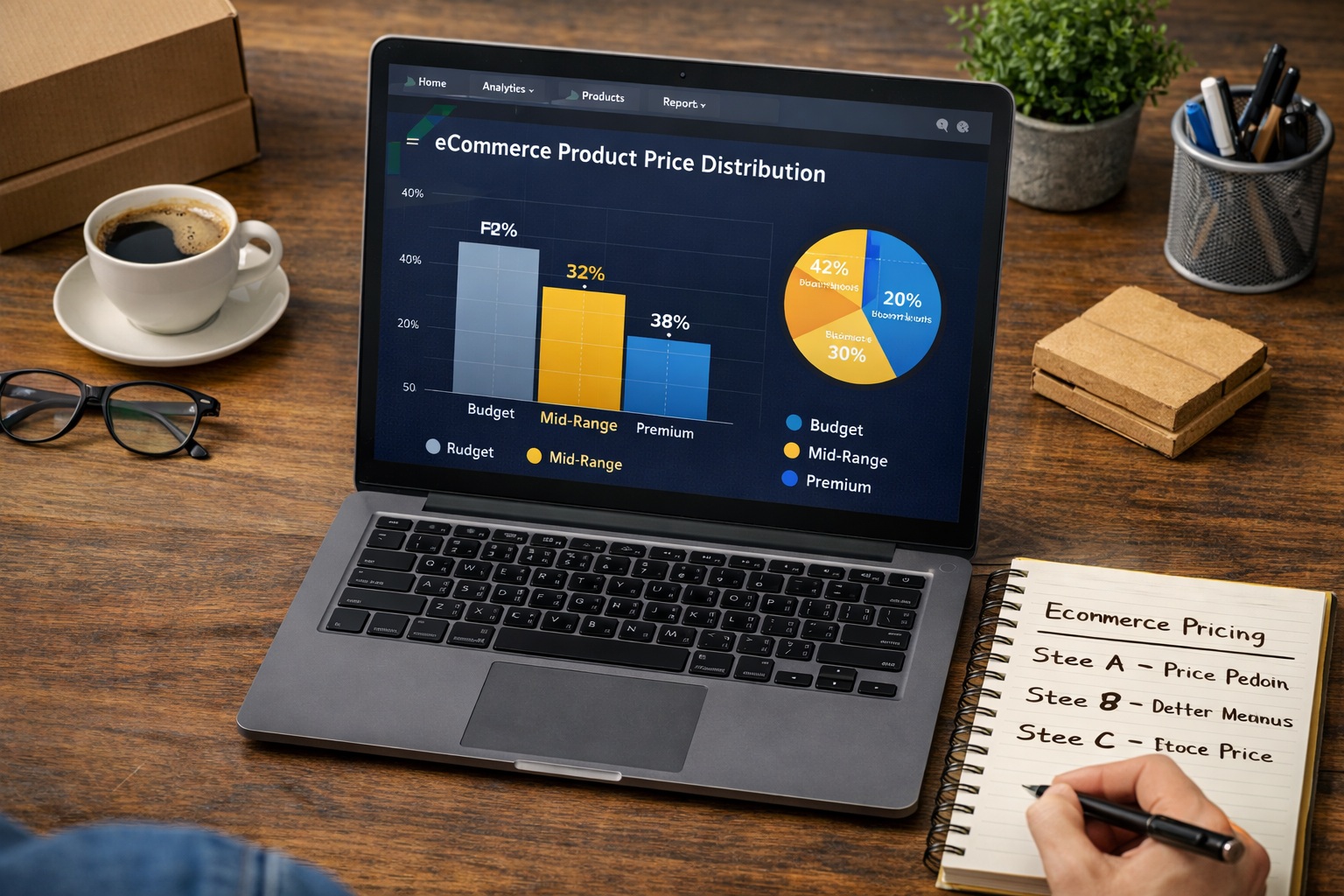
$30-$69.99 (Value Range): 20% of successful products. Requires stronger brand authority and value communication but supports healthier margins.
$70+ (Premium Range): 10% of successful products. Requires substantial trust-building, proven results, premium positioning. Most beginners should avoid this range until establishing authority.
Price Testing And Optimization Framework
Pricing is not final – it’s testable variable continuously optimized through data analysis.
Initial Launch Pricing
Start with calculated price based on formulas above. This data-driven approach beats guessing. After launch, monitor conversion rates and sales volume, not just total revenue.
Price Adjustment Protocol
After 20-30 sales with 3%+ conversion rate: Increase price by one dollar increments. Test for two weeks. If conversion remains stable or improves, increase another dollar. Continue until conversion declines noticeably.
If sales plateau or conversion drops: Decrease price by one dollar. Continue testing to find optimal price point balancing conversion and margin.
Typical optimization range: Most products find optimal pricing within three to five dollars of initial price. Testing beyond this range rarely improves profitability.
Data-Driven Decision Making
Monitor these metrics continuously:
– Conversion rate: Percentage purchasing after viewing product – Bounce rate: Percentage leaving without viewing product – Traffic source: Where customers arrive from – Device type: Mobile vs. desktop conversion differences
Price changes affect conversion rates differently across traffic sources. Paid advertising may support higher prices due to targeted audience. Organic traffic may require lower prices due to broader audience demographics.
Avoiding Common Pricing Mistakes
Mistake One: Ignoring Competitor Price Wars
Competing purely on price creates downward spiral destroying margins. If competitors lower prices relentlessly, resist matching automatically. Instead, differentiate through superior customer service, faster shipping options, better product quality, stronger brand positioning, or enhanced product descriptions.
Customers value factors beyond price when communicated effectively. Understanding different dropshipping vs ecommerce models and variations like private label vs white label dropshipping helps identify differentiation opportunities beyond price competition alone.
Mistake Two: Underestimating Advertising Costs
Many beginners price products assuming organic traffic without advertising budget allocation. In reality, customer acquisition costs typically range from five to twenty dollars depending on industry and traffic source. Most successful dropshippers invest heavily in paid advertising through platforms like Facebook or TikTok Shop dropshipping.
If you fail to allocate advertising costs in pricing, every paid customer acquisition reduces profit below calculated margin. Over-allocate advertising costs in pricing rather than under-allocating. Dropshipping startup costs must include realistic advertising budgets.
Mistake Three: Setting Prices Too Low Hoping Volume Compensates
Low margins require unrealistic sales volume to generate profit. Selling one hundred units with two-dollar profit generates two hundred dollars revenue. Selling ten units with thirty-dollar profit generates three hundred dollars – higher profit with substantially lower volume.
Focus on healthy margins rather than volume. Fewer profitable sales beat numerous unprofitable sales.
Mistake Four: Neglecting Seasonal Pricing Adjustments
Many products experience seasonal demand fluctuations. Winter clothing sells better in cold months. Summer products peak in warm months. Adjust prices seasonally capturing increased willingness-to-pay during high-demand seasons.
Similarly, holidays create pricing opportunities. Premium pricing during peak seasons generates higher margins more efficiently than competing on price year-round.
Pricing Across Traffic Sources
Different customer acquisition methods support different price points:
Paid Advertising (Facebook, Google): Supports higher prices due to targeted audience quality. Premium pricing justified because customers searched specifically for product type or matched audience demographics indicate high purchase intent.
Influencer Marketing: High-quality endorsements support premium pricing. Influencer audiences trust recommendations supporting higher price points than untargeted traffic.
Organic Search: Moderate pricing works best. Customers searching for products have medium purchase intent. Overly high prices reduce conversion while too-low prices suggest low quality.
Social Media Organic: Lower pricing performs better. Organic followers browsing feeds have lower purchase intent. Lower prices reduce friction enabling impulsive purchases.
Frequently Asked Questions
What is a Good Profit Margin for Dropshipping?
Target 40-70% gross profit margin covering all direct costs while supporting advertising and operations. Net profit margin (after all expenses) should target 20-30% minimum. Many beginners achieve 5-15% net profit initially – acceptable but leaves little room for error.
Should I Price Based on Competition or My Costs?
Both. Calculate costs establishing minimum viable price maintaining profitability. Research competitor pricing understanding market ceiling. Price between these boundaries based on value differentiation. Compete on value rather than price alone. Learning about best dropshipping suppliers helps understand competitive landscape.
How Often Should I Adjust Prices?
Test new prices every two weeks if collecting sufficient sales data (20+ units). After finding optimal price point, adjust only when costs change significantly or market conditions shift. Constant price changes confuse customers and reduce conversion.
What Happens If I Price Too High?
Customers perceive products as overpriced, bouncing without engagement. Conversion rates plummet. Traffic source quality matters – premium-positioned brands support higher prices through credibility and proven track records.
What Happens If I Price Too Low?
Customers question quality – suspiciously cheap products suggest low quality. Conversion may improve initially but profitability suffers. You cannot scale unprofitable businesses, regardless of sales volume.
Implementation Checklist
Week One: – Calculate total landed costs for three leading products – Research five to ten competitors noting pricing and positioning – Determine target profit margin by product category
Week Two: – Apply markup multipliers generating base prices – Implement psychological pricing (.99 endings) – Set initial test prices
Week Three-Four: – Launch products at test prices – Monitor conversion rates and sales volume – Collect customer feedback on pricing
Month Two: – Analyze performance data – Adjust prices based on conversion and margin metrics – A/B test price variations with paid traffic
Month Three Forward: – Optimize continuously based on data – Adjust seasonal pricing – Test perceived value increases with traffic variations
Conclusion
Strategic pricing represents powerful competitive advantage directly affecting profitability. Calculate true landed costs including all expenses. Research market positioning understanding competitive context. Apply proven pricing strategies balancing conversion and margin. Test continuously refining based on real performance data.
The most profitable dropshippers avoid guessing, treat pricing as testable variable, and optimize relentlessly. Start with calculated prices based on proven formulas. Monitor conversion and revenue metrics. Adjust systematically. Within three months of disciplined testing, most dropshippers identify optimal pricing points generating sustainable profitability.
Remember: profitability matters more than revenue. One thousand dollars monthly profit at sixty-dollar average order value beats five hundred dollars monthly profit at thirty-dollar average order value, despite halved transaction volume. Price strategically, optimize continuously, and build genuinely profitable dropshipping business.
For those starting their journey, understanding how to start dropshipping and learning about dropshipping startup costs helps establish realistic expectations. Explore dropshipping trends for 2026 and examine best dropshipping niches to ensure your pricing aligns with market opportunities. Whether you’re interested in specific niches like supplement dropshipping, dropshipping pet products, or coffee dropshipping, these pricing principles apply universally. Build your brand through effective pricing strategy combined with quality products and excellent customer service.