
Choosing between Shopify and eBay represents one of the most critical decisions for aspiring dropshippers. Both platforms enable you to build profitable e-commerce businesses, but they serve fundamentally different purposes and cater to different business goals.
This comprehensive guide compares these platforms across every important dimension to help you make the right choice for your unique situation.
Key Takeaways: Shopify vs eBay
Shopify is a customizable hosting platform for building your own branded online store with complete design control. eBay is a marketplace connecting buyers and sellers with built-in organic traffic from millions of users.
eBay is best if you want quick startup with minimal effort, immediate access to customers, and lowest initial investment. Shopify is best if you want long-term brand building, unlimited product listings, and maximum customization.
eBay offers free organic traffic from existing marketplace users. Shopify requires you to generate your own traffic through marketing and advertising.
Shopify has lower fees overall with no listing or transaction fees when using Shopify Payments. eBay charges listing fees and final value fees on all sales.
Both platforms support dropshipping automation integration with tools like AutoDS, making operational scaling manageable regardless of your choice.
What Is eBay?
eBay is an online marketplace platform pioneering e-commerce since the mid-1990s. As a marketplace, it connects buyers and sellers in one unified platform where millions of products compete for customer attention daily.

For dropshippers, eBay offers massive organic traffic advantage. When you list products on eBay, you immediately gain visibility to millions of existing users searching for products you offer. You don’t need to spend months building audience or investing heavily in advertising initially.
The platform is extremely user-friendly for beginners. Setup takes hours, not days. You list products, handle customer service, and suppliers handle fulfillment. The operational simplicity makes eBay ideal for entrepreneurs testing business viability.
What Is Shopify?
Shopify is a Software-as-a-Service (SaaS) platform enabling complete e-commerce store creation and management. Unlike eBay’s marketplace model, Shopify gives you complete control over store design, branding, and customer experience.

With Shopify, you build your own branded online storefront showcasing your unique identity. You design the store appearance, control all messaging, manage customer relationships directly, and build genuine brand equity over time.
Shopify functions as an all-in-one e-commerce platform handling product listings, order processing, payment management, and customer communication from one dashboard. The comprehensive feature set supports scaling from small startup to large enterprise operations.
Detailed Comparison: eBay vs Shopify
Platform Structure
eBay is a marketplace where your store shares space with millions of other sellers. All sellers use the same interface and templates, creating intense competition and limited differentiation opportunities.
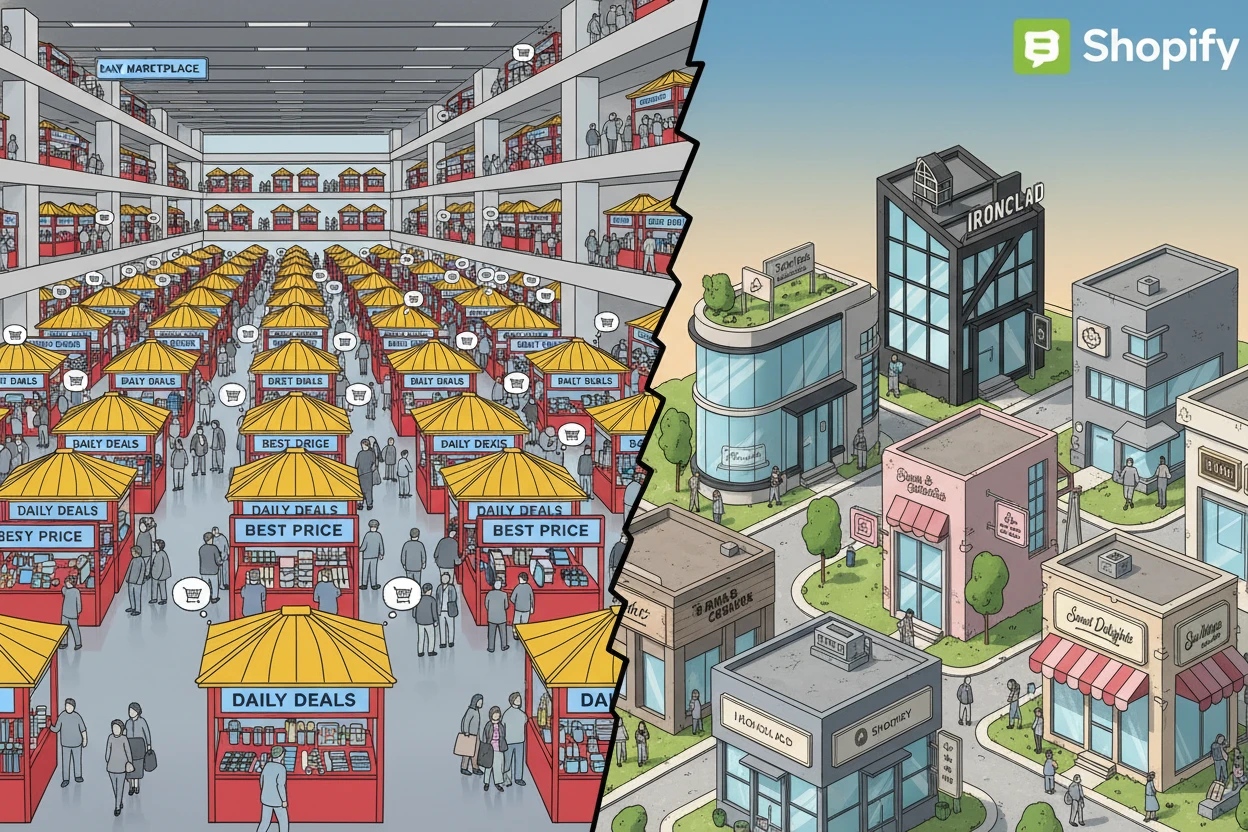
Shopify is a hosted platform where you own your individual store and brand identity. Your store design, messaging, and experience are completely yours, enabling professional brand presentation.
Product Listing Limits
eBay has severe selling limits based on your subscription tier. The Starter plan allows only 250 listings. Even the Enterprise plan maxes out at 100,000 listings. These limits restrict catalog growth significantly.
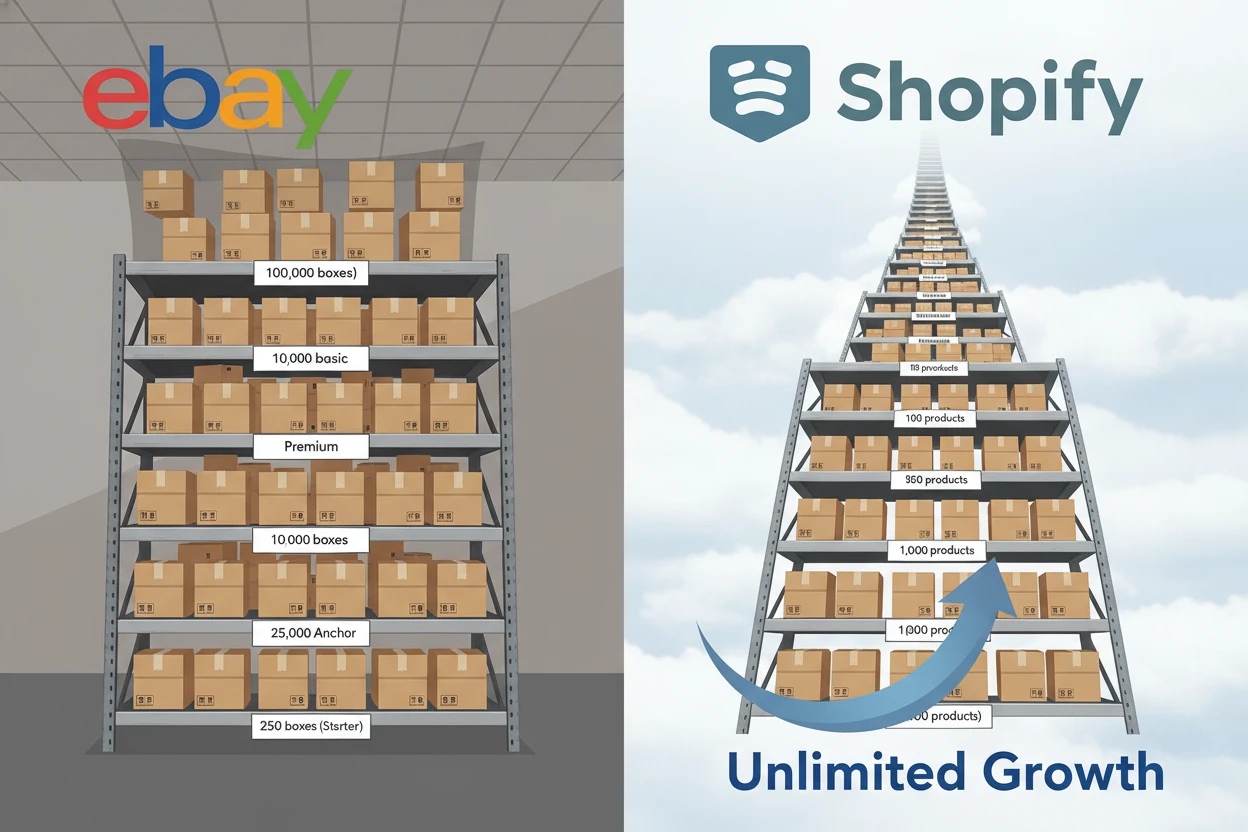
Shopify offers unlimited product listings on every plan. You can sell 100 products or 100,000 products with identical subscription cost. This unlimited flexibility enables true scaling.
Organic Traffic
eBay provides free organic traffic from marketplace users actively searching. You gain immediate visibility without marketing investment initially. This advantage accelerates early revenue generation significantly.
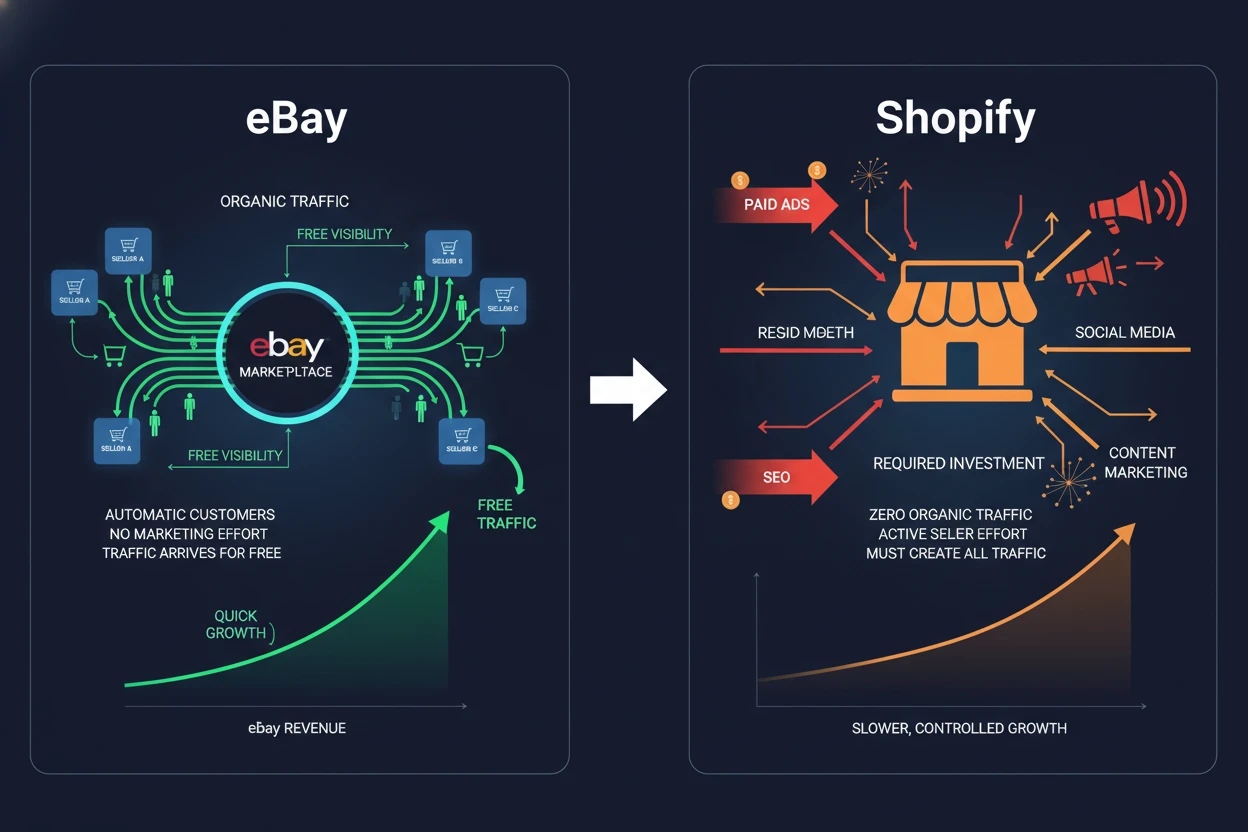
Shopify provides no organic traffic. You bear complete responsibility for customer acquisition through paid advertising, SEO, social media, and content marketing. This requires more marketing investment but gives you complete traffic control.
Customization and Branding
eBay offers limited customization. All seller stores look similar, making brand differentiation extremely difficult. You compete primarily on product quality, pricing, and customer service rather than brand identity.
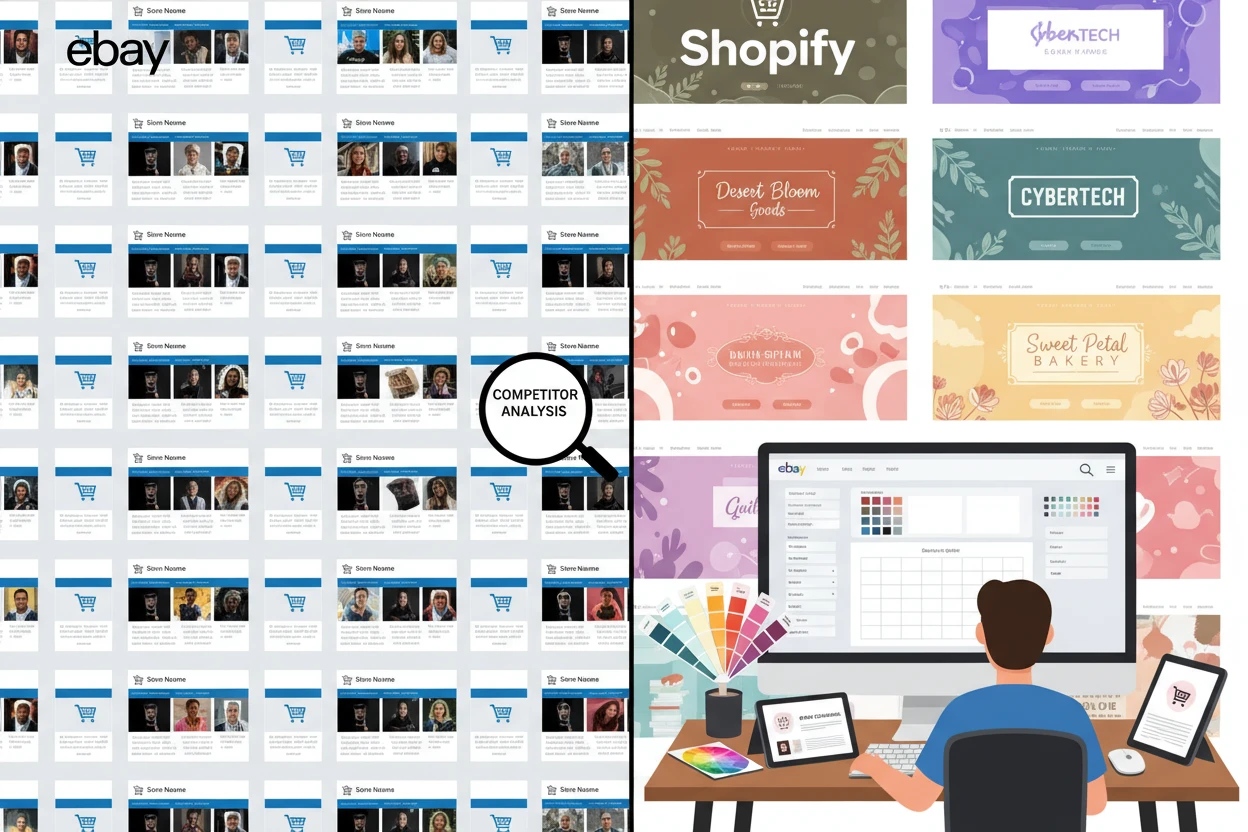
Shopify provides extensive customization. Hundreds of customizable themes enable unique store design. You control colors, fonts, layout, messaging, and entire customer experience. Professional branding becomes possible.
Subscription Costs
eBay charges yearly subscriptions:
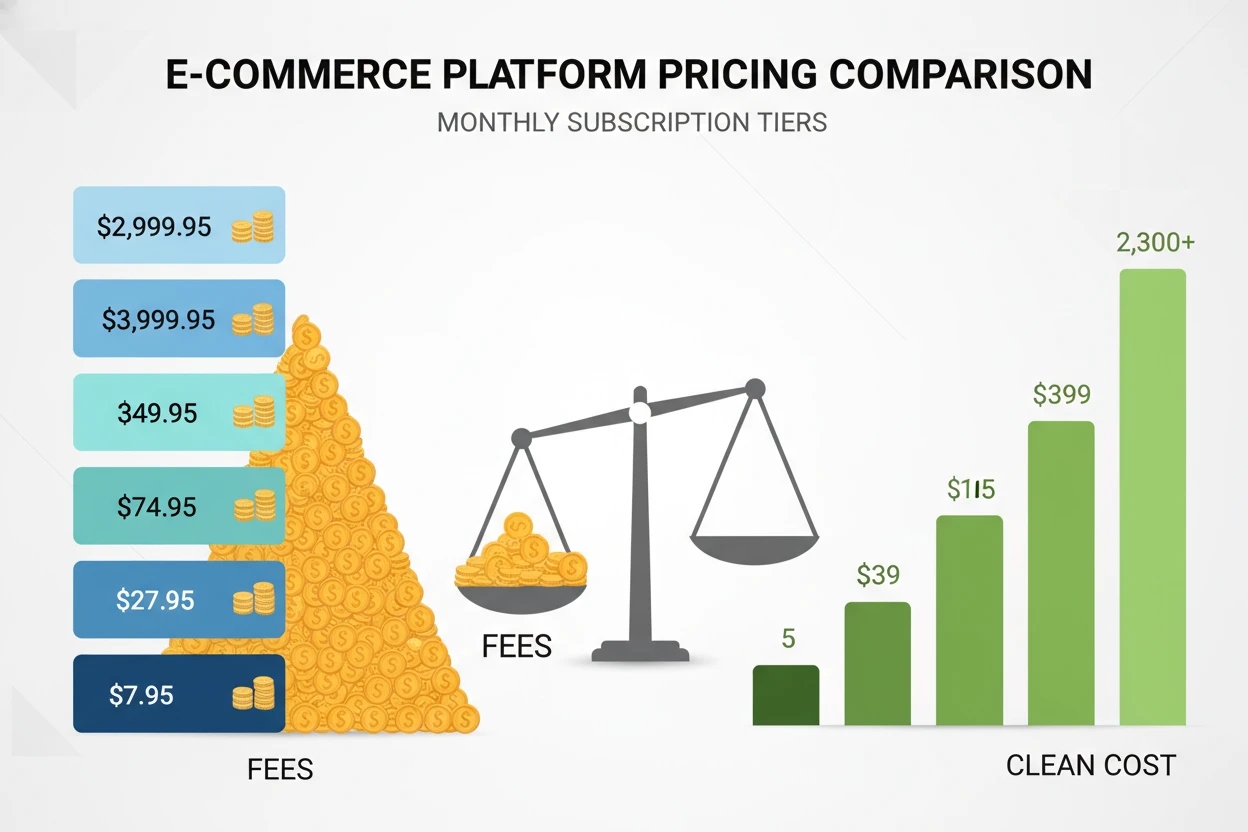
- Starter: $7.95/month or $4.95 if billed yearly
- Basic: $27.95/month or $21.95 yearly
- Premium: $74.95/month or $59.95 yearly
- Anchor: $349.95/month
- Enterprise: $2,999.95 yearly
Shopify charges monthly subscriptions:
- Starter: $5/month
- Basic: $39/month
- Standard: $105/month
- Advanced: $399/month
- Plus: $2,300+/month
Transaction and Listing Fees
eBay charges multiple fees: insertion fees (listing), final value fees (percentage of sale), and payment processing fees. These fees accumulate significantly on high-volume operations.
Shopify charges no listing fees. With Shopify Payments, you avoid transaction fees entirely. You only pay payment processing fees, resulting in substantially lower total costs.
Analytics and Reporting
eBay provides basic analytics showing sales performance and customer insights. The analytics capabilities are sufficient for basic business management but lack advanced features.
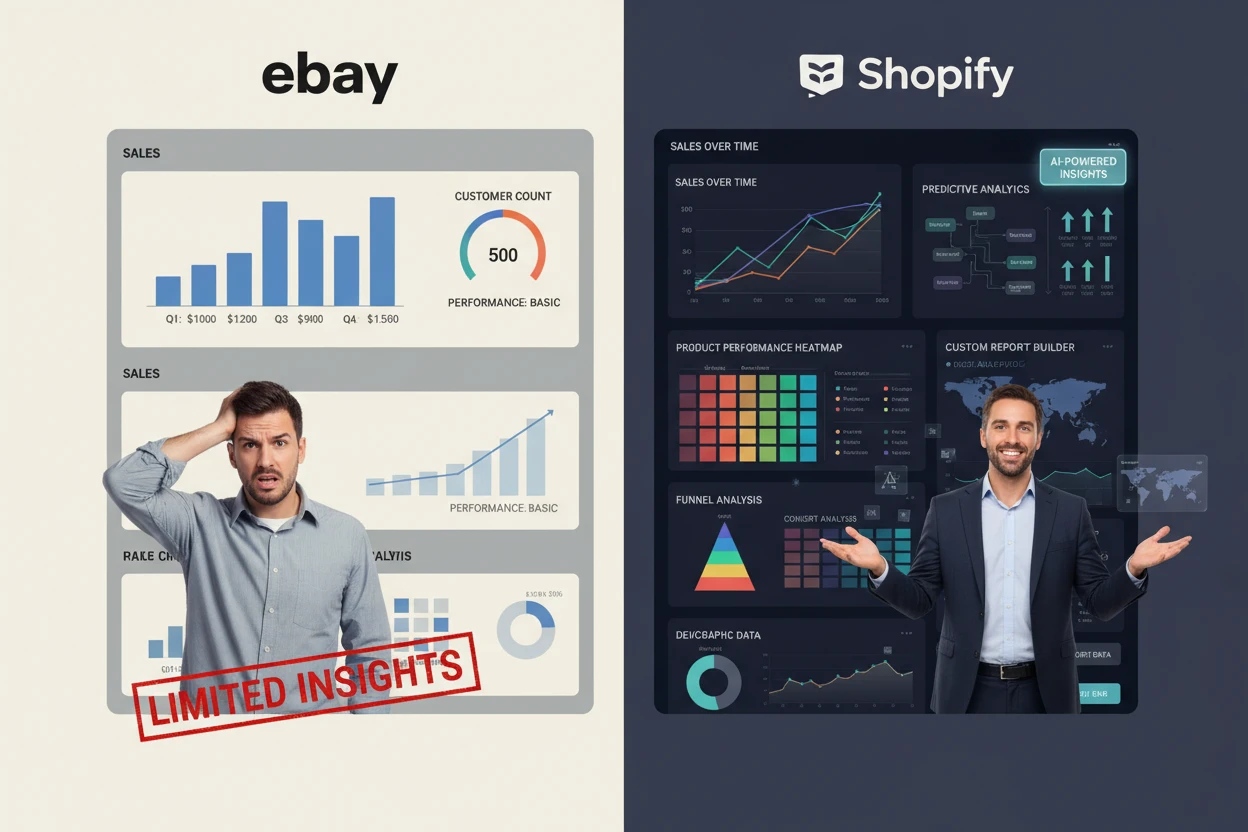
Shopify provides professional-grade analytics including detailed sales reports, customer behavior analysis, product performance metrics, and advanced insights supporting strategic decisions.
Built-in Features
eBay features internal marketing tools (eBay PPC for paid promotion), buyer and seller protection program, competitive analysis visibility, and basic store management.
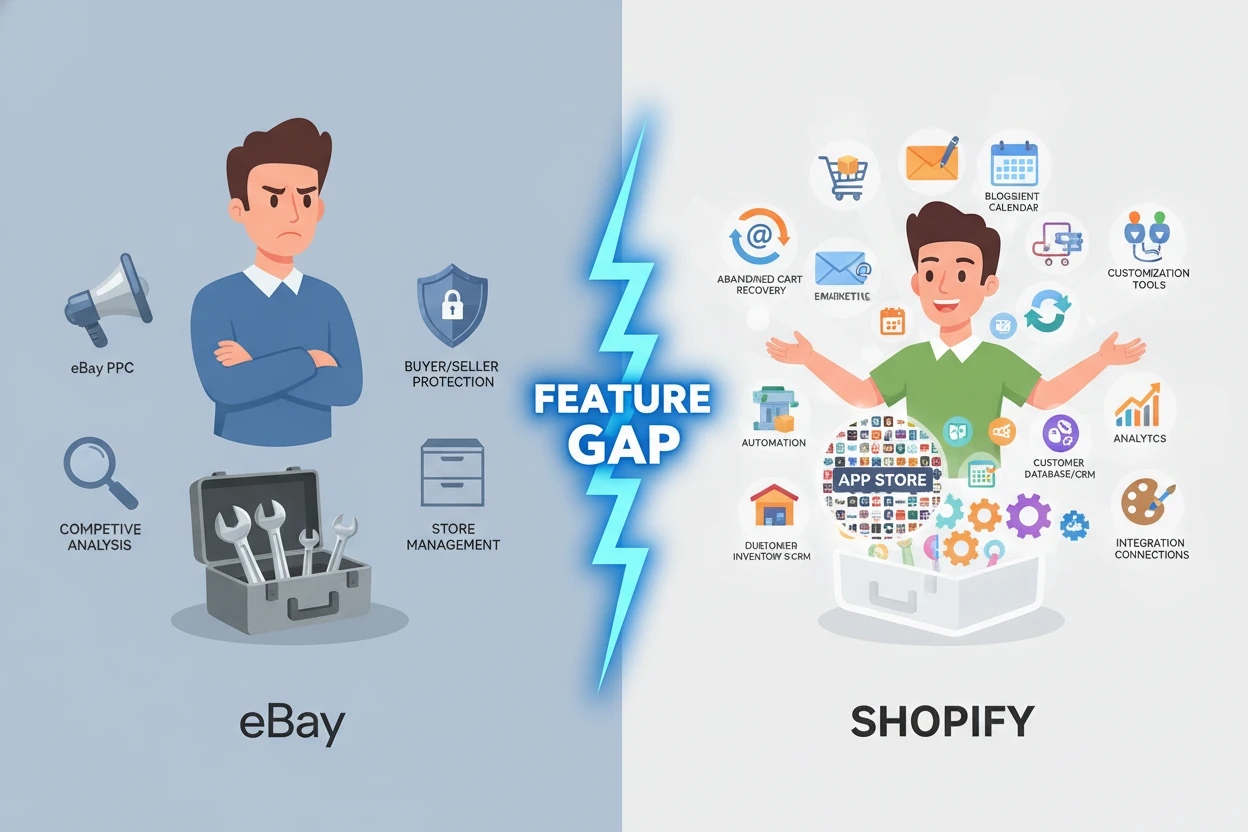
Shopify features built-in blogging for content marketing, extensive app store with hundreds of business apps, abandoned cart recovery, email marketing tools, and advanced inventory management.
eBay Dropshipping Advantages and Disadvantages
Advantages of eBay Dropshipping
Free organic traffic from marketplace users eliminates initial marketing pressure. Low-cost startup with minimal capital investment makes it accessible to most entrepreneurs. Buyer and seller protection ensures transaction security for you and customers.
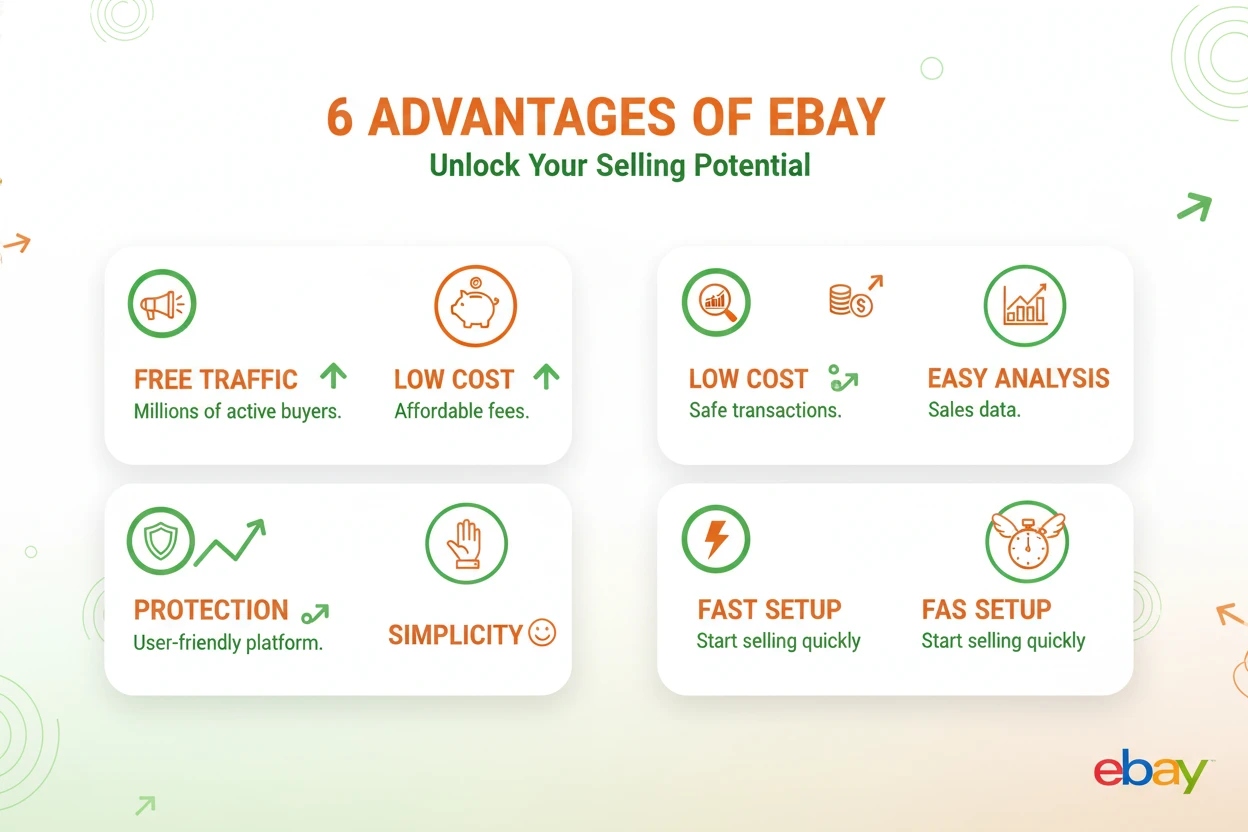
Easy competitive analysis by viewing what competitors sell and their pricing strategies. Simple user-friendly interface requires minimal technical skills. Quick setup enables revenue generation within days.
Disadvantages of eBay Dropshipping
Severe selling limits restrict catalog size and growth potential. Limited customization options prevent meaningful brand differentiation. Intense marketplace competition from thousands of sellers increases marketing pressure. Multiple fees compress profit margins significantly. Difficult establishing unique brand identity in crowded marketplace. No content marketing tools limit long-term business asset building.
Shopify Dropshipping Advantages and Disadvantages
Advantages of Shopify Dropshipping
Complete customization enables unique brand identity and professional presentation. Unlimited product listings enable true catalog scaling without restrictions. Full customer relationship ownership builds direct loyalty.
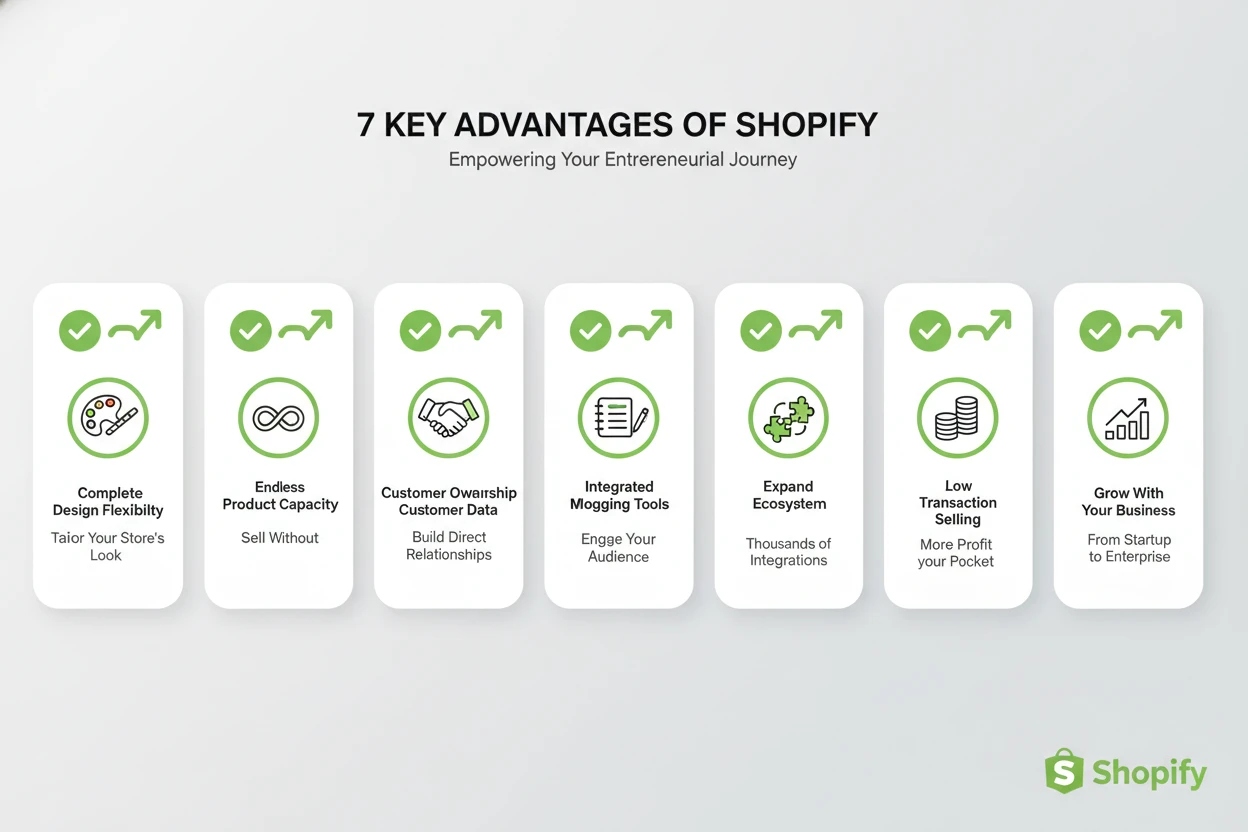
Built-in blogging supports content marketing and organic search visibility. Extensive app ecosystem enables continuous business optimization. Lower overall fees preserve more profit per sale. Scalable platform grows with your business from startup to enterprise.
Disadvantages of Shopify Dropshipping
No organic marketplace traffic requires active marketing and traffic generation investment. Monthly subscription fees apply regardless of sales volume. Learning curve steeper than eBay for store optimization and management. You handle all customer service responsibilities independently. Responsibility for inventory management across suppliers. Competitive landscape with other Shopify stores still intense. Requires sustained marketing investment for consistent traffic.
Pricing Detailed Breakdown
eBay Subscription Plans
Starter Store ($7.95/month): 250 product listings, basic seller tools
Basic Store ($27.95/month): 1,000 fixed-price listings, expanded tools
Premium Store ($74.95/month): 10,000 listings, advanced features
Anchor Store ($349.95/month): 25,000 listings, priority support
Enterprise Store ($2,999.95/year): 100,000 listings, dedicated support
Plus insertion fees per listing, final value fees per sale (typically 12-15%), and payment processing fees.
Shopify Subscription Plans
Starter ($5/month): Social selling focus, limited e-commerce features
Basic ($39/month): Core e-commerce, 2% transaction fee with basic payment processing
Standard ($105/month): Professional reporting, 1% transaction fee, five staff accounts
Advanced ($399/month): Advanced features, 0.5% transaction fee, 15 staff accounts
Plus ($2,300+/month): Enterprise solutions with dedicated support
All plans include unlimited product listings. Shopify Payments eliminates transaction fees entirely.
Comparison Table: eBay vs Shopify
| Factor | eBay | Shopify |
|---|---|---|
| Platform Type | Marketplace | Hosted e-commerce |
| Organic Traffic | Free built-in | None (self-generated) |
| Product Limits | 250-100,000 | Unlimited |
| Customization | Limited | Extensive |
| Branding Control | Low | High |
| Startup Cost | $7.95-$27.95/month | $5-$39/month |
| Listing Fees | Yes (per product) | No |
| Transaction Fees | Yes (12-15%) | No (with Shopify Payments) |
| Setup Difficulty | Very easy | Easy to moderate |
| Analytics | Basic | Professional |
| Blogging Tool | No | Yes |
| App Store | No | Yes (extensive) |
| Best For | Quick startup, testing | Brand building, scaling |
| Brand Building | Minimal | Excellent |
Which Platform Should You Choose?
Choose eBay If You Want To
Start quickly with minimal setup effort and time investment. Tap into millions of existing marketplace customers without marketing work initially. Test products with lower financial risk and investment. Focus primarily on selling rather than brand building. Avoid technical website customization and design work. Generate revenue within days rather than weeks.
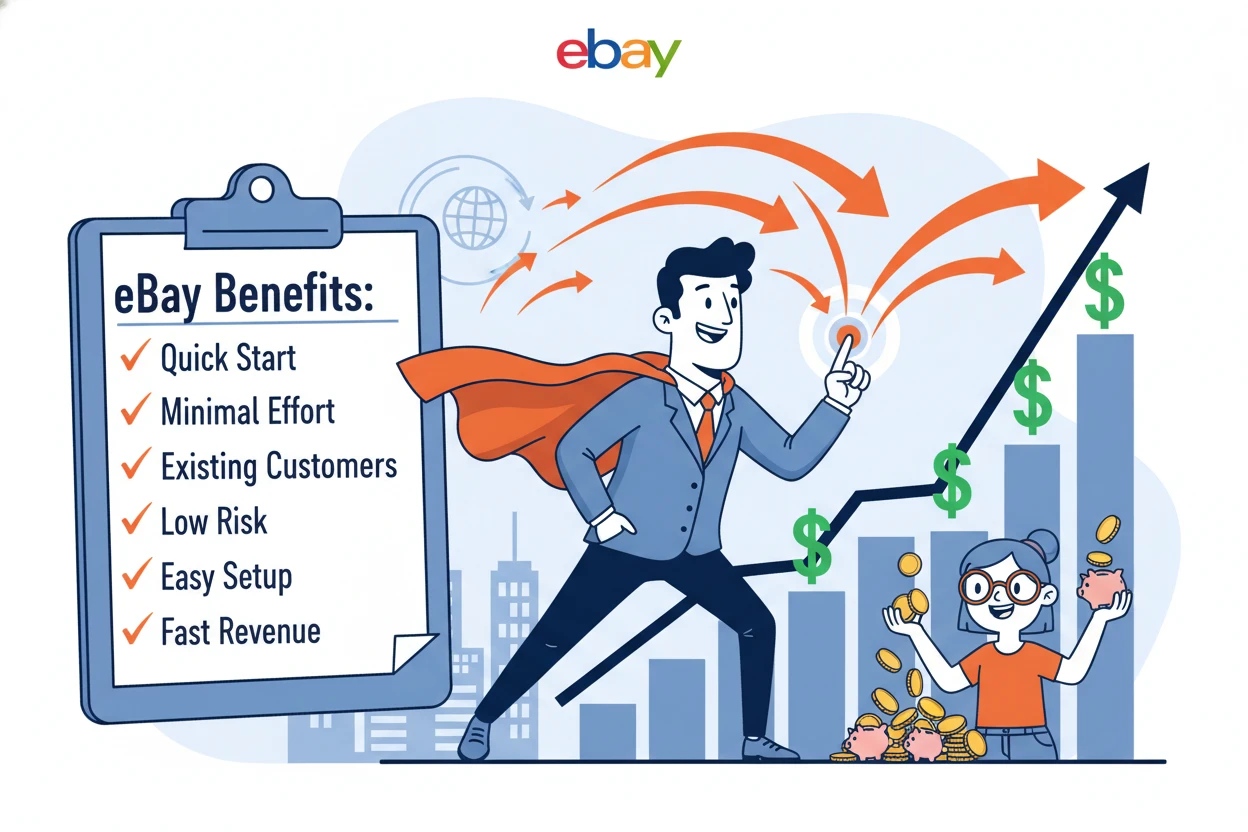
eBay works best for beginners with limited budgets, entrepreneurs testing multiple products, and sellers prioritizing quick market entry over long-term brand development.
Choose Shopify If You Want To
Build a long-term branded business becoming increasingly valuable over time. Control your complete brand identity, design, and customer experience. Establish customer loyalty and repeat purchase relationships. Scale from small startup to large, sophisticated operation. Access unlimited product listings supporting major growth. Keep more profits through significantly lower fees. Build a sellable business asset with genuine equity value.
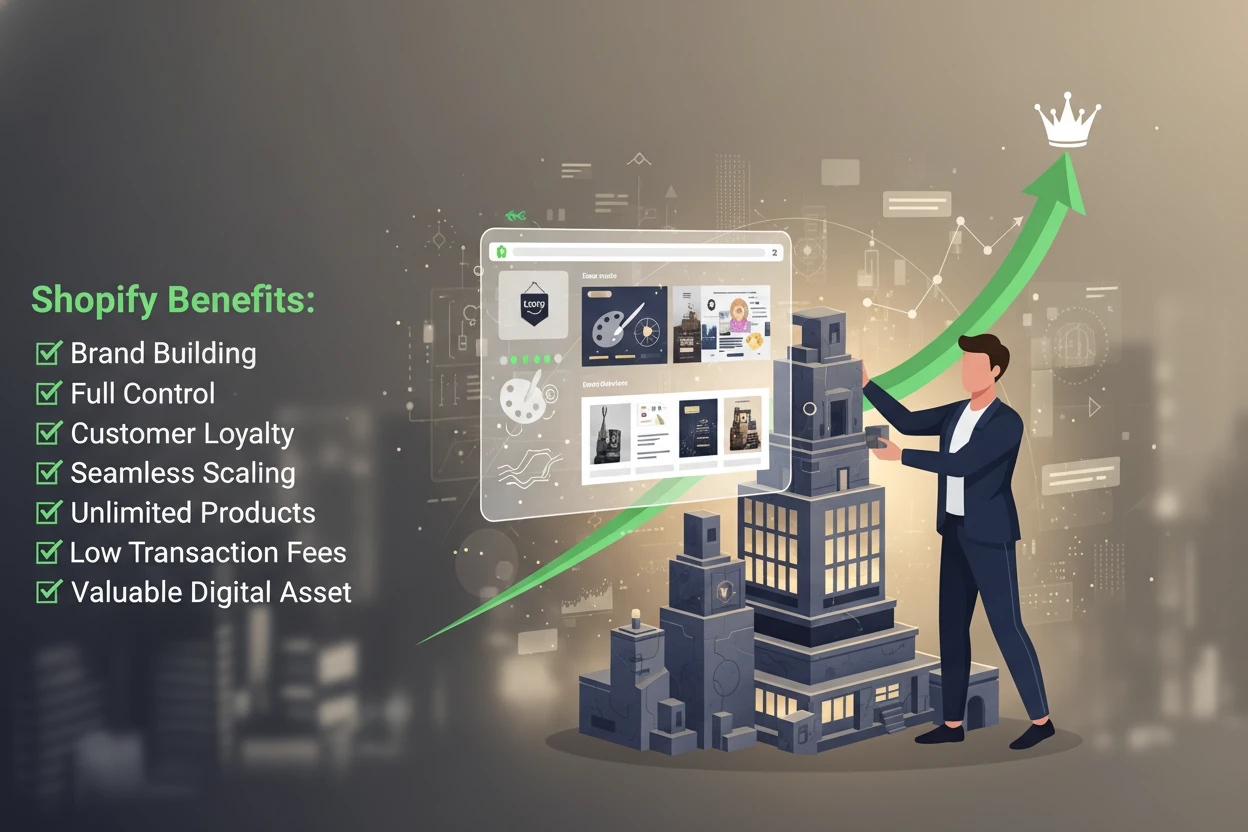
Shopify works best for ambitious entrepreneurs, sellers focused on branding, businesses targeting long-term growth, and creators wanting complete operational control.
Which Is More Affordable?
eBay appears cheaper initially with lower monthly costs ($7.95-$27.95). However, multiple fees accumulate significantly. Insertion fees, final value fees (12-15% of sale), and payment processing add up fast on volume operations.
Shopify’s higher monthly cost ($39-$399) is offset by zero listing fees and no transaction fees with Shopify Payments. For high-volume sellers, Shopify becomes substantially cheaper overall.
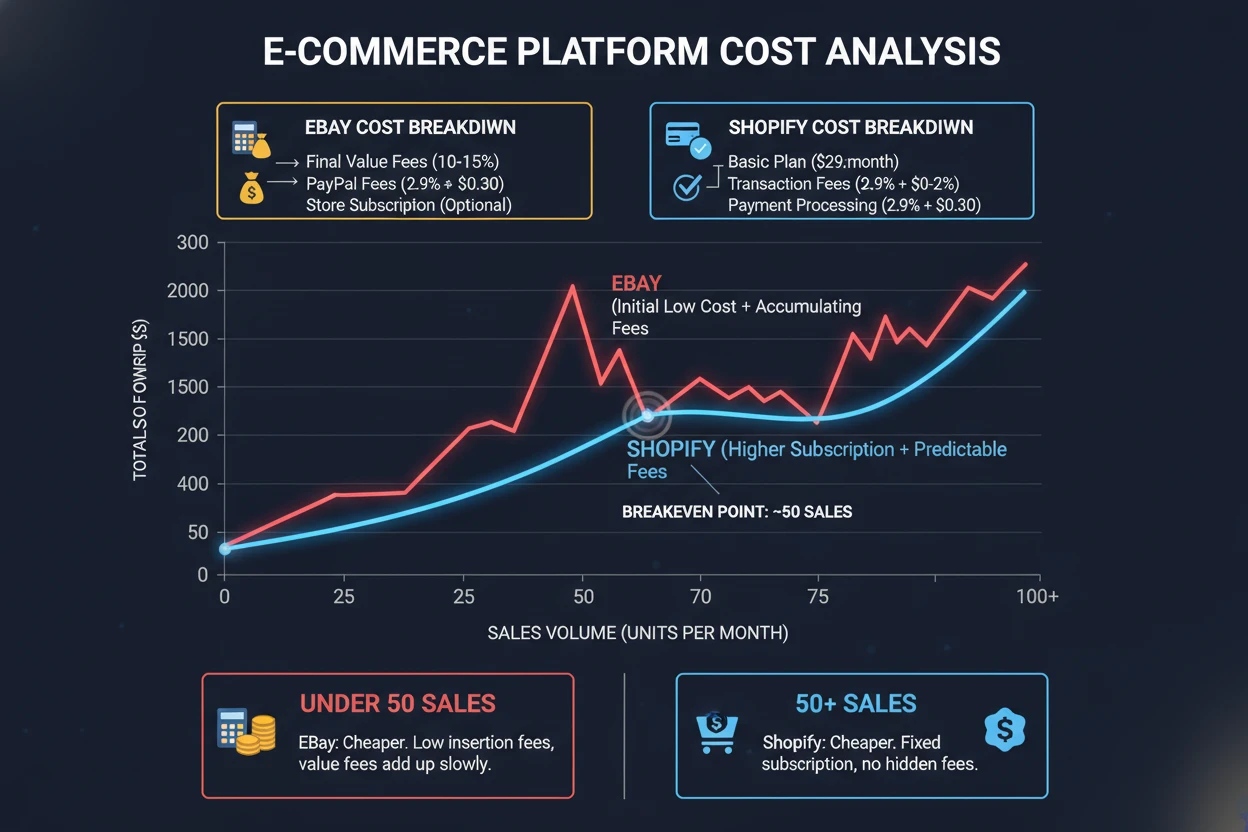
For small sellers (under 50 monthly sales), eBay costs less. For medium to large sellers (50+ monthly sales), Shopify typically costs less due to fee structure.
Can You Sell on Both Platforms?
Absolutely. Many successful entrepreneurs use both platforms simultaneously. Shopify’s Marketplace Connect app syncs orders and products between Shopify and eBay seamlessly.
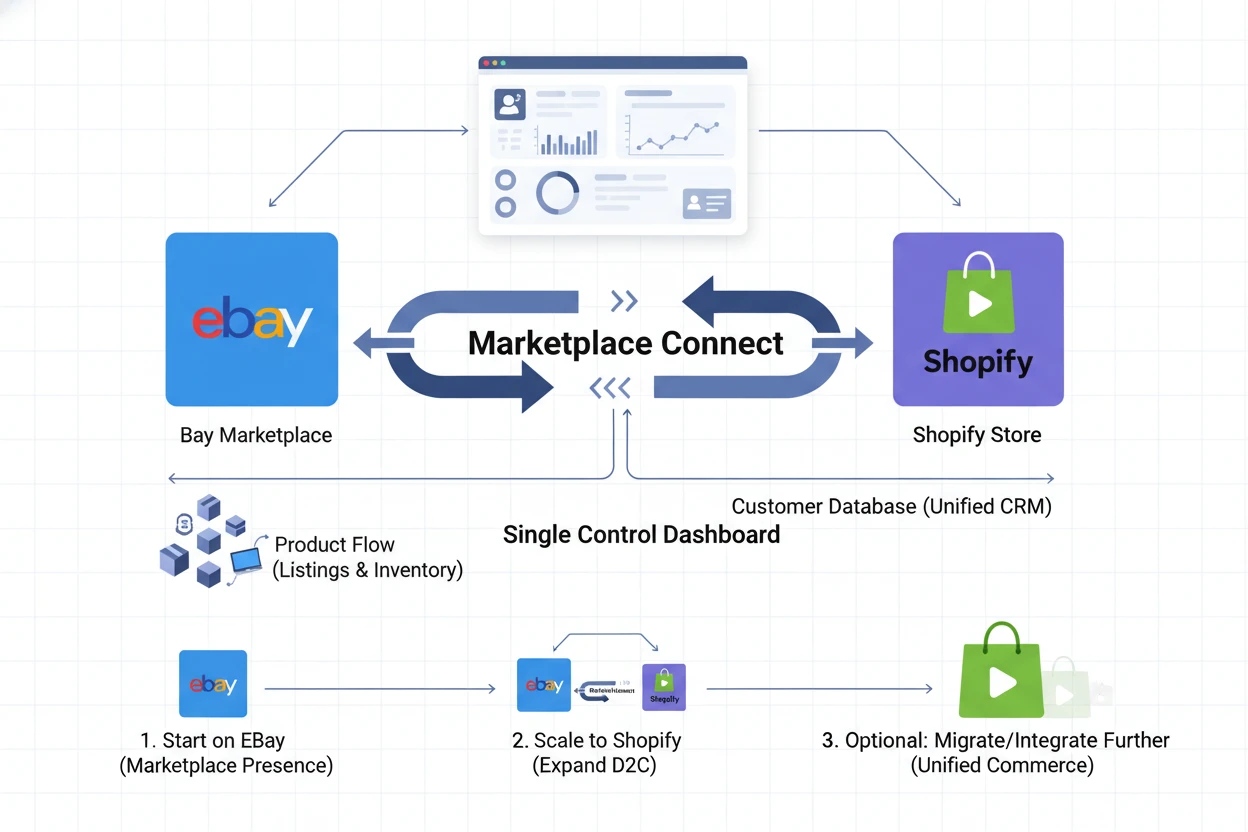
This hybrid approach leverages eBay’s free organic traffic while building your independent Shopify brand. You test products on eBay, scale winners on Shopify, and eventually transition to Shopify-focused operations as your brand grows.
Frequently Asked Questions
Is Shopify Better Than eBay?
It depends on your goals. eBay is better for quick startup with minimal effort. Shopify is better for long-term brand building and maximum profitability. Neither is objectively better; they serve different purposes.
Can I Migrate From eBay to Shopify?
Yes. Shopify provides comprehensive migration guides enabling smooth product and customer data transfer. Many sellers start on eBay for quick revenue, then migrate to Shopify as they scale and want greater control.
Which Platform Is Better for Beginners?
eBay is simpler requiring minimal technical skills and setup time. Shopify is more beginner-friendly for learning e-commerce fundamentals with excellent resources and support. Choose eBay for absolute simplicity; choose Shopify if you want to build real business skills.
Does Shopify Charge Transaction Fees?
Shopify charges no transaction fees when using Shopify Payments. You only pay standard payment processing costs. This represents major savings compared to eBay’s 12-15% fees.
What Are eBay’s Selling Limits?
eBay restricts listings based on subscription: Starter allows 250, Basic allows 1,000, Premium allows 10,000, Anchor allows 25,000, and Enterprise allows 100,000. These limits restrict growth significantly.
Why Choose Shopify Over eBay?
Choose Shopify for brand building, unlimited listings, customization, lower fees, and long-term business growth. Choose eBay for quick startup, free traffic, and simplicity.
Conclusion: Making Your Final Decision
eBay and Shopify represent different paths to dropshipping success. eBay prioritizes accessibility and quick startup. Shopify prioritizes brand building and long-term profitability.
The best strategy combines both platforms. Start on eBay generating quick revenue without marketing pressure. Build initial customer base and product-market validation. Once profitable, migrate successful products to Shopify. Use Shopify’s customization for brand building and better margins. Eventually transition primary focus to Shopify as brand equity grows.
This hybrid approach minimizes risk while maximizing upside potential. You get eBay’s traffic advantage initially and Shopify’s branding and profitability advantages long-term.
Your next step: Start on whichever platform aligns with your immediate goals, but plan your long-term migration to Shopify as you scale. Both platforms support dropshipping automation integration, making multi-platform management easier than ever before in 2026.