You want to launch an online store but face a crucial decision: Wix or Shopify? Wix promises beautiful, easy-to-build websites with affordable plans. Shopify emphasizes powerful ecommerce tools and scalability. But which actually helps you sell more?
This guide compares both platforms across 8 critical factors: ease of use, features, design flexibility, apps, payment options, pricing, SEO and support. Discover which platform matches your business model and growth ambitions.
Key Takeaways of Wix vs Shopify
Choose Wix if: You prioritize design aesthetics, want an affordable entry point, plan a hybrid website/store, and don’t need advanced ecommerce automation.
Choose Shopify if: You’re serious about ecommerce sales, need scalability, want powerful selling tools, and can invest in long-term growth.
Main difference: Wix is a website builder that sells products. Shopify is an ecommerce platform that looks professional.
Best for beginners: Wix (easier setup, lower cost). Best for scaling: Shopify (better tools, unlimited growth potential).
What Is Wix?
Wix is a website builder offering drag-and-drop design freedom combined with ecommerce capabilities. Launched in 2006, Wix prioritizes stunning visual design and ease of use. The platform serves small businesses, freelancers, and creative entrepreneurs wanting professional websites without coding.
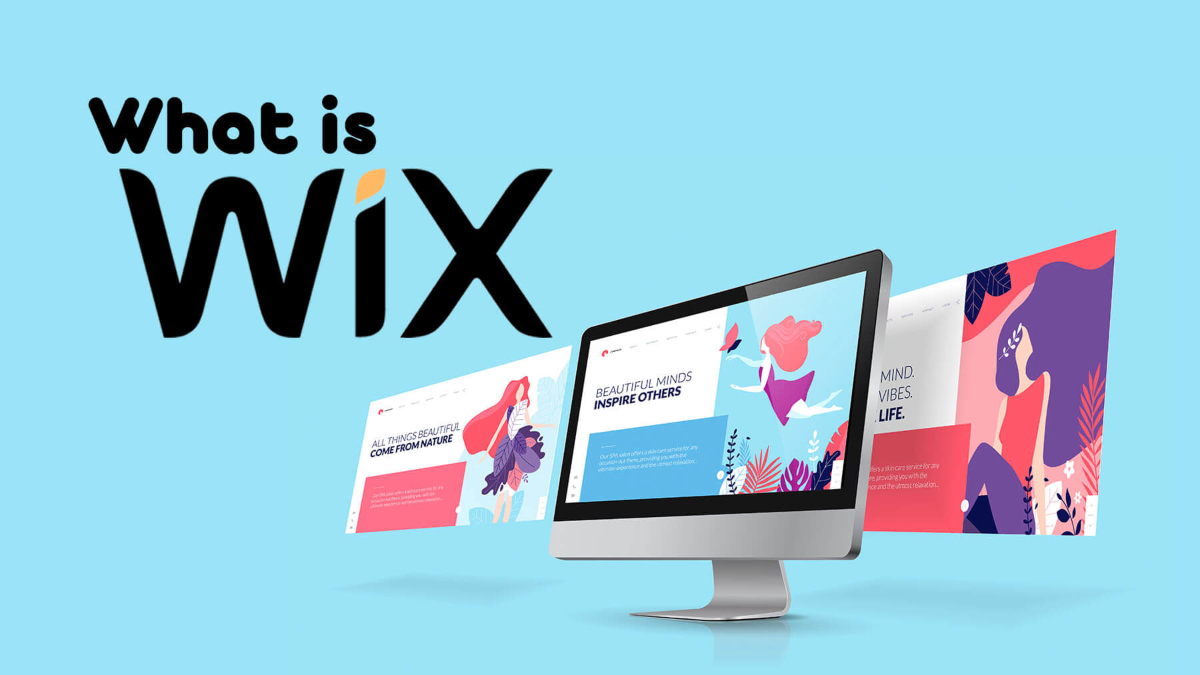
Wix Ecommerce capabilities include product catalogs, inventory management, order processing, and basic marketing tools. However, ecommerce is secondary to design flexibility. Wix excels at helping beginners create beautiful online presences quickly.
Typical use cases include small retail stores, service-based businesses with shop components, creative portfolios with products, local businesses needing online presence, and hybrid website/store models.
Best suited for: Solopreneurs, designers, local service providers, and small business owners valuing aesthetics and ease over advanced selling features.
What Is Shopify?
Shopify is a dedicated ecommerce platform launching in 2006, designed exclusively for online selling. Shopify prioritizes sales optimization, inventory management, multi-channel selling, and business scalability. The platform serves entrepreneurs serious about ecommerce, from small startups to established brands.
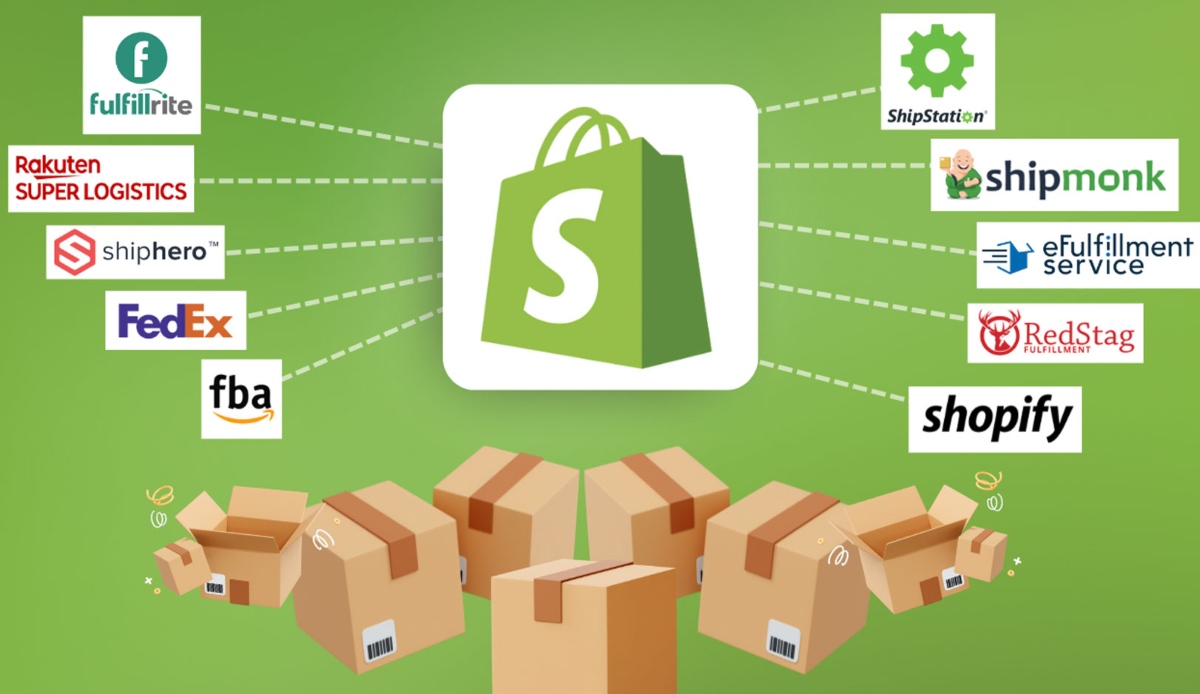
Shopify’s core focus is moving inventory and maximizing revenue. Every feature targets conversion rate optimization, customer lifetime value, and operational efficiency.
Typical use cases include dropshipping businesses, print-on-demand sellers, digital product retailers, subscription box companies, B2B wholesalers, and high-growth ecommerce brands.
Best suited for: Ecommerce-focused entrepreneurs, resellers, content creators monetizing audiences, and business owners prioritizing sales and scalability over design aesthetics.
Wix vs Shopify: What’s the Main Difference?
The fundamental distinction is philosophy:
Wix = Website builder + ecommerce features. Start with beautiful design, add selling capabilities as needed.
Shopify = Ecommerce platform + website tools. Start with sales optimization, apply design as secondary consideration.
This difference impacts every aspect: ease of use (Wix wins initially), ecommerce features (Shopify dominates), design flexibility (Wix superior), scalability (Shopify unmatched), and long-term cost (Shopify more expensive but justifiable at scale).
For entrepreneurs whose primary goal is aesthetic design with light selling, Wix excels. For business owners whose primary goal is maximizing sales revenue, Shopify wins decisively.
Wix vs Shopify Comparison by Core Ecommerce Factors
Ease of Use and Setup
Wix advantage: Drag-and-drop editor is incredibly intuitive. Create your first page in 5 minutes. Add products in 10 minutes. Launch your first store in under 1 hour. Zero technical knowledge required. Wix’s onboarding walks beginners through every step.

Shopify advantage: Clear, organized dashboard. Professional interface. Setup takes 2-3 hours but feels more business-oriented. Learning curve is steeper than Wix but manageable for non-technical users.
Winner: Wix for beginners. Shopify wins for users comfortable with more complexity.
Ecommerce Features and Selling Tools
Wix approach includes product catalogs with basic management, inventory tracking that’s functional but limited, simplified order management, support for both digital and physical products, and basic marketing tools like email and social integration. However, automation capabilities are weak, making Wix suitable for small operations with manageable order volumes.
Shopify approach provides advanced product management including variants, bundles, and subscriptions, sophisticated inventory management with automated reordering, order automation and fulfillment workflows, multi-channel selling across Facebook, Instagram, TikTok, and Amazon, advanced marketing automation, and intelligent features like abandoned cart recovery and customer segmentation with detailed analytics.
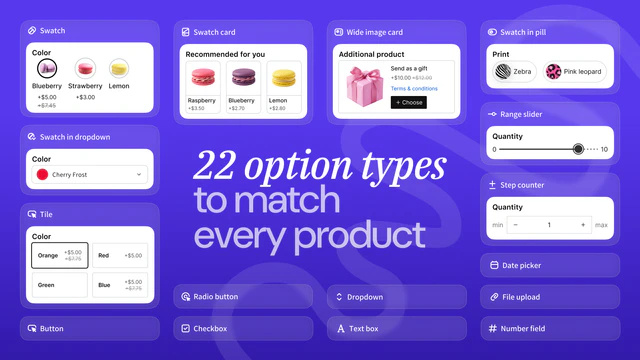
Winner: Shopify decisively. Shopify’s ecommerce features are exponentially more powerful. Wix handles basic selling adequately, but Shopify enables sophisticated sales operations that drive revenue at scale.
Themes, Design, and Customization
Wix advantages include 900+ professionally designed templates with unlimited drag-and-drop customization requiring no coding knowledge. You maintain complete visual control with responsive design guaranteed. The branded editor uses intuitive controls, making it ideal for creative, design-forward businesses that want visual differentiation.
Shopify advantages include 200+ high-performing ecommerce-focused themes, customization possible through code knowledge, focus on conversion-optimized designs, excellent mobile optimization, though limited free themes with premium options costing $180-380.
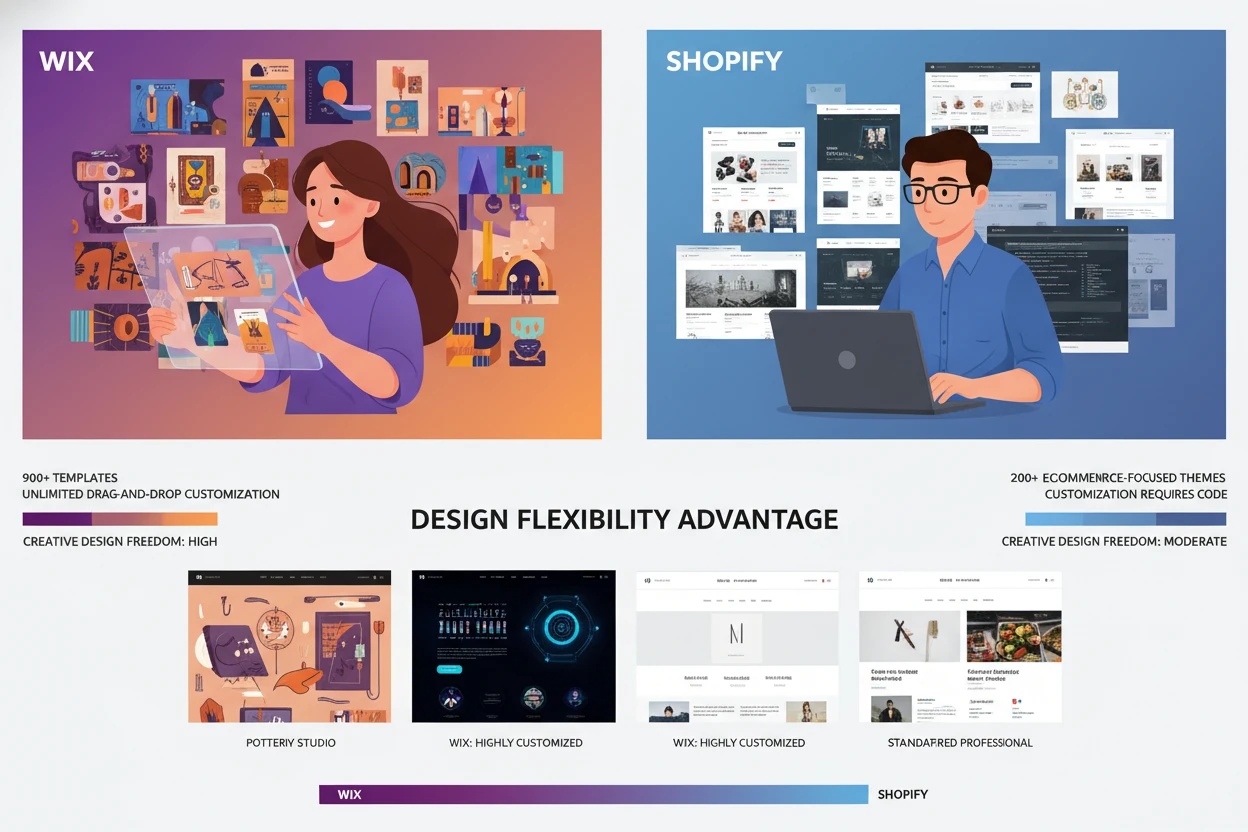
Winner: Wix for design flexibility and ease of use. Shopify wins for conversion-focused professional ecommerce stores.
Apps, Integrations, and Extensions
Wix App Market offers 250+ apps with limited selection compared to Shopify. Apps often cost $5-50+ monthly, and integration quality varies. This smaller ecosystem limits your ability to extend functionality beyond core features.
Shopify App Store provides 6,000+ apps covering virtually any business need imaginable. Apps range from free to premium ($20-100+/month), with high-quality integrations maintained by dedicated developers. The massive ecosystem means you can find solutions for almost any requirement.
Read more: Best Apps for Dropshipping 2026 | Top 12 Shopify Solutions
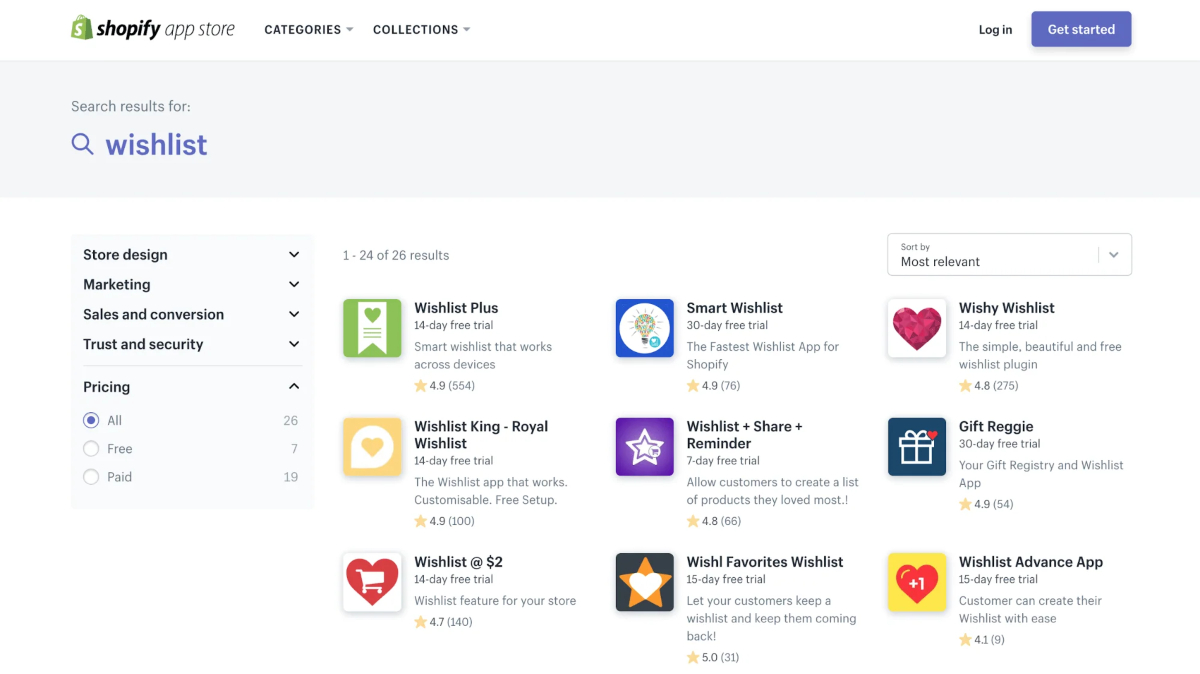
Winner: Shopify decisively. The massive app ecosystem enables unlimited functionality and customization. Wix’s limited selection restricts advanced capabilities and business growth.
Payment Gateways and Checkout Experience
Wix supports 70+ payment methods with built-in payment processing and transaction fees, simplified checkout in 2-3 steps, basic abandoned cart recovery, and limited checkout customization options. The experience is straightforward for customers but lacks advanced optimization.
Shopify supports 100+ payment methods with multiple payment processor options, customizable checkout flows for different business needs, advanced abandoned cart automation, one-click checkout with Shop Pay, and conversion-optimized checkout features designed to reduce cart abandonment and increase conversions.
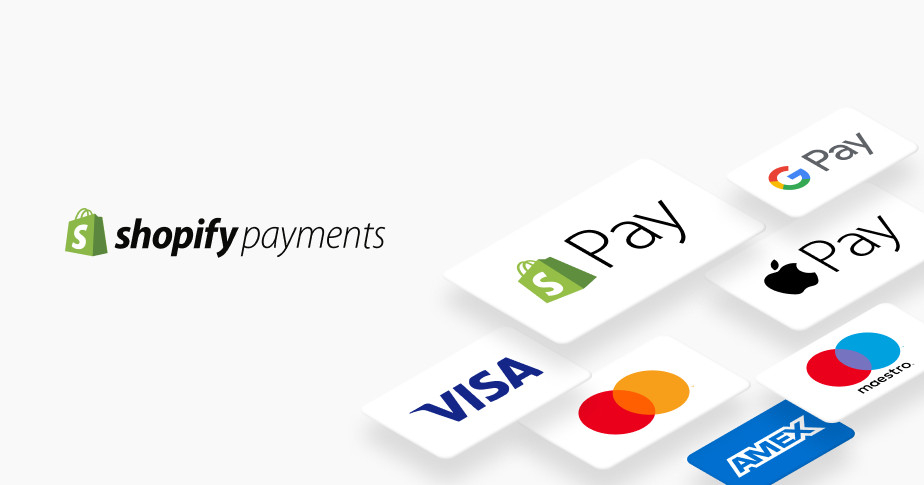
Winner: Shopify for payment flexibility and checkout optimization, though both platforms adequately support the essential payment processing needs of most online stores.
Shipping, Taxes, and Global Selling
Wix shipping offers basic shipping rate configuration, integration with major carriers but limited in scope, manual tax setup requiring you to calculate and manage, limited multicurrency support, and basic international selling capabilities. Scaling global operations becomes cumbersome quickly.
Shopify shipping provides advanced shipping zone configuration for different regions, full carrier integration including USPS, UPS, FedEx, and DHL with real-time rate calculations, automated tax calculation by location and jurisdiction, full multicurrency and multilingual support, and advanced international selling features including international payment methods and customer management.
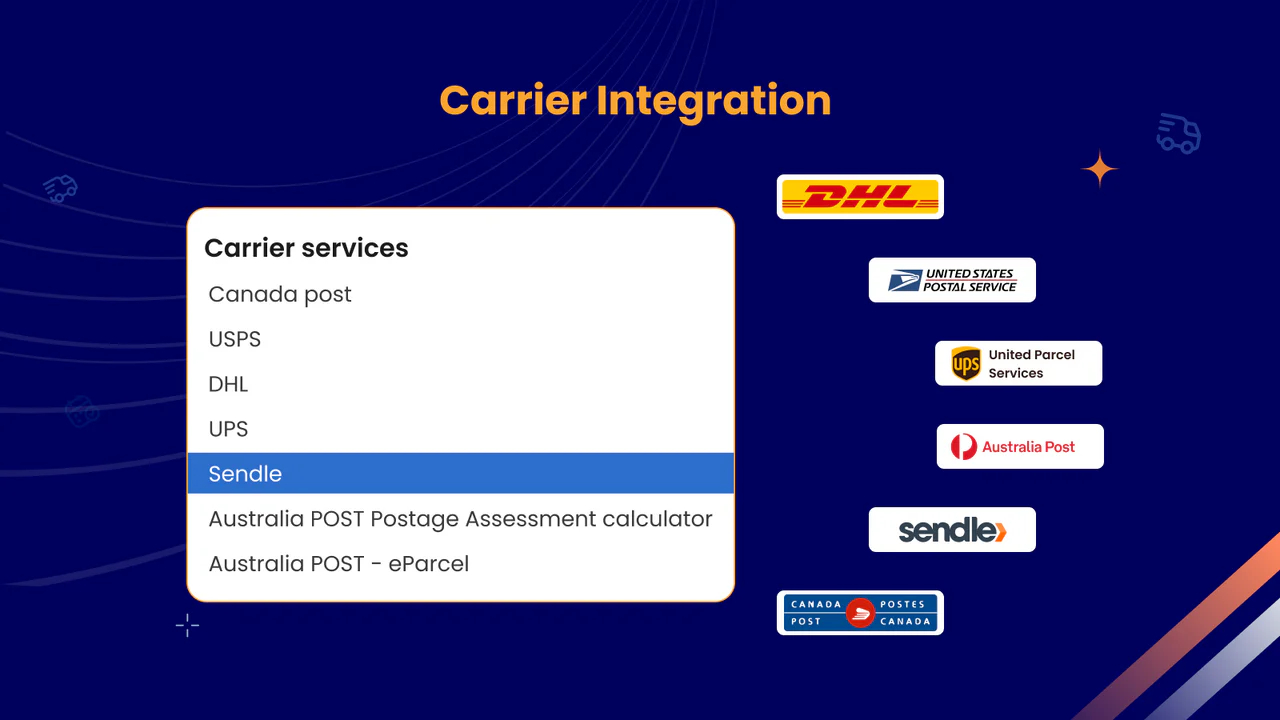
Winner: Shopify decisively. Global selling and tax automation are vastly superior. For businesses expanding internationally, this difference significantly impacts operations and compliance.
SEO Capabilities and Performance
Wix SEO includes an SEO tool that provides recommendations, mobile-first indexing readiness, adequate but not optimized page speed, limited technical SEO control over site architecture, and inherent challenges ranking for competitive keywords due to shared domain infrastructure.
Shopify SEO features clean, SEO-friendly code structure optimized for search engines, technical SEO best practices built-in, fast loading times that outperform Wix, easier crawling and indexing for Google, and better ranking potential for competitive search terms due to domain authority and optimization focus.
Winner: Shopify for SEO performance. Technical structure and page speed give Shopify a significant competitive advantage in organic search visibility.
Security, Hosting, and Reliability
Wix includes SSL certificates for secure browsing, Wix-managed hosting ensuring reliability, 99.9% uptime guarantee, adequate security features for small businesses, and handles all technical infrastructure management. You focus purely on content while Wix manages the backend.
Shopify offers SSL certificates included, enterprise-grade hosting infrastructure, 99.99% uptime SLA (higher availability), advanced security features including PCI compliance and DDoS protection, and regular security updates and patches. The infrastructure supports massive transaction volume.
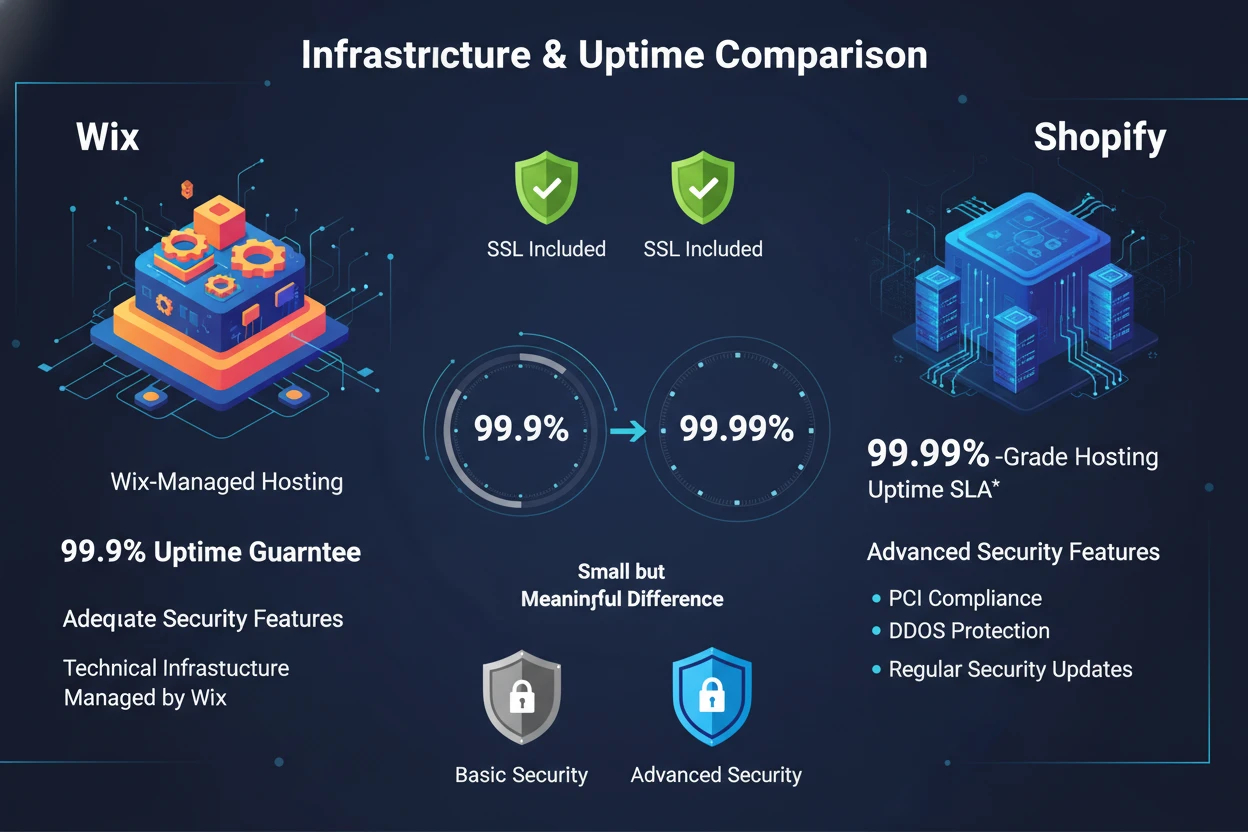
Winner: Shopify for enterprise-grade infrastructure, though both platforms are secure and reliable for typical online stores.
Customer Support and Resources
Wix support provides email support available 24/7, live chat support during limited hours, extensive help center with thousands of articles, active community forums for peer-to-peer assistance, limited phone support availability, and typical response times of 24-48 hours. Support is adequate for most issues.
Shopify support offers 24/7 live chat support with real agents, 24/7 phone support by calling directly, comprehensive documentation and guides, highly active community forums, dedicated support for higher-tier plans with faster response times, and response times typically under 1 hour. Support is a significant advantage.
Winner: Shopify for responsive and comprehensive support access. If you need quick answers, Shopify’s 24/7 live support is invaluable.
Wix vs Shopify Pricing and Fees
Wix Ecommerce Pricing
Wix offers three main plans: Business Basic at $27 monthly supporting 500 products with basic features, Business Unlimited at $32 monthly with unlimited products, and Business Premium at $49 monthly with advanced capabilities. Transaction fees are 2.9% + $0.30 per transaction through Wix Payments. On a $100 sale, you pay approximately $3.20 in fees, roughly 3.2% total cost. Hidden costs are minimal, making Wix highly transparent in pricing.
Shopify Pricing and Fees
Shopify offers four subscription tiers: Starter at $5 monthly for basic online selling, Basic at $39 monthly providing core ecommerce features, Standard at $105 monthly for professional capabilities, and Premium at $399 monthly with advanced functionality. Payment processing costs 2.9% + $0.30 per transaction on the basic plan, with rates decreasing on higher tiers. Additional app costs typically range from $0-100+ monthly depending on your specific needs. On a $100 sale with the Basic plan, you pay subscription portion plus $3.20 payment processing, approximately $3.33+ in fees (3.33%+).
Wix vs Shopify Cost Comparison
For $5,000 monthly revenue:
- Wix: $27/month + ~$160 payment fees = $187/month (3.74%)
- Shopify Basic: $39/month + ~$160 payment fees = $199/month (3.98%)
- Winner: Wix (slightly cheaper)
For $50,000 monthly revenue:
- Wix: $49/month + ~$1,600 payment fees = $1,649/month (3.30%)
- Shopify Standard: $105/month + ~$1,600 payment fees + apps $200 = $1,905/month (3.81%)
- Winner: Wix (lower fees)
However: Shopify’s advanced features (automation, apps, integrations) generate additional revenue that typically offsets higher costs at scale.
Wix vs Shopify for Dropshipping
Wix dropshipping: Limited. No native dropshipping integrations. Requires manual supplier management. Order automation is weak. Not recommended for serious dropshippers.
Shopify dropshipping: Optimized. Native integrations with Oberlo, Spocket, AliExpress. Automated order fulfillment. Built for dropshipping businesses.
Winner: Shopify decisively. Dropshippers should avoid Wix entirely.
Wix vs Shopify vs Other Platforms
Shopify vs Wix vs WordPress
WordPress offers maximum control and flexibility but requires technical expertise, hosting management, and security responsibility. Best for content-heavy sites. Wix is easier; Shopify is more specialized for selling.
Shopify vs Wix vs Squarespace
Squarespace positions between Wix and Shopify. Beautiful design but limited ecommerce features. Good for portfolio/shop hybrids. Wix offers more design freedom; Shopify offers more ecommerce power.
Wix vs Shopify vs BigCommerce
BigCommerce competes with Shopify in enterprise ecommerce. More powerful than Shopify for B2B. More complex than Wix. Better for established brands needing advanced features.
Wix vs Shopify for Different Business Types
Small Businesses and Beginners
Wix wins. Lower cost, easier setup, beautiful templates enable quick launches. Perfect for testing ecommerce viability with minimal investment.
Growing Ecommerce Brands
Shopify wins. Scalability, advanced features, app ecosystem support rapid growth. Long-term investment justified by revenue increases.
Content-Driven and Service-Based Stores
Wix wins. Hybrid website/shop model suits service providers, consultants, and content creators. Better blogging capabilities than Shopify.
Wix vs Shopify Pros and Cons
Pros and Cons of Wix
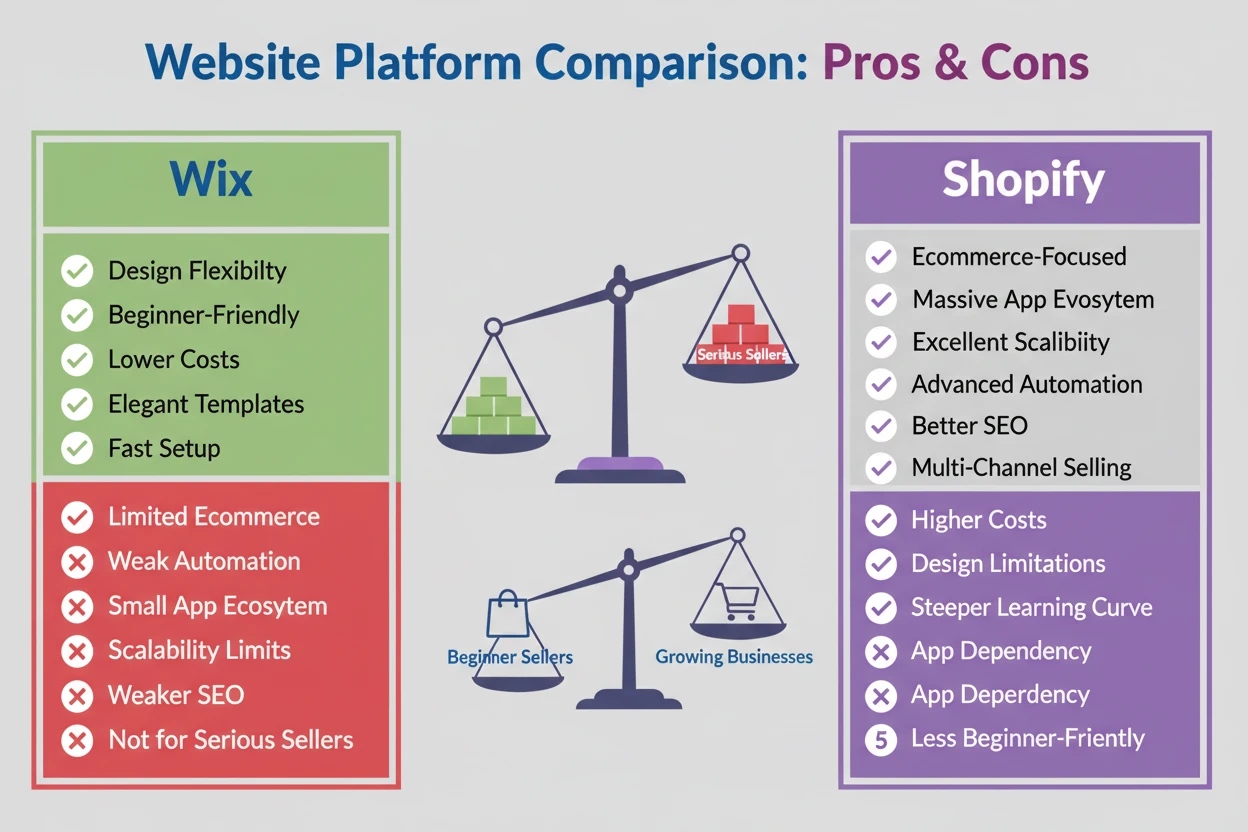
Wix strengths include exceptional design flexibility allowing complete visual control, a beginner-friendly interface requiring no technical knowledge, lower entry costs ($27-49 monthly), beautiful professionally designed templates, effective hybrid website/shop models, and faster initial setup getting you live in hours.
Wix limitations include weak ecommerce features adequate only for small operations, limited automation capabilities making scaling manual and tedious, a small app ecosystem restricting customization, limited scalability once monthly sales exceed $10K, weaker SEO structure making organic ranking harder, and general unsuitability for sellers with serious ecommerce ambitions beyond basic online presence.
Pros and Cons of Shopify
Pros:
- Ecommerce-focused tools
- Massive app ecosystem (6,000+)
- Superior scalability
- Advanced automation
- Better SEO structure
- Excellent support
- Multi-channel selling
Cons:
- Higher long-term costs
- Design limitations without code
- Steeper learning curve
- App dependency
- Less beginner-friendly
- Design less flexible than Wix
Wix vs Shopify FAQs
Wix vs Shopify which is better for online store?
Shopify is generally better for serious ecommerce. Superior features, scalability, and automation justify higher costs. Wix suits beginners and hybrid websites.
Is Wix good for ecommerce websites?
Adequate but limited. Wix handles basic ecommerce adequately for small sellers. For serious ecommerce ambitions, Shopify is superior.
Is Shopify worth it for small businesses?
Yes, if ecommerce is core. $39/month investment generates substantial returns through better features and conversion tools. Wix is cheaper initially but limits growth.
Wix vs Shopify dropshipping which is better?
Shopify decisively. Wix lacks dropshipping integrations and automation. Shopify is built for dropshipping businesses.
Shopify vs Wix which is better for ecommerce?
Shopify wins decisively for ecommerce-focused businesses. Wix wins for design-focused hybrid websites.
Conclusion: Wix vs Shopify, Which One Should You Choose?
Choose Wix if:
- You’re a beginner wanting quick, beautiful launch
- Your focus is design aesthetics
- You want hybrid website/store
- Budget is primary concern ($27-49/month)
- Sales volume is modest (under $10K/month)
Choose Shopify if:
- Ecommerce is your core business
- You want advanced selling features
- You plan to scale significantly
- You need app ecosystem and integrations
- You’re willing to invest in long-term growth
- You sell dropshipped or digital products
Final recommendation: Start with Wix for rapid testing and beautiful design. Migrate to Shopify once monthly sales exceed $10K. Shopify’s investment becomes justified at scale, and its features enable further growth Wix cannot support.
The best platform isn’t universal – it matches your business model and growth ambitions. For casual online selling or portfolio shops, Wix is superior. For ecommerce entrepreneurs, Shopify is the clear winner.
Choose based on your actual priorities: design ease and affordability (Wix) or ecommerce power and scalability (Shopify).