You’ve got products to sell online but can’t decide between Etsy vs eBay. Etsy attracts handmade-focused buyers but charges more in fees. eBay reaches millions globally but drowns you in competition and complexity. Which platform actually makes you more money?
This guide compares fees, seller experience, competition levels, and ideal product types. Discover exactly which marketplace fits your business or whether you should sell on both simultaneously.
Overview of Etsy and eBay
What Is Etsy?
Etsy is a global marketplace specializing in handmade items, vintage goods (20+ years old), and craft supplies. Launched in 2005, Etsy attracts approximately 90 million monthly active buyers specifically searching for unique, creative products they can’t find on Amazon or traditional retail stores.

Etsy sellers are typically independent makers, artists, craftspeople, and creative entrepreneurs. Buyers on Etsy actively seek handmade quality, unique items, and direct connections with makers. The platform emphasizes authenticity, creativity, and personal stories behind products.
Common Etsy use cases include handmade jewelry, vintage clothing, custom home decor, digital downloads, craft supplies, art prints, and niche artisan goods. Etsy works best for sellers offering distinctly unique or creatively produced items.
What Is eBay?
eBay is a massive global marketplace for new and used goods across virtually every category imaginable. Founded in 1995, eBay hosts over 600 million active listings with approximately 147 million monthly active buyers shopping everything from collectibles to electronics to apparel.

eBay sellers range from individual resellers to established businesses. Buyers include bargain hunters, collectors, resellers, and people seeking both new and used items. The platform supports two main selling models: fixed-price listings (like traditional e-commerce) and auctions (bidding-based sales).
Common eBay use cases include reselling used items, liquidating inventory, selling collectibles, running drop-shipping businesses, and wholesale operations. eBay accommodates virtually any legal product.
Read more: Top 25 eBay Dropshipping Suppliers in USA & UK for 2026
Etsy vs eBay for Sellers: Key Differences at a Glance
| Factor | Etsy | eBay |
|---|---|---|
| Best for | Handmade, vintage, creative goods | New/used items, collectibles, resale |
| Target Audience | Creative buyers seeking unique items | Price-conscious buyers, collectors |
| Product Categories | Limited to specified types | Virtually unlimited |
| Seller Competition | Moderate, less price-focused | Intense, highly price-driven |
| Setup Difficulty | Easy (30 minutes to first listing) | Moderate (1-2 hours) |
| Monthly Fees | $0 (no store required) | $7.95-27.95+ (optional store) |
| Listing Fees | $0.20 per listing (4 months) | $0.30-2.00 per listing |
| Transaction Fees | 5% of sale price | 12.9% of sale price |
| Payment Processing | 3% + $0.20 | 2.35% |
| Best Seller Profile | Independent artisans, makers, curators | Resellers, collectors, businesses |
Products You Can Sell: Etsy vs eBay
Product Focus and Categories
Etsy restricts listings to specific categories. Allowed products include handmade items (created by you), vintage goods (20+ years old), craft supplies, and certain pre-made items. Prohibited items include mass-produced goods, replicas, counterfeit items, certain digital products, and anything outside Etsy’s defined marketplace focus.
Read more: How to Find the Best Dropshipping Niches in 2026?
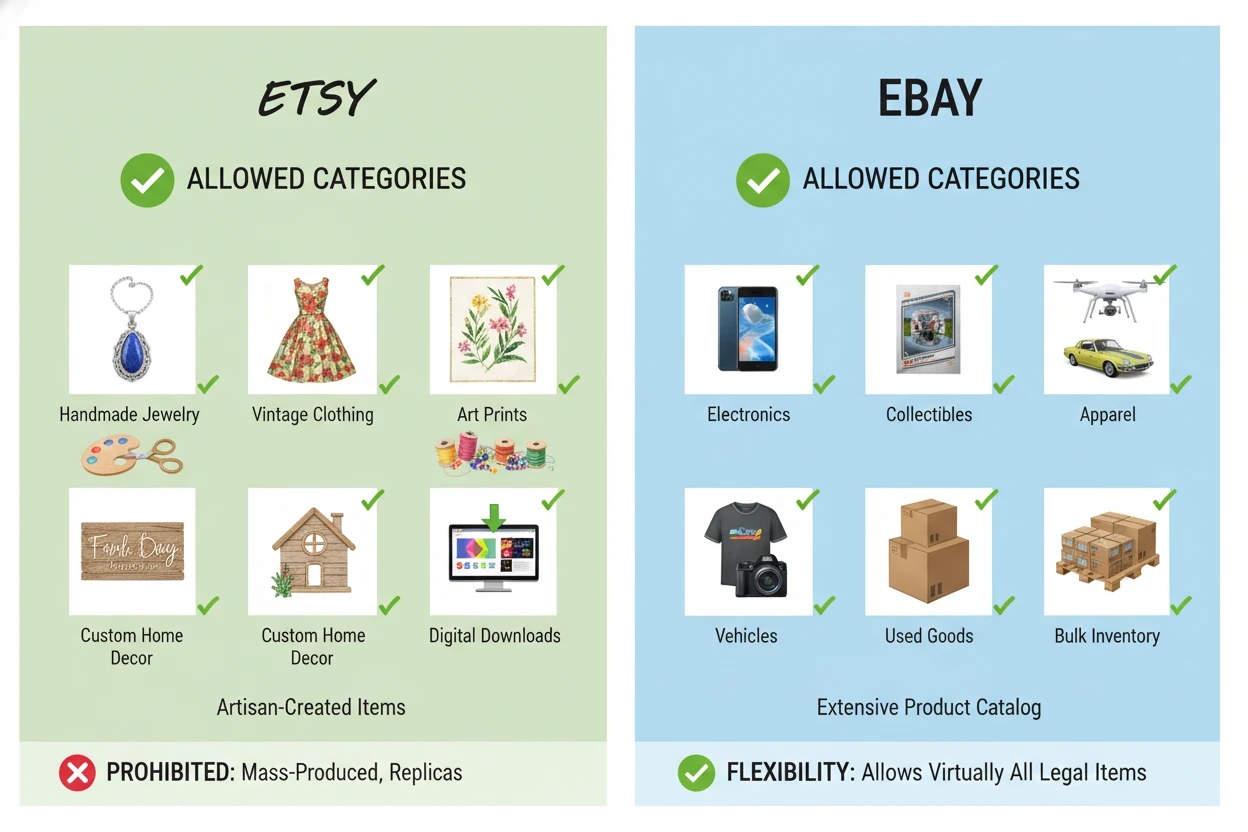
eBay permits virtually any legal product. Sellers list new items, used goods, collectibles, electronics, apparel, vehicles, and more. While some categories require special approvals (vehicles, weapons, etc.), eBay’s product flexibility vastly exceeds Etsy’s.
Selling Vintage on Etsy vs eBay
Etsy vintage requirements mandate items be genuinely 20+ years old, unaltered, and accurately described. Etsy vintage appeals to buyers seeking authentic collectible pieces and historical items.
eBay vintage flexibility includes both genuine vintage items and modern reproductions labeled as such. eBay accommodates broader vintage interpretations and doesn’t restrict “vintage-style” products.
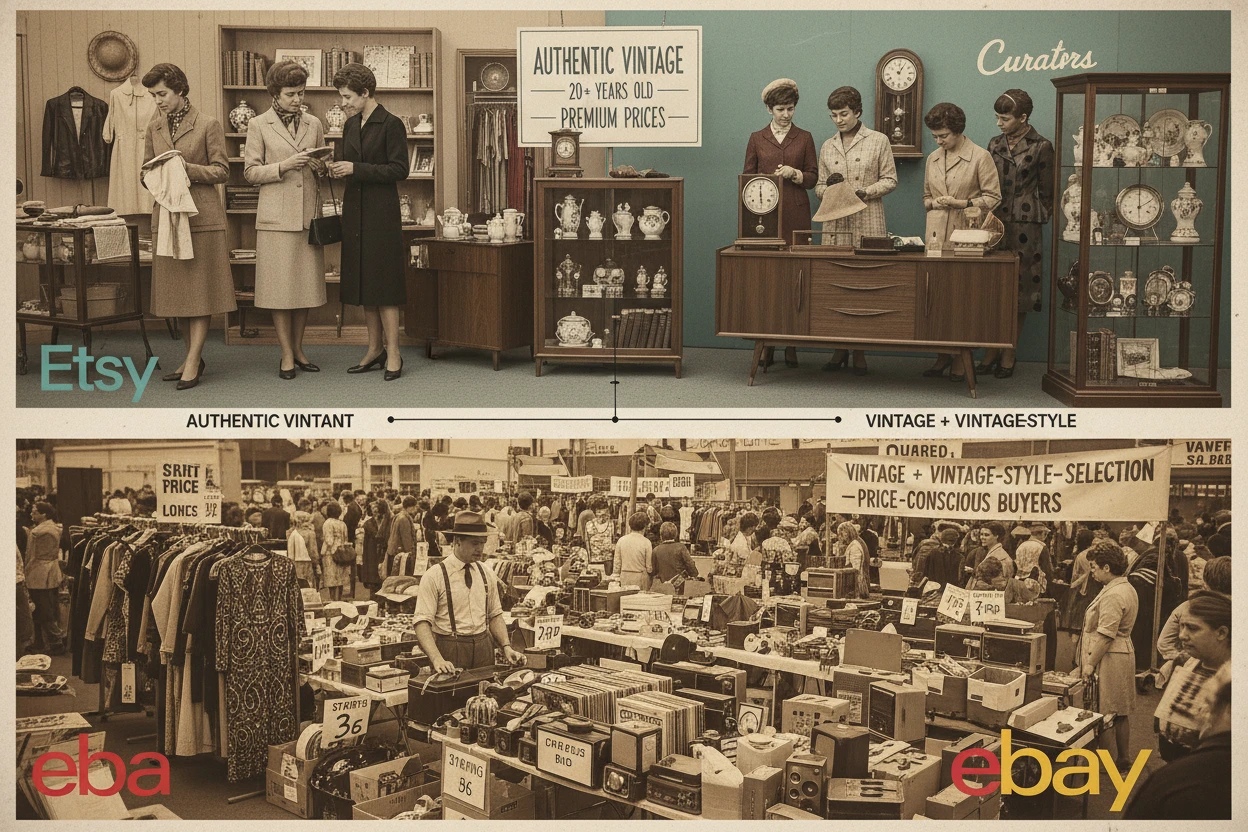
For serious vintage collectors and dealers, eBay typically provides better reach and flexibility. For sellers targeting authentic vintage enthusiasts, Etsy attracts more premium-priced buyers.
Selling Art on Etsy vs eBay
Etsy art selling emphasizes original artwork, prints, and artist-created pieces. Etsy buyers specifically seek art from independent artists and value the creator connection. Original art and limited-edition prints command strong prices on Etsy due to buyer demand for unique creations.
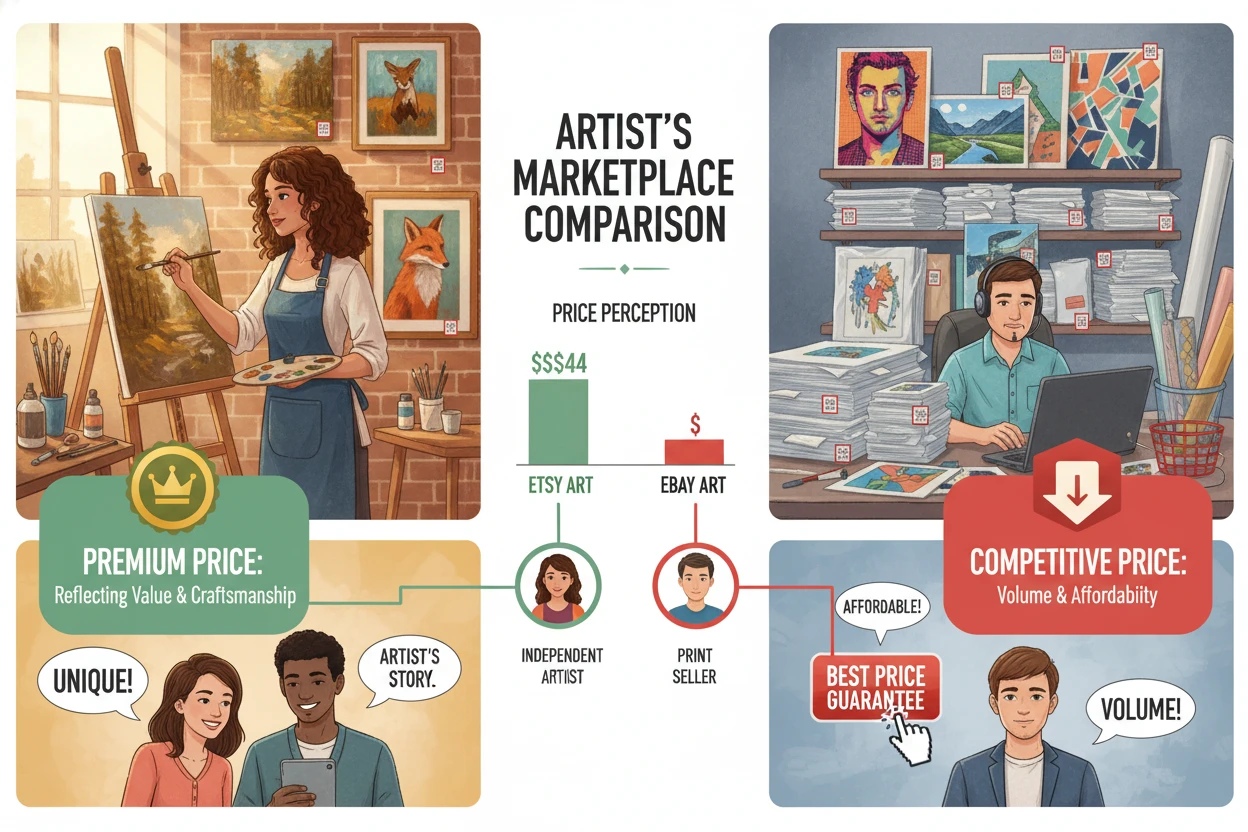
eBay art selling includes original art, reproductions, and prints but faces intense price competition. eBay art buyers often prioritize lower prices over artist connection, impacting profit margins.
Etsy is typically superior for artists seeking premium pricing and direct buyer relationships. eBay works better for volume-based art sales and prints.
Selling Models and Flexibility
Etsy vs eBay Selling Structure
Etsy operates on fixed-price listings exclusively. You set a price, and buyers purchase at that price. Etsy doesn’t support auctions, negotiation, or variable pricing. This simplicity suits handmade sellers offering unique items where price negotiation doesn’t apply.
eBay offers both fixed-price and auction listings. Auction listings allow competitive bidding, potentially increasing final sale price. Fixed-price listings function like traditional e-commerce. This flexibility enables diverse selling strategies.
For bulk inventory or collectibles, eBay’s options provide strategic advantages. For handmade goods, Etsy’s simplicity suffices.
Selling on eBay vs Etsy for Beginners
Etsy’s learning curve is gentle. Create an account, write a product description, upload photos, set price, and list. Most beginners complete their first listing within 30 minutes. Etsy’s interface prioritizes simplicity and straightforward seller operations.
eBay’s learning curve is steeper. You must navigate category selection, pricing strategies (fixed vs auction), handling time, shipping settings, and detailed return policies. New sellers typically need 1-2 hours to feel comfortable listing items.
For beginners with minimal marketplace experience, Etsy’s user-friendly approach reduces learning friction. eBay suits those comfortable with more complexity.
Etsy vs eBay Fees and Selling Costs
Etsy Fees Explained
Listing fees: $0.20 per listing (active for 4 months) Transaction fees: 5% of sale price Payment processing fees: 3% + $0.20 per transaction (US domestic) Shipping label fees: Free through Etsy Optional advertising: Etsy Ads ($1-5+ per day at your discretion)
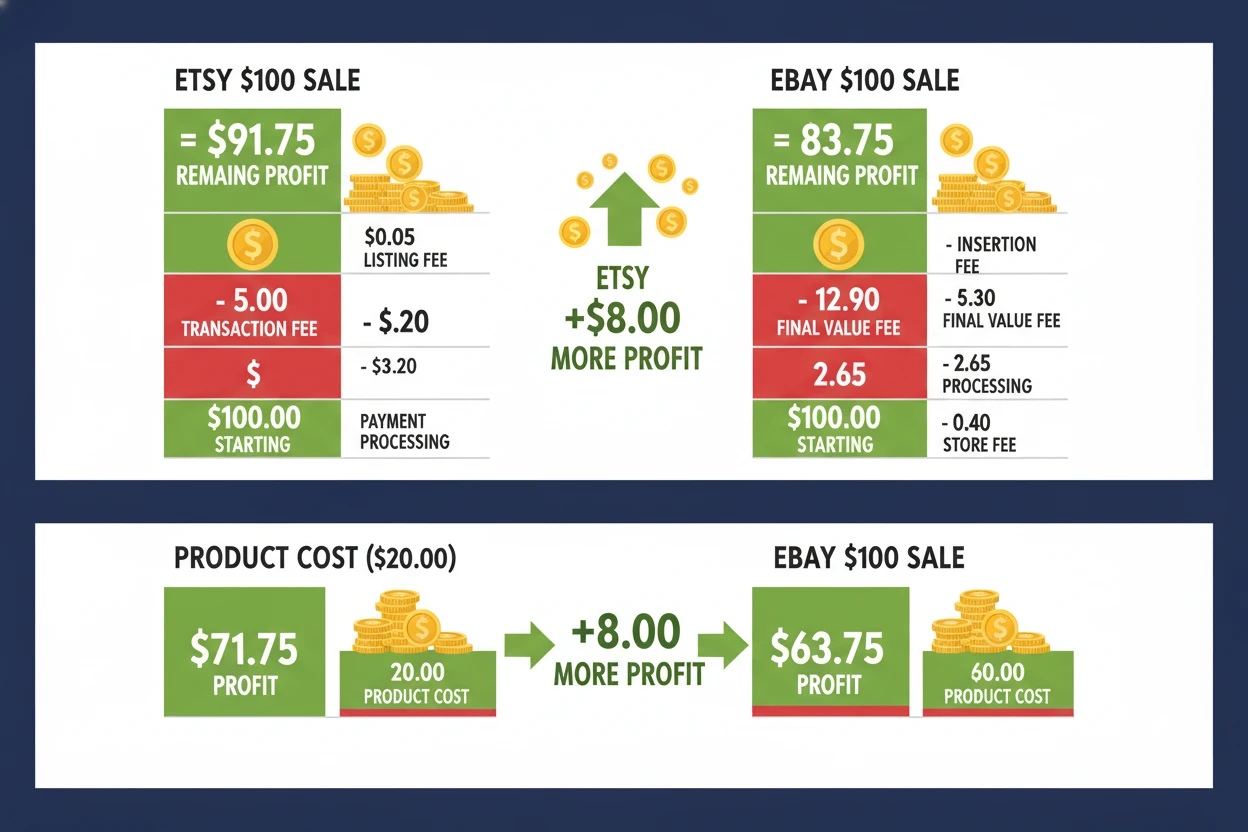
Example: $100 sale on Etsy
- Listing: $0.05 (prorated)
- Transaction: $5.00
- Payment processing: $3.20
- Total: $8.25 (8.25% total cost)
eBay Fees Explained
Insertion/listing fees: $0.30-2.00 per listing (varies by category) Final value fees: 12.9% of sale price Payment processing fees: 2.35% + $0.30 per transaction Store subscription: $7.95-27.95 monthly (optional but recommended) Promoted listings: Optional, variable cost
Example: $100 sale on eBay (with optional store)
- Insertion: $0.30
- Final value: $12.90
- Payment processing: $2.65
- Store portion: $0.40 (prorated)
- Total: $16.25 (16.25% total cost)
Etsy Fees vs eBay Fees: Direct Comparison
On a $100 sale: Etsy costs $8.25 (8.25%), eBay costs $16.25 (16.25%)
On a $50 sale: Etsy costs $4.13 (8.26%), eBay costs $8.00 (16%)
On a $500 sale: Etsy costs $41.25 (8.25%), eBay costs $81.25 (16.25%)
eBay fees are approximately double Etsy’s, making Etsy significantly more cost-efficient for the vast majority of sellers.
How Much Does Each Platform Take From a $100 Sale?
How Much Does Etsy Take From a $100 Sale?
Selling a $100 item on Etsy incurs $8.25 in fees, leaving you $91.75 before shipping costs and product expenses. Your actual profit depends on product cost. If your cost is $20, your profit is $71.75 per sale (before shipping).
How Much Does eBay Take From a $100 Sale?
Selling a $100 item on eBay with a store subscription incurs $16.25 in fees, leaving you $83.75 before shipping and product costs. If your product cost is $20, your profit is $63.75 per sale (before shipping). eBay reduces your profit by approximately $8 per $100 sale compared to Etsy.
Traffic, Competition, and Buyer Behavior
Customer Base Comparison
Etsy buyers actively search for handmade, unique, and creative items. They value maker stories, product authenticity, and creative quality over price. Etsy’s 90 million monthly active buyers specifically choose the platform because they want items Walmart and Amazon don’t offer.
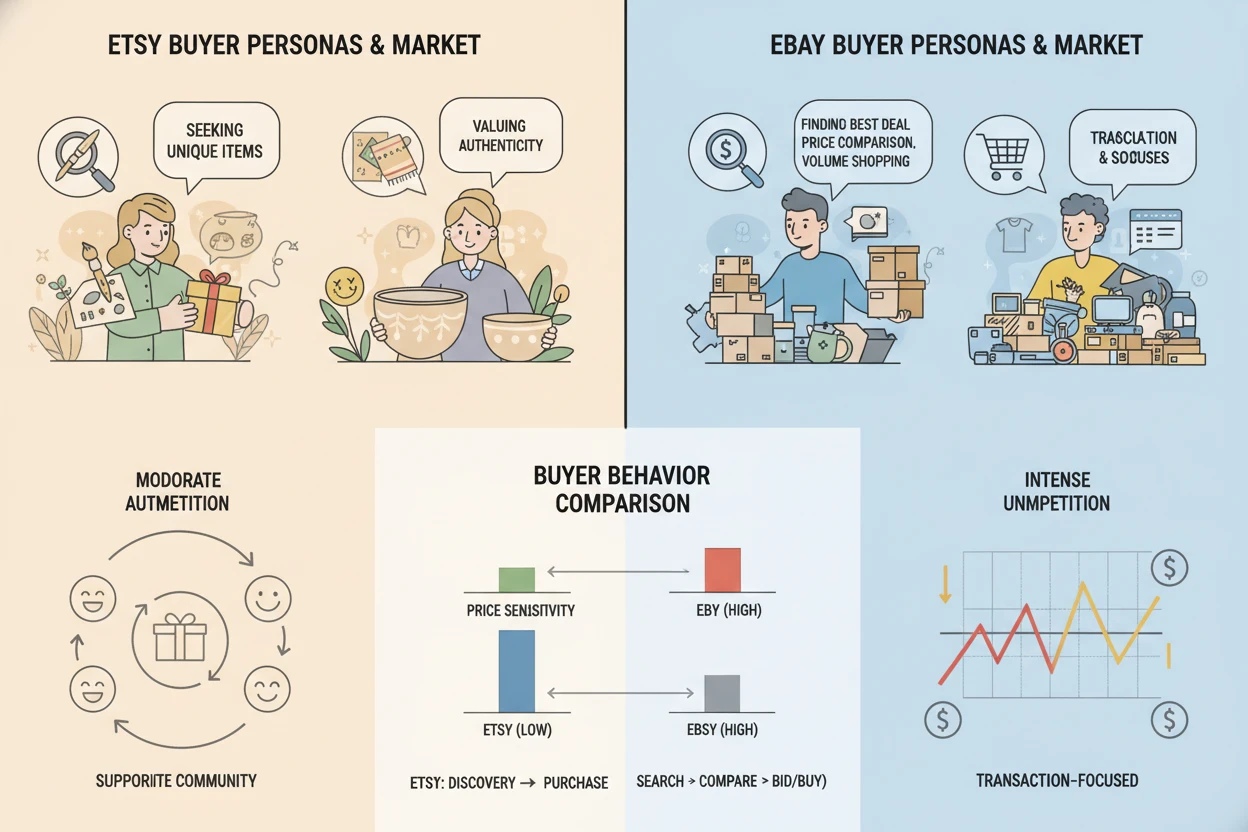
eBay buyers include bargain hunters, collectors, resellers, and people seeking both new and used goods. Price sensitivity is high. eBay buyers often comparison shop and expect competitive pricing. The mentality is “find the best deal,” not “support the maker.”
For creative products, Etsy’s audience alignment is superior. For competitive pricing-sensitive markets, eBay’s volume can drive sales despite lower margins.
Competition Level and Price Pressure
Etsy competition is moderate for most handmade categories. While competition exists, product uniqueness and craftsmanship differentiate sellers. Price wars are uncommon because buyers expect price variation based on quality and customization.
eBay competition is intense and price-focused. Dozens of sellers often list identical or near-identical items, driving prices down. eBay’s pricing algorithms favor lower-priced items, intensifying pressure to reduce margins.
Etsy supports brand building and premium pricing. eBay rewards volume and low-cost operations.
Seller Tools, Marketing, and SEO
Etsy Seller Tools
Etsy SEO focuses on optimizing titles, tags, and descriptions for Etsy’s internal search algorithm. Good Etsy SEO visibility drives significant traffic within Etsy’s ecosystem. Improving Etsy search ranking is achievable through quality photography, detailed descriptions, and proper tagging.
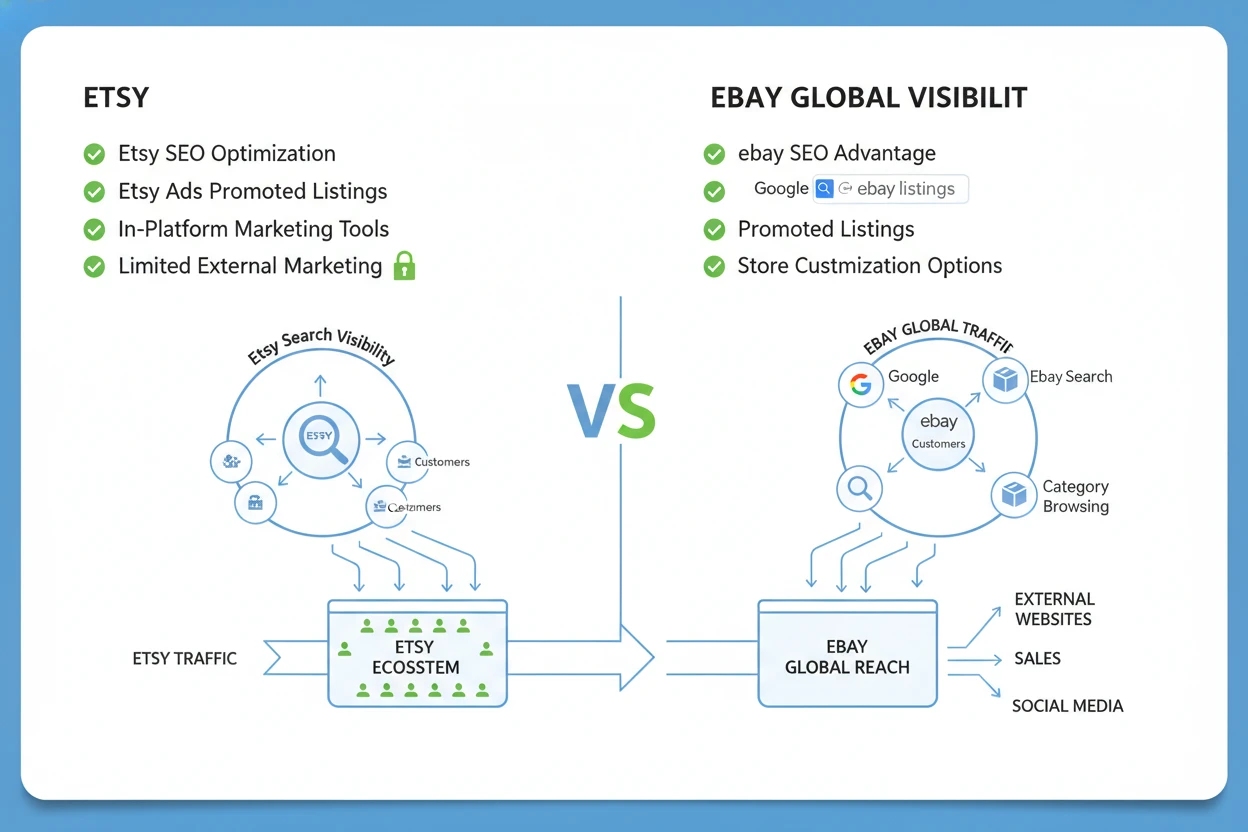
Etsy Ads enable promoted listings within Etsy search results. You pay per click or per sale, starting at $1-5 per day. Etsy Ads integrate seamlessly into the platform and target shoppers actively searching within Etsy.
Branding limitations exist because all Etsy shops operate within the same marketplace template. Your brand identity is constrained by Etsy’s design framework.
eBay Seller Tools
eBay SEO advantages include massive Google Search visibility. Well-optimized eBay listings rank for Google searches, driving external traffic. eBay’s domain authority helps listings compete in organic search results.
Promoted listings on eBay cost variable amounts but place your items prominently in search results and category pages.
Store customization is limited compared to self-hosted platforms but greater than Etsy, allowing some brand differentiation.
Pros and Cons of Selling on Etsy vs eBay
Pros and Cons of Etsy
Pros:
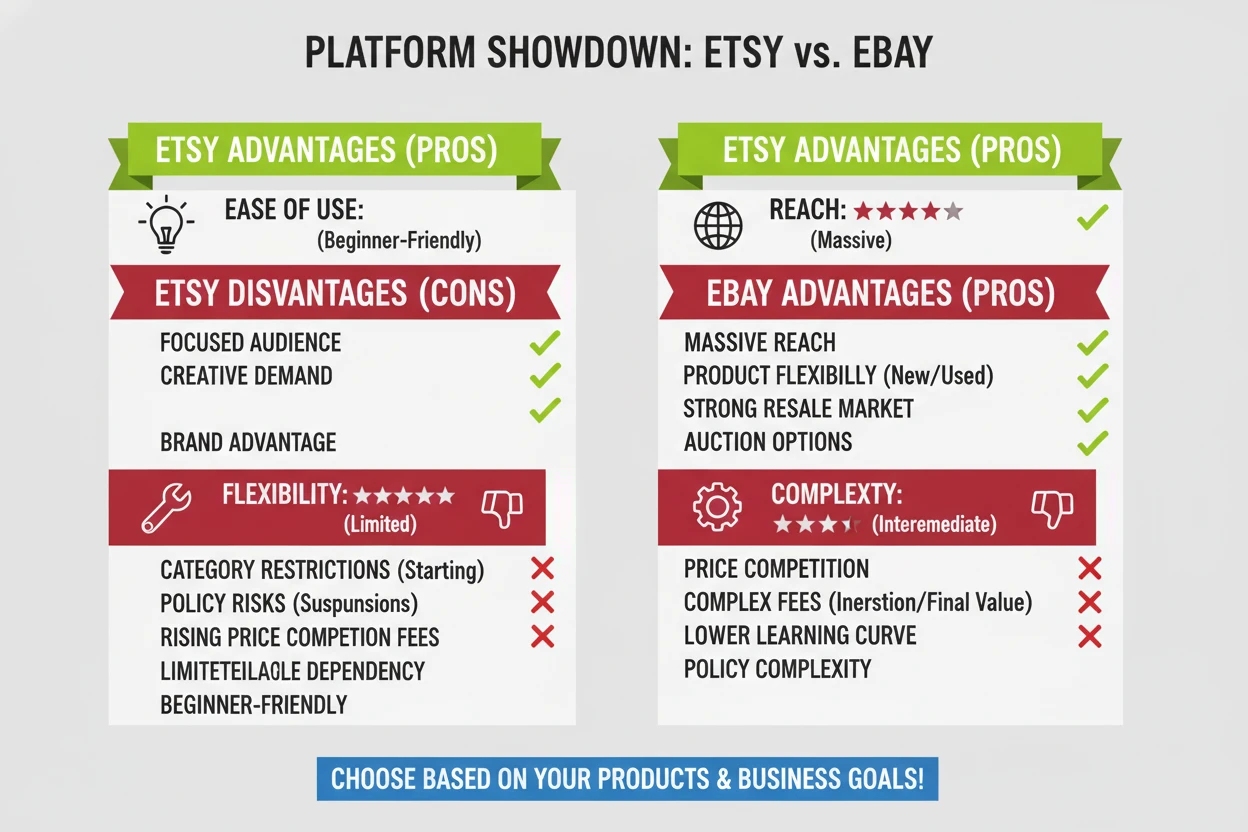
- Focused audience actively seeking handmade/unique items
- Strong demand for creative products and higher buyer willingness-to-pay
- Brand storytelling advantage and maker connection appeal
- Lower fees than eBay (8.25% vs 16.25%)
- Less intense price competition
- Easier platform to use for beginners
Cons:
- Strict product category restrictions
- Marketplace dependency and policy enforcement risks
- Rising fees over time
- Limited customization and branding
- Cannot build external brand authority as easily
Pros and Cons of eBay
Pros:
- Massive global audience and traffic volume
- Flexible product rules accommodating diverse inventory
- Strong resale market with established buyer base
- Google search visibility benefits organic traffic
- Auction option for premium items or collectibles
Cons:
- Intense price competition driving margins down
- Complex fee structure and higher overall costs
- Lower brand loyalty with price-driven buyers
- More complicated platform for new sellers
- Policy complexity and enforcement issues
Traffic, Reach and Marketplace Alternatives
Etsy vs eBay vs Amazon
Scale: Amazon dominates with 390 million monthly active buyers, compared to eBay’s 147 million and Etsy’s 90 million.
Competition: Etsy has moderate competition; eBay has intense competition; Amazon has extreme competition especially for established products.
Fees: Etsy (8.25%), eBay (16.25%), Amazon (15% for most categories + $0.99 per sale).
Best for sellers: Etsy suits independent creators; eBay suits resellers and collectible dealers; Amazon suits established brands and high-volume sellers.
Etsy vs eBay vs Facebook Marketplace
Local vs Global: Facebook Marketplace enables local sales without shipping; Etsy and eBay are global platforms.
Trust and Protection: Etsy and eBay provide built-in buyer protection; Facebook Marketplace offers minimal protections.
Best by product type: Etsy for handmade; eBay for used collectibles; Facebook Marketplace for bulk, local sales.
Which Platform Is Better for You as a Seller?
Etsy vs eBay for New Sellers
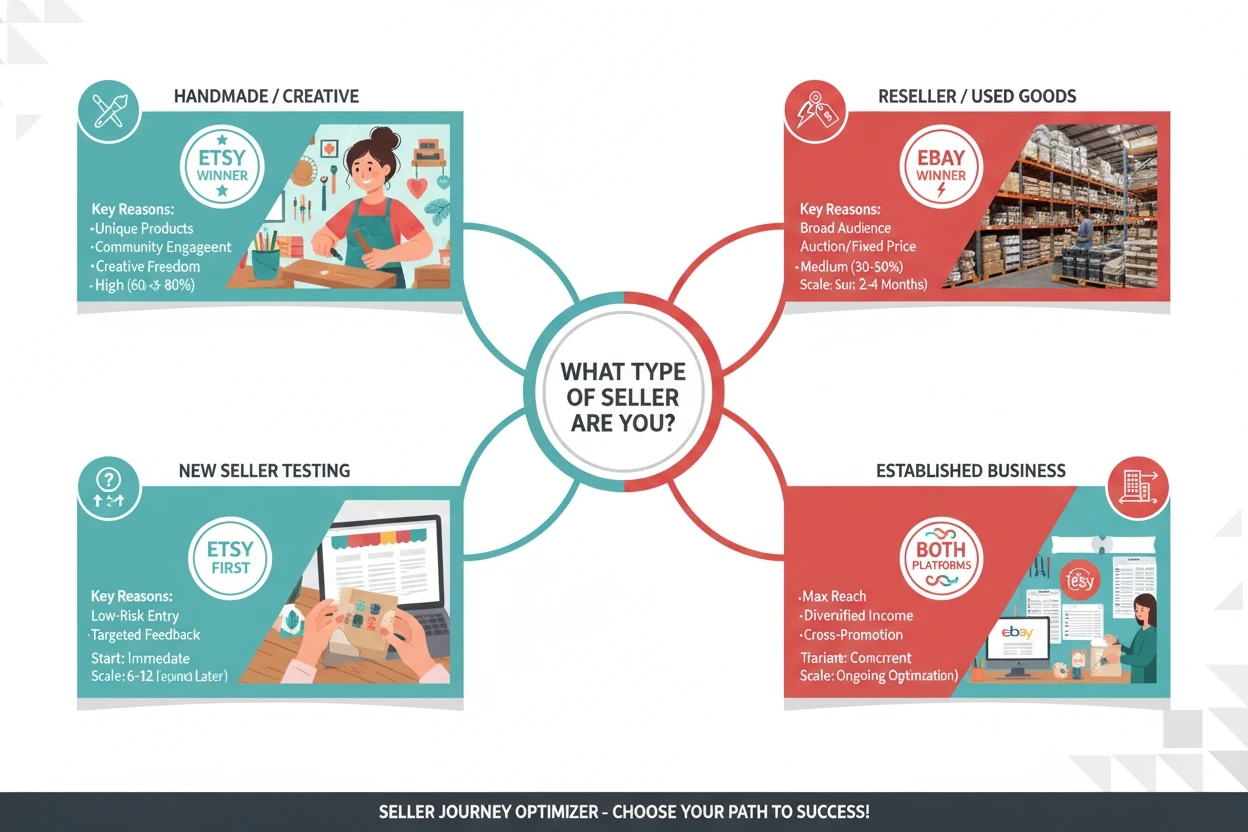
Startup costs: Etsy requires minimal investment. Create free account, invest in product photography, and pay per listing. eBay requires store subscription ($7.95-27.95 monthly) for serious sellers. Etsy’s lower startup costs make it ideal for testing viability.
Risk level: Etsy offers lower risk due to reduced fees and focused audience validation. If your products don’t sell, losses are minimal. eBay’s higher fees and learning curve increase initial risk.
New sellers should start with Etsy to test market fit with minimal financial risk.
Etsy vs eBay for Established Businesses
Scaling limitations: Etsy’s product category restrictions limit expansion possibilities. eBay’s flexibility enables diverse product lines and scaling strategies.
Multi-channel selling: Established businesses typically use both platforms plus additional channels (Shopify, Amazon). Etsy provides brand-building revenue; eBay provides volume-based revenue.
Established businesses benefit from multi-channel approaches, leveraging each platform’s strengths.
Downsides and Limitations You Should Know
What Is the Downside of Etsy?
Policy enforcement risks include sudden account suspensions for policy violations, often without clear explanations. Appealing suspension decisions can be difficult.
Rising fees have increased significantly over Etsy’s history, reducing seller profitability. Further increases appear likely.
Marketplace dependency means your entire business relies on Etsy’s algorithms and policies. Policy changes can devastate sales overnight.
What Is the 5000 Rule on eBay?
eBay limits new sellers to 50 listings during their first month. As reputation builds, this limit increases (500, then 5,000 listings). The 5,000-listing ceiling restricts high-volume sellers without established history.
For sellers planning massive operations, this limit creates barriers until reputation is established.
Frequently Asked Questions About Etsy vs eBay
Is Etsy better than eBay for sellers?
It depends on your product type and business model. Etsy is better for handmade, unique, and creative items. eBay is better for volume reselling and used goods. For handmade products, Etsy is typically superior due to audience alignment and lower fees. For resale and collectibles, eBay’s reach often wins.
Etsy vs eBay for selling handmade items?
Etsy wins decisively. Etsy buyers specifically search for handmade items, and the platform’s fee structure favors handmade sellers. eBay’s price competition and lower buyer willingness-to-pay for artisan goods make it less suitable.
eBay vs Etsy for selling used products?
eBay wins. eBay dominates the used goods market with established buyer bases for used collectibles, electronics, and general merchandise. Etsy’s vintage category is limited and premium-focused. For bulk used goods, eBay provides superior traffic and buyer familiarity.
How much does Etsy take from a $100 sale?
Etsy takes $8.25 in fees (listing $0.05 + transaction $5.00 + payment processing $3.20), leaving you $91.75 before shipping and product costs.
How much does eBay take from a $100 sale?
eBay takes approximately $16.25 in fees with a store subscription (insertion $0.30 + final value $12.90 + payment processing $2.65 + store portion $0.40), leaving you $83.75 before shipping and product costs.
Is Etsy or eBay better for vintage sellers?
For authentic vintage dealers, eBay offers broader reach and audience variety. For premium vintage selling and maker-focused items, Etsy attracts higher-value buyers. Many vintage sellers use both platforms.
Can I sell on Etsy and eBay at the same time?
Yes, absolutely. Many successful sellers use both platforms. Etsy provides brand-building revenue with lower fees; eBay provides volume-based revenue with larger audience. Using both diversifies risk and maximizes reach.
Conclusion: Etsy vs eBay, Which Should You Choose in 2026?
Choose Etsy if:
- You create handmade or unique items
- You want lower fees and simpler operations
- You’re testing a new product idea with minimal investment
- You prefer building brand identity and customer relationships
- You target creative, unique-seeking buyers
Choose eBay if:
- You’re reselling used items or bulk inventory
- You want access to massive global audience
- You’re comfortable with price competition
- You sell collectibles or diverse product types
- You need auction capabilities
Optimal strategy: Launch on Etsy first to test demand with lower financial risk. Once validated, add eBay for volume-based revenue. Many successful sellers maintain active presence on both platforms, leveraging each marketplace’s unique strengths.
The right choice depends on your products, business model, and target customers. Etsy excels at helping creative entrepreneurs build sustainable brands. eBay excels at moving volume through price-competitive markets. Choose based on your products and customers, or use both to maximize total revenue and reduce marketplace dependency.