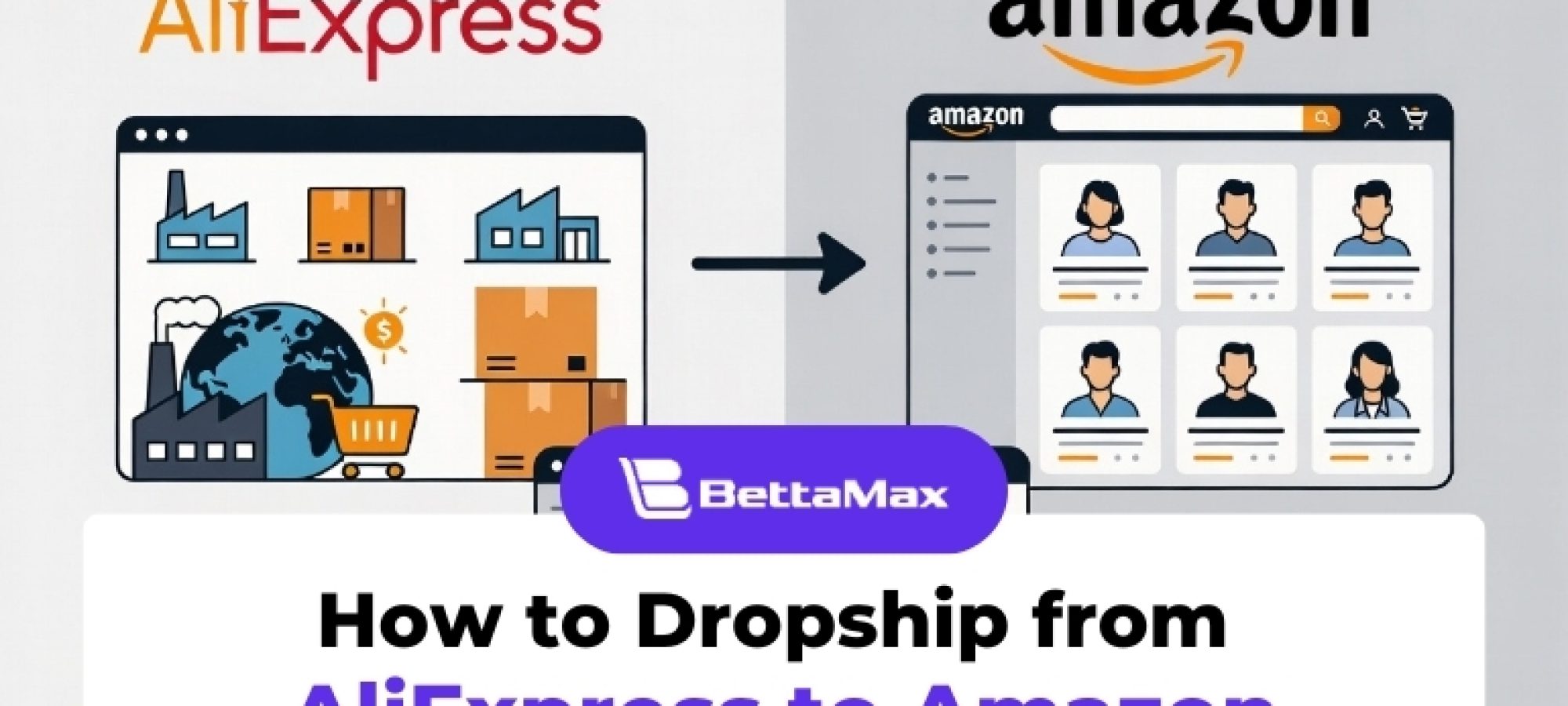

Amazon is the world’s largest e-commerce platform, with over 300 million active customers searching for products every day. AliExpress, on the other hand, is one of the largest global supplier marketplaces, offering millions of low-cost products directly from manufacturers and wholesalers.
Learn how to dropship from AliExpress to Amazon with this complete beginner’s guide. This article walks you through the real process, Amazon policies, profit calculations, and realistic expectations for 2026.
What Is AliExpress to Amazon Dropshipping?
AliExpress to Amazon dropshipping is a fulfillment model where you sell products on Amazon without holding any inventory. Instead, you source those products from AliExpress suppliers after a customer places an order on Amazon.
How the Order Flow Works in Real Practice
A customer discovers your product listing on Amazon. They find a product that solves a specific problem at a competitive price point. They click “Add to Cart,” proceed through checkout, and complete their purchase. Amazon processes the payment immediately and sends you the order notification. You now have a customer address and product order details. You log into AliExpress, find the same product from a reliable supplier, and place an order with the customer’s shipping address entered.
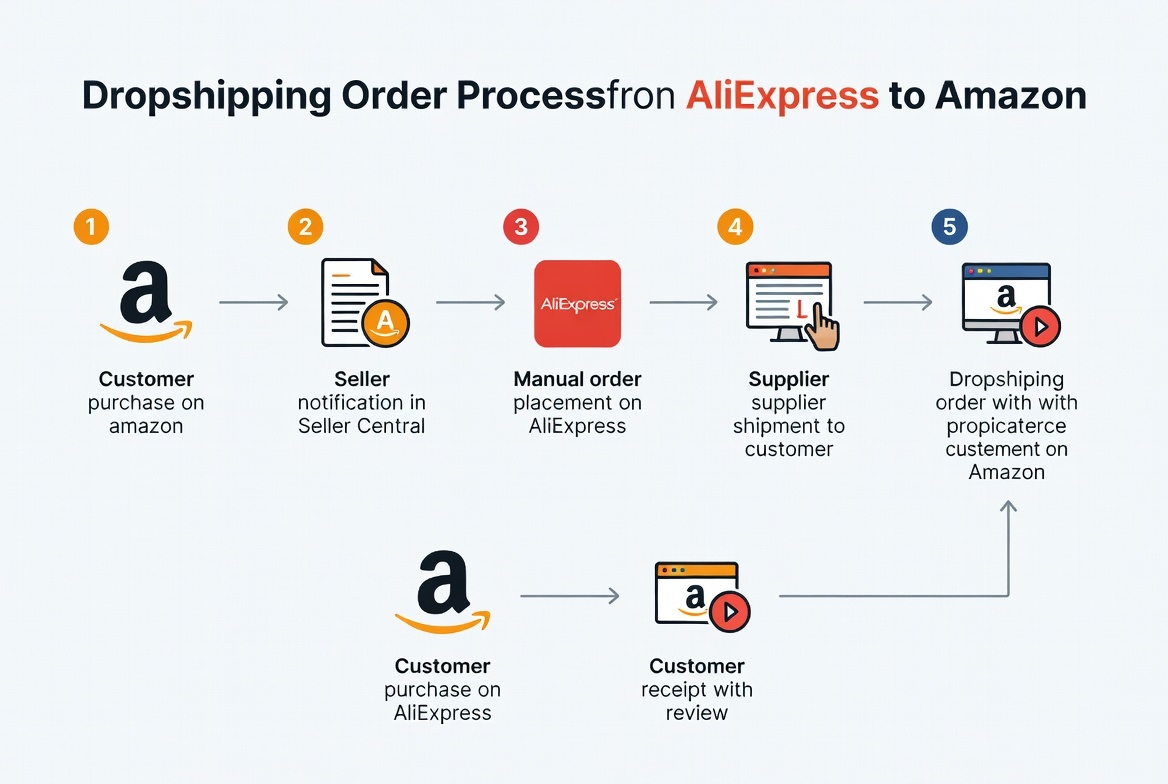
The AliExpress supplier fulfills the order from their warehouse and ships it directly to your customer’s address. Typically two to four weeks later, the package arrives. The customer opens it, uses the product, and hopefully leaves a positive review. You keep the difference between your Amazon selling price and your AliExpress costs as profit.
Why It Sounds Simple But Isn’t
On the surface, this sounds simple and straightforward. In practice, dropshipping from AliExpress to Amazon requires precision, discipline, and constant attention at every step. There are multiple points of failure. The supplier could ship the wrong item. The shipment could be delayed beyond your customer’s expectations. The product quality could disappoint. Any of these issues creates refunds, negative reviews, and potential account problems.
Your Role as Middleman
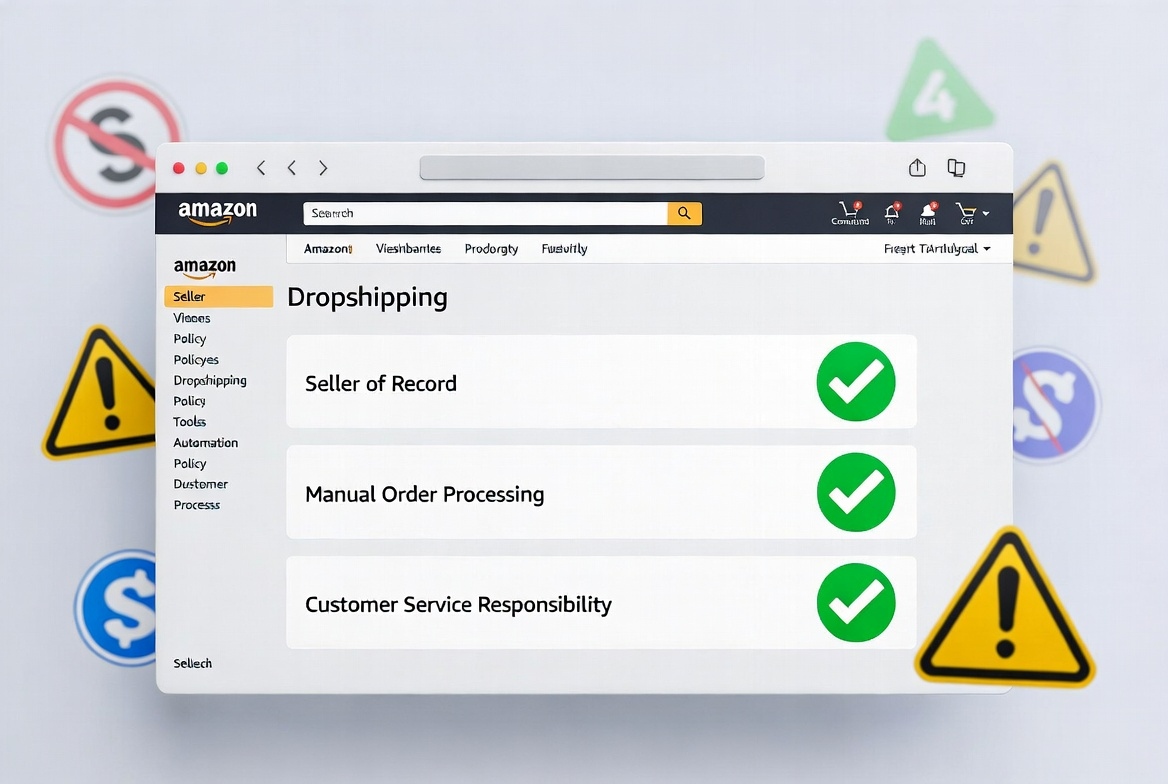
You’re essentially acting as a middleman layer between Amazon customers and AliExpress suppliers. Amazon does allow this model, but they enforce strict rules about how it must operate. You must be completely transparent about your role as the seller of record. You cannot display AliExpress branding, the supplier’s company name, or any reference to AliExpress in your communications with customers. You must handle all customer service yourself, including refunds, returns, and complaint resolution. You cannot use automation tools to sync orders between AliExpress and Amazon. Amazon explicitly prohibits this, and detection results in account suspension. And you must constantly monitor product quality to prevent refund rates from climbing, which damages your seller rating and triggers Amazon’s suspicious activity investigation.
This is fundamentally different from other e-commerce models like retail arbitrage or wholesale dropshipping. AliExpress dropshipping sits in its own category with its own specific rules and constraints.
Can You Dropship from AliExpress to Amazon in 2026?
Yes, you can dropship from AliExpress to Amazon in 2026, but only if you follow Amazon’s dropshipping policy precisely. Understanding what Amazon allows and what it prohibits is absolutely critical before you invest time and money into this model.
What Amazon’s Policy Actually Requires
You Must Be the Seller of Record
First, you must be listed as the seller of record on all documentation. Your name or business name must appear on invoices and packing slips. Customers must never see AliExpress branding, supplier names, or references to another marketplace. This is non-negotiable in Amazon’s eyes. Amazon wants customers to associate the transaction with you, not with the AliExpress supplier. This requirement exists to protect Amazon’s brand and customer relationships.
You Handle All Customer Service Responsibly
Second, you are responsible for customer service, returns, and refunds. If a customer complains about shipping time, product quality, or anything else, Amazon holds you accountable. The customer contacts you, not the AliExpress supplier. You handle the resolution or the refund. Amazon doesn’t care that your supplier was the cause. Your seller rating depends on your handling of these situations. This puts you in a position where you must actively manage supplier quality and customer expectations.
Manual Order Processing Is Mandatory
Third, manual order processing is required. Amazon does not allow automated order placement for dropshippers. Tools that automatically place AliExpress orders when an Amazon sale occurs violate Amazon’s policy. This is a major restriction that surprises many beginners. Hundreds of dropshippers have had their accounts suspended for using automation tools. The intent behind this rule is to prevent a completely hands-off model where Amazon customers are essentially buying blind from unmarked AliExpress sellers. Amazon wants you to have control, visibility, and responsibility over the process.
Legal vs Risky Setups Explained
What’s Considered Legal
A compliant setup involves manual operations where you personally review each order, place it with a reliable supplier, monitor tracking, and handle customer communication. You’re transparent with Amazon about being a dropshipper. You maintain quality standards. You process refunds promptly. You document everything. This approach takes more time and effort but keeps you compliant with Amazon’s policies.
What Gets Accounts Suspended
A risky setup involves automation where orders sync silently between AliExpress and Amazon. Customers never interact with you directly. AliExpress tracking numbers appear in customer communications. You include AliExpress invoices or branding in shipments. You ignore quality control issues. You treat dropshipping as a completely passive income stream. Amazon’s detection algorithms catch these violations regularly, and account suspension is swift and permanent.
The difference between a compliant setup and a risky one comes down to transparency and control. A manual operation where you personally manage the process is allowed. An automated system where orders sync silently and customers never interact with you is not allowed.
Pros and Cons of Dropshipping from AliExpress to Amazon
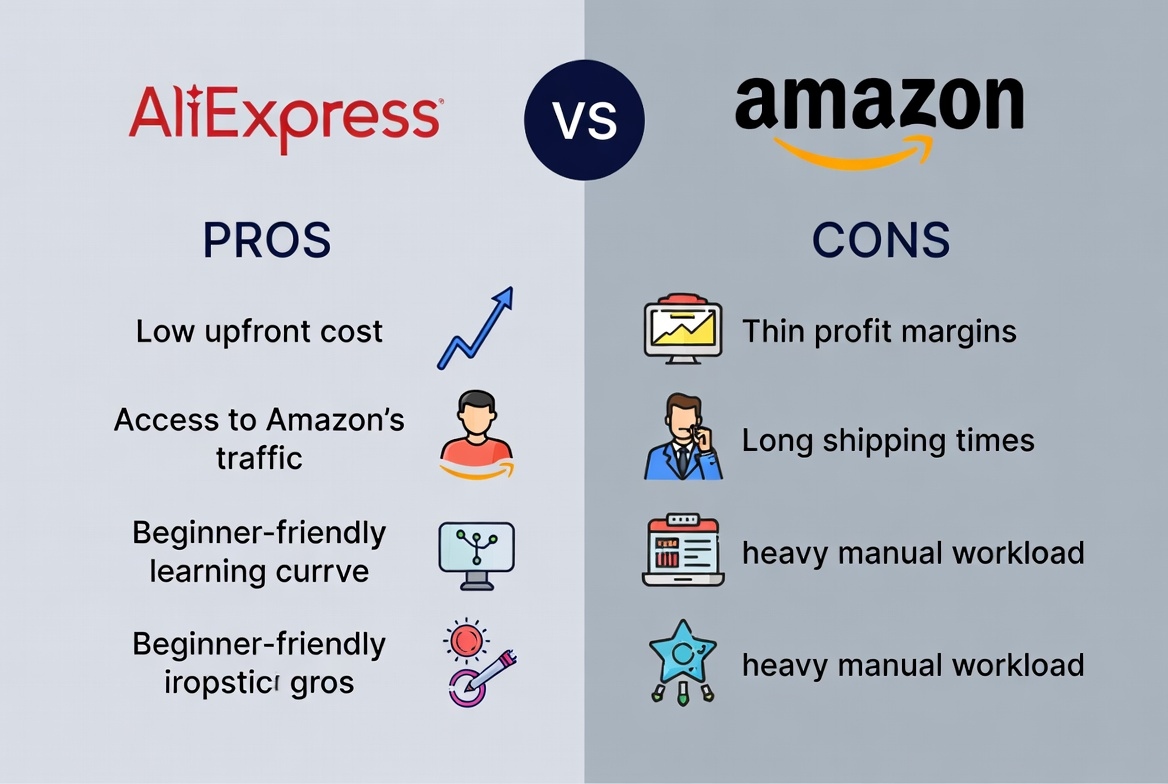
Before starting, it’s important to understand what you gain and what you give up. Successful dropshippers are realistic about the tradeoffs.
Advantages of This Model
Low Upfront Capital Requirements
The biggest advantage of this model is low upfront cost. You don’t need to buy inventory, rent storage space, or invest heavily before testing products. You can list multiple products and see what sells without committing any capital beyond the Amazon seller account fee. For beginners with limited budgets, this is a significant advantage. You can start learning e-commerce practically risk-free. Unlike wholesale or private label models that require thousands of dollars upfront, dropshipping lets you validate demand before investing serious money.
Leverage Amazon’s Traffic and Customer Trust
Another advantage is Amazon’s built-in traffic and trust. Millions of customers browse Amazon daily looking for solutions to problems. You don’t need to build a website, figure out payment gateways, or generate traffic from scratch. Amazon’s ecosystem handles discovery, payment processing, and buyer protection. This is a massive advantage compared to starting your own e-commerce store. You tap into existing demand without needing marketing skills or advertising budgets. Amazon’s reputation for customer protection also means customers are more likely to buy without extensive research.
Strong Learning Platform for Beginners
AliExpress to Amazon dropshipping is also a strong learning model. Beginners gain hands-on experience with product research, pricing psychology, customer expectations, inventory management, and operational workflows. If you eventually want to start other e-commerce businesses, this education is valuable. You understand how customers shop, what messaging resonates, and how to manage supplier relationships. This real-world education would cost thousands in courses or consulting.
Disadvantages of This Model
Extremely Thin Profit Margins
This cannot be overstated. After Amazon referral fees (typically 15 to 45 percent depending on category), your product cost from AliExpress, shipping from China, and your own time investment, many products only generate one to three dollars in real profit per sale. For a product listed at fifteen dollars, your net profit might be only four to six dollars after all costs. This sounds okay until you factor in refunds, customer service time, and operational overhead. You need volume to make meaningful income, and volume is difficult to achieve without scaling to multiple products and extensive marketing.
The thin margins mean that even small mistakes (wrong shipping estimates, supplier delays, quality issues) wipe out your profit. A five-dollar refund on a six-dollar profit product eliminates your entire margin for that sale.
Long Shipping Times Create Customer Dissatisfaction
AliExpress standard shipping typically takes two to four weeks to arrive. Amazon customers, especially those in the United States and Europe, expect much faster delivery. This mismatch creates frustration and leads to customers requesting refunds or leaving negative reviews before products even arrive. Your seller rating suffers, and Amazon’s algorithm suppresses slow-shipping listings in favor of faster alternatives. You cannot compete with sellers offering Prime two-day delivery.
This shipping time disadvantage is structural. You cannot improve it without using express shipping (which costs more) or moving to FBA (which requires upfront inventory investment). Either solution reduces your already-thin margins further.
Manual Order Processing Doesn’t Scale Easily
Every single sale requires you to place an individual order on AliExpress. As volume increases, this quickly becomes unsustainable. If you receive fifty orders in a day, you’re placing fifty AliExpress orders manually. That’s five to ten hours of pure data entry and order placement. Most successful dropshippers eventually hire virtual assistants, which adds to costs and reduces your already-thin margins. This operational bottleneck prevents passive income and limits growth.
The manual requirement also means you cannot truly automate your business. Someone must be actively working on orders daily. This is not a business you can set up and forget.
Limited Control Over Quality and Fulfillment
You have limited control over product quality and fulfillment. If a supplier ships a defective item, you deal with the refund and negative review. If a supplier goes offline, your customers have no product. You cannot inspect items before they ship to customers. You’re entirely dependent on supplier reliability, and even reliable suppliers have occasional quality issues. Too many complaints or refunds can trigger Amazon’s account review process, resulting in warnings or suspension.
This quality dependency means you’re constantly at risk. One supplier problem can cascade into multiple customer complaints, negative reviews, and account warnings.
Understanding the Full Impact of These Tradeoffs
Because of these tradeoffs, this model works best as a learning or testing phase rather than a long-term scalable business. Understanding both the advantages and disadvantages helps you set realistic expectations and make an informed decision about whether this model fits your goals.
What You Need Before Starting AliExpress to Amazon Dropshipping
Amazon Seller Account Requirements
Choosing Your Plan
The foundation of any Amazon selling business is a proper Seller Central account. Most dropshippers choose the Professional plan, which costs $39.99 per month. This allows unlimited product listings and gives you access to more advanced selling tools. The Individual plan charges $0.99 per sale but limits you to forty listings per month, which is why most serious sellers avoid it.
For dropshipping, the Professional plan is almost always the better choice. You’ll likely list more than forty products, and the features available on Professional are essential for managing a dropshipping operation.
Understanding Amazon’s Fee Structure
Understanding Amazon’s fee structure is essential before you do anything else. Amazon charges a referral fee on every order, which is a percentage of your selling price. This ranges from 8 to 45 percent depending on the product category. Books have 15 percent. Electronics have 8 percent. Clothing has 17 percent. Toys have 15 percent. Collectibles go to 20 percent. Some specialized categories like shoes and watches go even higher.
This referral fee is taken automatically by Amazon before you receive your payment. It’s not a surprise charge later; it’s deducted upfront. Understanding your category’s fee is critical for pricing products correctly.
Additional Fees Beyond Referral
Beyond the referral fee, Amazon also charges a small transaction fee for payment processing. This is typically around 2 percent of your selling price. When you combine the referral fee and the transaction fee, a significant portion of your selling price goes directly to Amazon.
Required Documents and Information
You’ll need valid identification (passport or government ID), a bank account (where Amazon deposits your earnings), a credit card (for your seller account fee), and tax identification. In the United States, this means an EIN or SSN. Other countries have different tax identification requirements. Approval from Amazon typically takes 24 to 48 hours, though some regions require additional verification steps.
Your AliExpress Account
While an AliExpress account is not strictly required, it’s strongly recommended. Having an established account allows you to track orders, communicate with suppliers before placing bulk requests, use AliExpress’s buyer protection if an order doesn’t arrive, and build a reputation history with suppliers. Creating an account is free and takes five minutes.
Step-by-Step: How to Dropship from AliExpress to Amazon
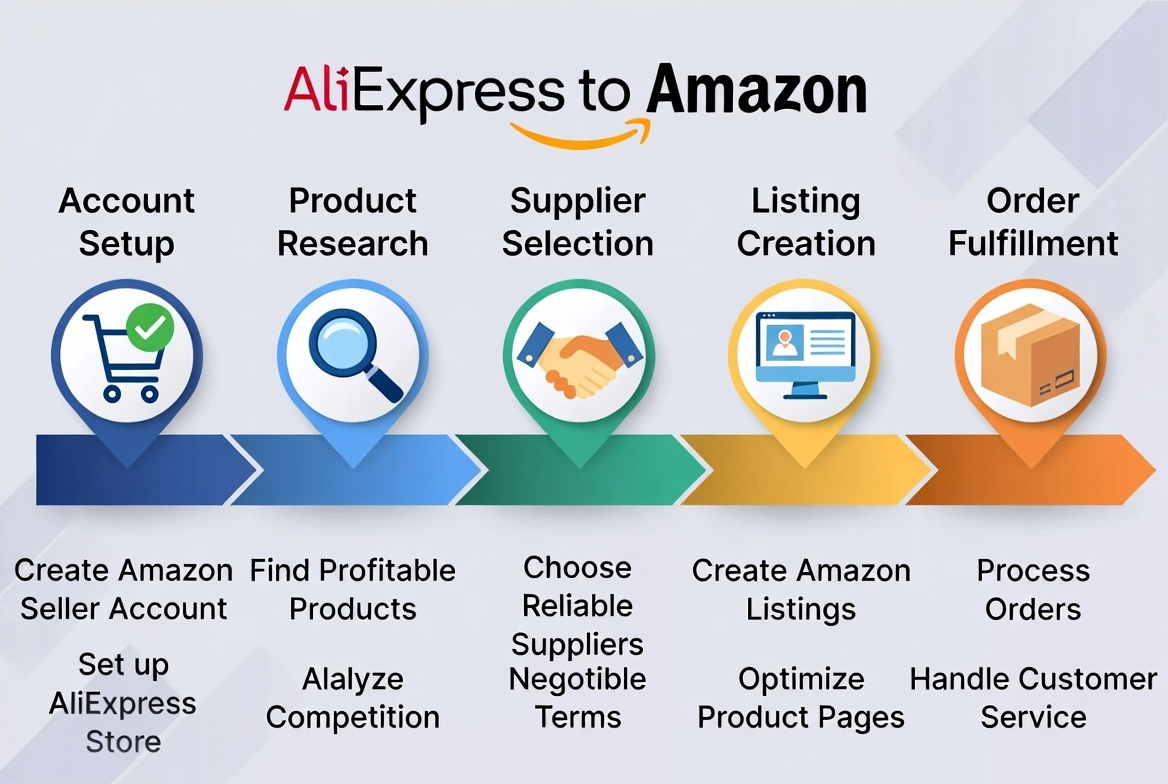
The journey from beginner to active dropshipper follows a clear path, though success depends on execution at each step.
Step 1: Setting Up Your Amazon Seller Account
Registration and Verification
The process begins by visiting Seller Central and registering. You’ll provide business information, complete identity verification, link a bank account, and choose your plan. The entire process takes one to two hours. Most sellers receive approval automatically within 24 hours.
Once approved, you can begin researching and listing products. You’ll have access to Seller Central, Amazon’s dashboard for managing your account, listings, orders, and performance metrics.
Complete All Verification Steps
Don’t skip any verification steps or try to rush the process. Amazon’s verification system protects both the platform and legitimate sellers. Incomplete or inaccurate information delays approval or results in account suspension later.
Step 2: Researching Winning Products on AliExpress
Using the AliExpress Dropshipping Center
Product research is the most critical step in this entire journey. Successful sellers don’t pick products randomly. They use systematic research methodology. Start with the AliExpress Dropshipping Center, which provides official data on sales volume, ratings, and growth trends. Filter for products with at least 1,000 orders in the past month, ratings of 4.8 stars or higher, and suppliers with above 95 percent positive feedback. These filters immediately eliminate a large percentage of unsuitable products.
Cross-Checking with Google Trends
Next, cross-check your candidates using Google Trends. Search the product keyword on Google Trends and look at the search volume pattern over twelve months. You’re looking for products with stable or rising search interest, not viral spikes that are already declining. A product that was trending three months ago is too late. You want products that are building momentum or have sustained steady demand.
Examining Existing Amazon Listings
Finally, examine existing Amazon listings for the same or similar products. This is critical because it shows real market demand. If no Amazon listings exist, the product might have demand on AliExpress but not with Amazon customers. If hundreds of identical listings exist, the market is saturated and margins will be compressed.
Step 3: Validating Demand on Amazon
Before listing anything, spend time on Amazon researching the competitive landscape. Search for your product keyword and study the top five listings. What prices are they selling at? What are their ratings and review counts? How much shipping variation exists? If the top sellers all seem profitable and well-reviewed, the product likely has real demand. If most listings have poor ratings or zero reviews, the market might be weak.
Step 4: Finding Reliable AliExpress Suppliers
Filtering by Rating and History
Not all AliExpress suppliers are equal. Some are scammers. Some have poor quality control. Some don’t accept dropshipping orders. Look for suppliers with store ratings above 95 percent, a store history of at least one year, and detailed feedback history.
Reading the one- to three-star reviews often reveals problems that five-star reviews don’t mention. Common complaints include shipping delays, product damage, and misleading descriptions. Look for patterns in complaints rather than isolated issues.
Direct Communication Before Ordering
Contact potential suppliers before ordering. Ask directly whether they accept dropshipping orders and single-item orders. Some suppliers require minimum purchases of ten or more units. Others refuse dropshipping because Amazon is a competitor. Finding willing suppliers is harder than beginners expect.
Step 5: Ordering Samples
Before scaling, order samples from your top two or three product candidates. Pay for the order yourself. Receive the actual product. Use it. Assess the quality, packaging, and whether it matches the photos. This step reveals quality issues that no online review can capture. Many beginners skip this step and regret it later when customers start complaining.
Step 6: Creating Your Product Listings
Manual Listing Creation
Everything must be done manually. You cannot import products from AliExpress in bulk. You must create each listing individually on Amazon Seller Central. Fill out the required fields: category, product title, brand name, country of origin, SKU, condition (New), description, images, price, and variations if applicable.
Writing Compelling Titles and Descriptions
Your product title should be descriptive and keyword-rich, following Amazon’s guidelines. Your description should be unique and original, not copied from AliExpress. Amazon actively detects plagiarism and penalizes sellers. Write from a customer benefit perspective. Instead of “This is a phone mount,” write “Keep your phone secure while driving. Magnetic attachment works with any phone. Three mounting options: dashboard, windshield, or air vent.”
Optimizing Product Images
Product images are critical for conversion. Download images from AliExpress, but edit them. Remove watermarks. Improve lighting if needed. Add lifestyle photos showing the product in use. Include multiple angles and variations. Amazon’s algorithm favors listings with high-quality, diverse imagery.
Step 7: Optimizing for Conversion
Using Bullet Points Effectively
Use the five-bullet section to highlight key benefits. Each bullet should answer a customer question or emphasize a specific advantage. Write in customer language, not technical language. If professional seller tier is available in your category, invest in A+ content, which allows richer formatting and better presentation.
Creating Professional Listings
Professional presentation matters. Customers judge your listing based on appearance. Spelling errors, inconsistent formatting, or unclear language reduces trust and conversion rates. Spend time polishing each listing.
Step 8: Managing Fulfillment and Orders
Processing Daily Orders
When a customer orders on Amazon, you receive a notification in Seller Central. You note their address and product details. You log into AliExpress and place an identical order with the customer’s address. You receive tracking information from the supplier and update your Amazon listing with this tracking number. You monitor the tracking to confirm arrival.
This process requires fifteen to thirty minutes per order for beginners. As you develop efficiency, it might drop to five to ten minutes per order. Ten daily orders means fifty to a hundred minutes of manual work. Fifty daily orders means this becomes your full-time job.
Handling Customer Communication
Any customer communication or issues are your responsibility. Shipping delays, quality complaints, refund requests, and return authorizations all go through you. Professional and prompt communication is essential for maintaining your seller rating. Slow response times generate negative reviews and complaints.
Pricing, Fees, and Real Profit Expectations
Understanding real profit requires walking through a complete example with actual numbers.
Complete Profit Calculation Example
Starting with a Concrete Product
Consider a magnetic phone mount. You find it on AliExpress for four dollars. Shipping via ePacket is two dollars (included in the listing price). You list it on Amazon for $15.99. Amazon’s referral fee for accessories is 15 percent, which equals $2.40. Amazon’s payment processing fee adds another $0.32. Your time to place the order, manage communication, and handle logistics averages about fifty cents per order based on a $10 to $15 hourly value you’re assigning to yourself.
Gross Profit Calculation
This gives you $15.99 minus $4 minus $2 minus $2.40 minus $0.32 minus $0.50 equals $6.77 gross profit. This looks decent on paper.
Adjusting for Reality
But this is before reality sets in. Approximately 10 percent of orders result in refunds. That represents a loss of $0.68 in profit on those orders. Processing refunds and customer service issues adds another $0.30 in time. Shipping from China sometimes takes longer than expected or encounters delays, which generates customer complaints that take time to manage, adding another $0.30 to deduct.
Your real profit per sale is approximately five to six dollars. For ten daily sales, that’s fifty to sixty dollars in daily profit. For fifty daily sales, that’s two hundred fifty to three hundred dollars daily. The income is real, but it requires volume and discipline.
Most beginners significantly underestimate their operational time and overestimate their profit per unit.
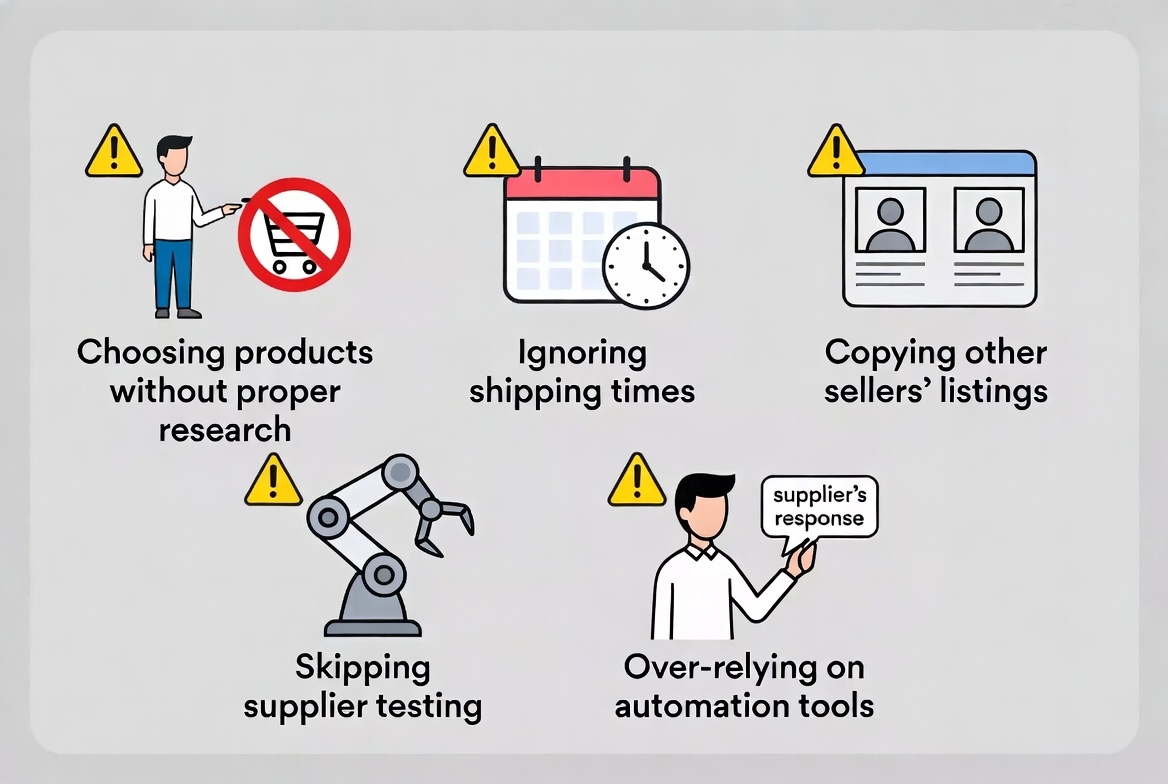
6 common Mistakes Beginners Make
Product Selection Errors
Many beginners choose products based on appearance rather than data. They see something they think is cool and assume it will sell. This leads to listing dozens of products with no sales. Product selection must be data-driven. Use metrics, not intuition.
Ignoring Shipping Time Realities
Others ignore shipping time expectations. They list AliExpress products that take four weeks to ship without considering that Amazon customers expect fast delivery. The mismatch creates refunds and negative reviews. Before listing, calculate total shipping time and compare to competitor shipping times.
Copying Content Directly
Copying AliExpress descriptions, images, and listing content violates Amazon policy and risks account suspension. Everything must be original and unique. Spend time rewriting descriptions and editing images.
Skipping Supplier Testing
Skipping supplier testing is another common mistake. Ordering samples seems like an additional expense, but it prevents worse expenses later in the form of refunds and account damage. Test before scaling.
Using Prohibited Automation
Using automation tools to sync AliExpress with Amazon is the fastest way to lose your account. This violates policy explicitly. Never use automation tools for dropshipping.
Underestimating Workload
Many beginners underestimate the manual workload. They expect passive income from day one. In reality, dropshipping requires active management of orders, suppliers, and customer service. Budget for manual work until you can afford to hire help.
Is AliExpress to Amazon Dropshipping Worth It in 2026?
Who This Model Works For
This model makes sense for specific situations and goals. It’s valuable for beginners who want to learn e-commerce fundamentals without committing capital. You understand how Amazon works, how customers shop, what product-market fit looks like, and how to manage operations. This education translates to other business models.
It’s useful for sellers validating demand before moving to wholesale or private label. Once a product proves it can consistently sell, buying inventory in bulk or launching FBA improves margins and stability.
Who This Model Doesn’t Work For
It’s not ideal for entrepreneurs seeking long-term scalability, passive income, or significant wealth building. The thin margins and manual workload create a natural ceiling.
It’s not suitable for passive income seekers. This is not passive. It requires constant manual work, daily order placement, customer service, and problem-solving.
It’s not appropriate for those needing immediate income. Revenue develops slowly. Monthly profits are typically five hundred to two thousand dollars while learning. Too slow for someone needing income urgently.
The Smart Transition Strategy
The smartest approach is to use AliExpress to Amazon dropshipping as a testing ground. Once a product proves demand with consistent sales, transition to bulk purchasing or FBA creates better margins and stability.
FAQs About AliExpress to Amazon Dropshipping
How do I dropship on Amazon from AliExpress as a beginner?
Follow these steps: Create and verify your Amazon seller account, research products using AliExpress Dropshipping Center and Google Trends, validate demand on Amazon, order samples from reliable suppliers, create optimized product listings manually, set up merchant fulfillment (FBM), and manage orders by manually placing AliExpress orders when customers purchase. Budget ten to fifteen hours for setup and expect four to eight weeks before first sales.
Is AliExpress to Amazon dropshipping legal?
Yes, it’s legal if you follow Amazon’s policies. You must be the seller of record, handle all customer service, process orders manually (not with automation), include no AliExpress branding, and maintain quality standards. Violating these policies results in account suspension.
Do I need automation tools for AliExpress to Amazon dropshipping?
No, and you shouldn’t use them. Amazon explicitly prohibits automated order placement. Tools that sync AliExpress with Amazon violate policy. Manual order processing is slower but policy-compliant. This is a drawback of the model but necessary for staying compliant.
What products should I avoid dropshipping on Amazon?
Avoid restricted products like weapons or hazardous items, counterfeit goods, trademarked products you don’t own, nutritional supplements with regulatory requirements, electronics requiring safety certifications, and items with extremely long shipping times of four weeks or more.
How long does AliExpress shipping take for Amazon orders?
Standard ePacket shipping takes seven to fourteen days to developed countries and fourteen to thirty days to developing countries. Some suppliers offer express shipping for additional cost at three to seven days. You cannot offer Prime two-day delivery with AliExpress dropshipping.
Can I scale AliExpress to Amazon dropshipping to $10,000 per month?
Theoretically yes, but practically difficult. You’d need fifty to one hundred profitable products, one hundred plus daily sales, hiring virtual assistants for order management, and extensive marketing. Most dropshippers reach two thousand to five thousand dollars monthly before switching to other models.