
You’ve created beautiful handmade items and need to choose where to sell them online. Etsy feels like home for artisans with lower fees and a supportive community, but Amazon Handmade offers access to millions more shoppers. Yet Amazon’s strict return policies and complex setup intimidate you.
Which platform actually helps independent makers earn more while maintaining sanity? This guide compares Amazon Handmade vs Etsy on fees, returns, competition, and real income potential so you can choose confidently.
Key Takeaways of Amazon Handmade vs Etsy
Choose Amazon Handmade if: You want massive customer reach, can handle higher return rates, prefer advanced advertising tools, and accept stricter operational requirements.
Choose Etsy if: You prioritize community, lower fees, supportive buyer culture, easier setup, and want to build a personal brand as an artisan.
Main profitability difference: Etsy wins on fee efficiency (8.25% vs 15%), but Amazon Handmade wins on traffic volume. Success depends on your product type and sales ability.
Best strategy: Many successful artisans sell on both platforms simultaneously, leveraging Etsy’s profit margins and Amazon’s customer volume.
What Is Amazon Handmade?
Amazon Handmade is Amazon’s dedicated marketplace for artisan-made and small-batch produced items. Launched in 2015, Handmade protects buyers seeking authentic, personally crafted goods while giving makers access to Amazon’s 380+ million monthly active buyers.
Amazon Handmade operates within Amazon’s ecosystem, requiring sellers to comply with Amazon’s operational standards including approval verification, handling time requirements, and return policies. Handmade items are clearly labeled as handmade, differentiating them from mass-produced Amazon inventory.
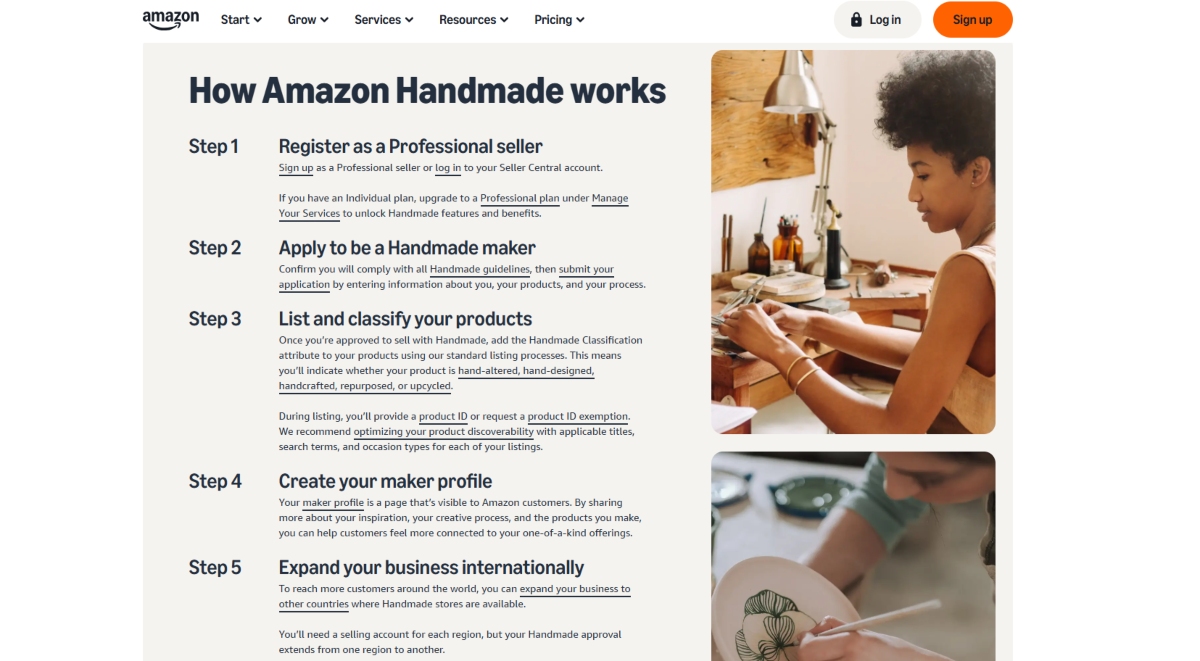
How it works: Artisans apply for Amazon Handmade approval by providing proof of personal creation (photos, videos, design documentation). Once approved, sellers list items using Amazon’s catalog system, set pricing, and fulfill orders via Amazon shipping or FBA (Fulfillment by Amazon).
Typical sellers include jewelry makers, artists, woodworkers, textile designers, custom makers, home decor artisans, and specialty craftspeople. Amazon Handmade attracts established artisans with production capacity and operational infrastructure.
What Is Etsy?
Etsy is a global marketplace specializing in handmade items, vintage goods, and craft supplies. With 90 million monthly active buyers, Etsy attracts people specifically searching for unique, artisan-made products they can’t find elsewhere.
Etsy’s culture celebrates independent makers, small businesses, and creative entrepreneurs. The platform emphasizes authenticity, personal stories, and direct connections between makers and buyers. Sellers maintain complete control over branding, pricing, and buyer relationships.
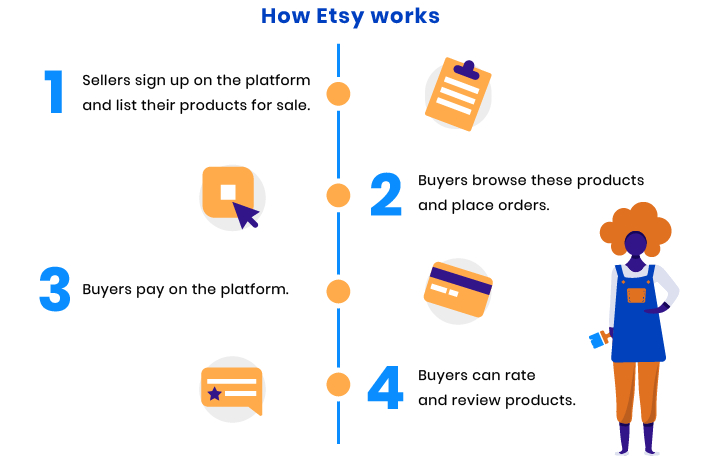
How it works: Create a free shop, list items with handwritten descriptions and personal photos, set fixed prices, and handle fulfillment yourself. Etsy provides built-in traffic but minimal operational requirements.
Typical sellers include independent artisans, jewelry makers, vintage dealers, artists, home decor creators, and craft supply makers. Etsy attracts early-stage to mid-stage makers valuing community and creative freedom.
Amazon Handmade vs Etsy Comparison Overview
| Factor | Amazon Handmade | Etsy |
|---|---|---|
| Best For | High-volume makers, established artisans | Independent creators, emerging makers |
| Customer Base | 380+ million Amazon shoppers | 90 million Etsy shoppers |
| Transaction Fees | 15% | 5% |
| Setup Time | 2-4 weeks (approval required) | 30 minutes |
| Return Rate | High (15-30%) | Low (5-10%) |
| Advertising Tools | Advanced (Sponsored Ads, CPC) | Basic (Etsy Ads) |
| Brand Control | Limited | Complete |
| Return Policy | Amazon-enforced (strict) | Seller-defined |
| Best For Beginners | No (steep learning curve) | Yes (easy entry) |
| Profit Margin | Lower due to fees + returns | Higher due to lower fees |
Products and Categories Allowed
Handmade Product Focus
Amazon Handmade accepts handmade items defined as personally crafted goods requiring verification. Allowed: jewelry, accessories, home decor, clothing, art, woodcraft, pottery, customized items. Amazon requires proof of personal creation through photos and documentation showing your hands making the product.
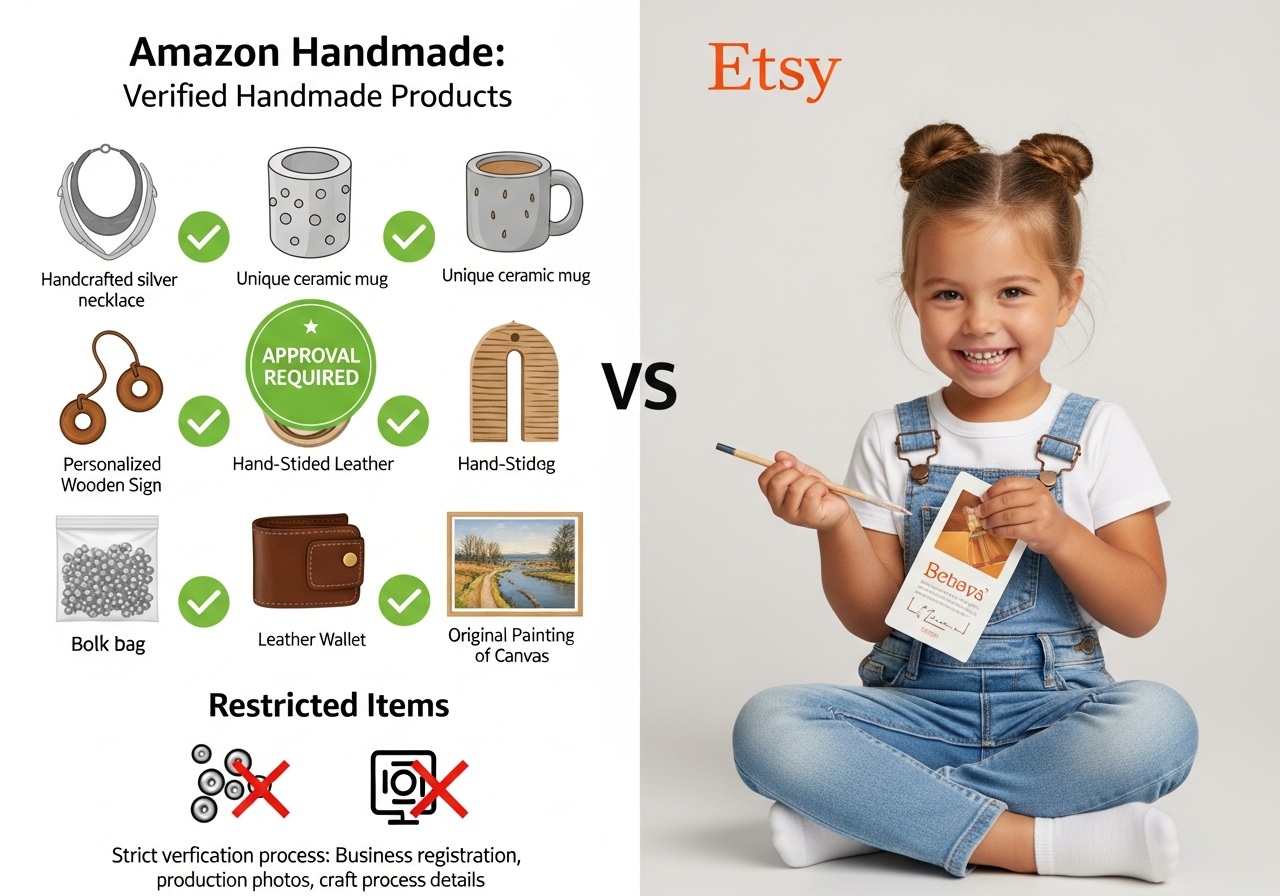
Etsy has broader handmade definitions. Allowed: handmade items, vintage (20+ years), craft supplies, digital downloads, customizable products. Etsy relies on seller honesty but vigorously investigates complaints.
Amazon Handmade has stricter verification ensuring authenticity. Etsy has broader flexibility accommodating various handmade interpretations.
Selling Art on Amazon Handmade vs Etsy
Etsy art market is massive. Original art, prints, digital art, and reproductions find eager buyers. Etsy artists set their own pricing with no fee caps. Average art prices range from $20-$500+, with no Amazon-style return complications.
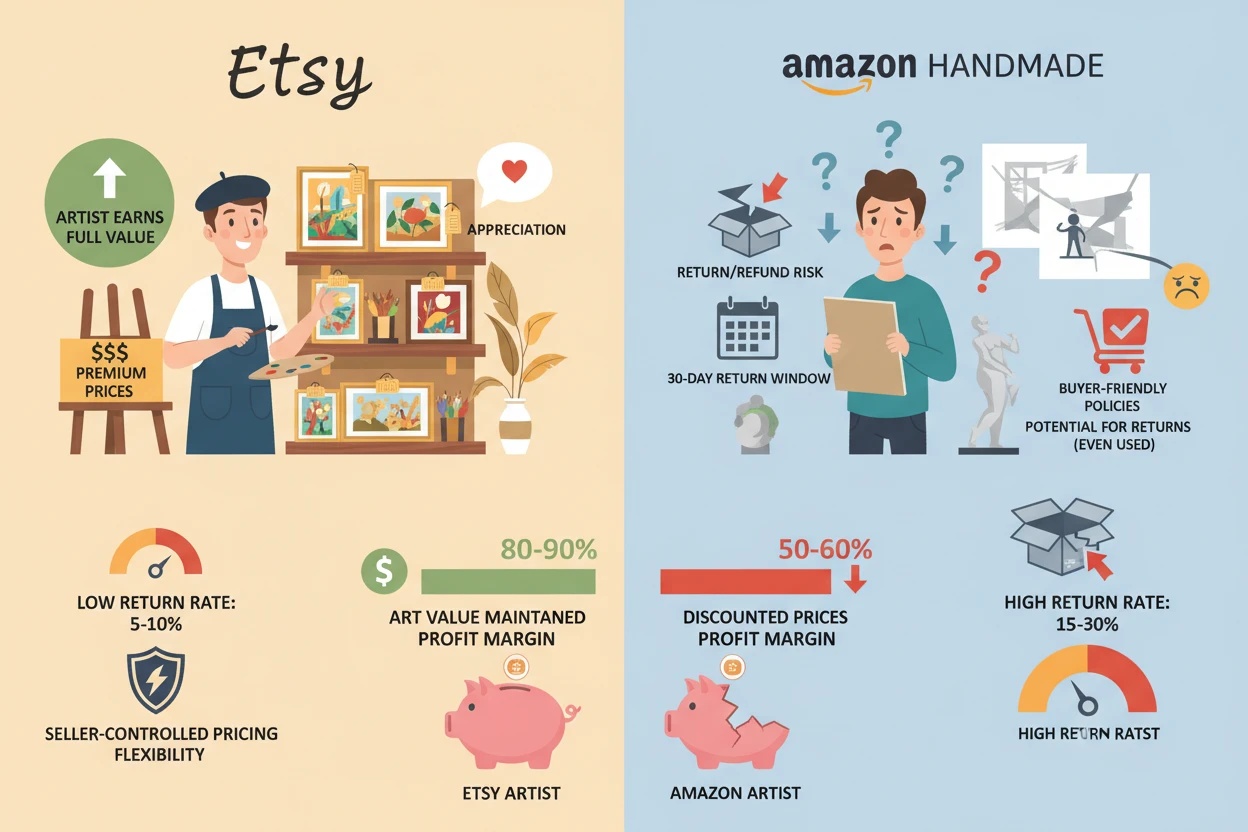
Amazon Handmade art faces stricter return policies. Original art and prints are allowed, but Amazon’s 30-day return window creates risk. High-value art pieces experience higher return rates.
Verdict: Etsy dominates for artists. Lower returns and price flexibility make profitability straightforward.
Amazon Handmade vs Etsy for Craft Supplies
Etsy specializes in craft supplies. Beads, yarns, fabrics, tools, embellishments find dedicated buyers. Etsy supply sellers build loyal customer bases with repeat purchases.
Amazon Handmade restricts bulk supplies. Individual handmade items yes, but supply-focused sellers should avoid Amazon Handmade. Amazon requires items to be “handmade” not “supplies for handmaking.”
Verdict: Etsy wins decisively for craft supplies and supply-based businesses.
Seller Experience and Platform Usability
Store Setup and Approval Process
Etsy setup: Create account (5 minutes), set shop name (5 minutes), add first listing (15 minutes). Launch selling in 25 minutes. No approval required. Start immediately.
Amazon Handmade approval: Complete detailed application (30 minutes), upload proof of creation (photos/videos of process), wait 2-4 weeks for manual review. Many applications are rejected. Approval is uncertain.
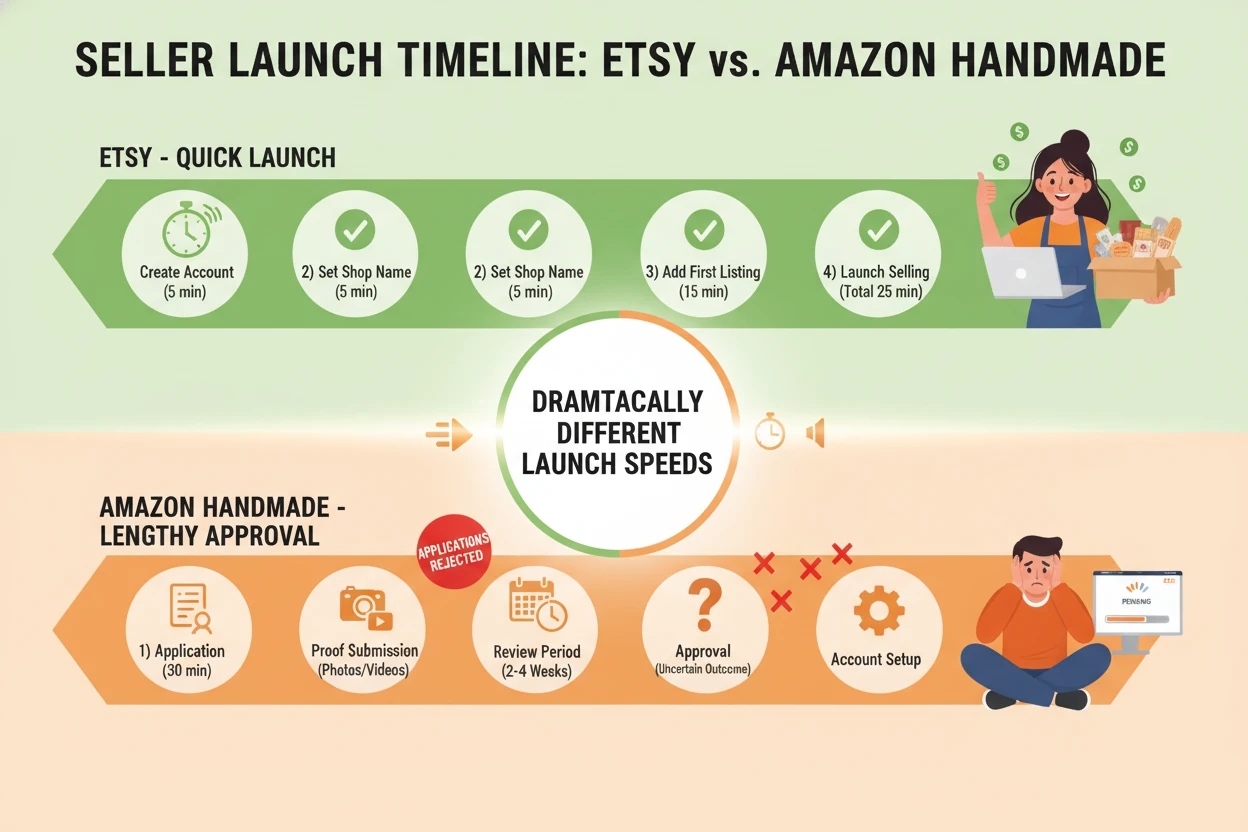
For beginners, Etsy’s instant activation dramatically reduces friction. Amazon’s approval process deters new sellers.
Ease of Listing and Store Management
Etsy listings are straightforward. Write title, add photos, write description, set price, list. Each listing takes 10-15 minutes. Managing 100 listings is manageable manually.
Amazon Handmade listings use Amazon’s complex catalog system. Assign UPC codes, select from predefined attributes, navigate Amazon’s category system. Learning curve is steep. Each listing takes 20-30 minutes.
Etsy prioritizes maker convenience. Amazon prioritizes data standardization.
Amazon Handmade vs Etsy Fees and Costs
Etsy Fees Explained
- Listing fee: $0.20 per listing (4-month duration)
- Transaction fee: 5% of sale price
- Payment processing: 3% + $0.20 (US domestic)
- Total on $100 sale: $8.25 (8.25%)
Amazon Handmade Fees Explained
- Referral fee: 15% of sale price (includes transaction and payment)
- Monthly subscription: Optional (Prime eligible sellers)
- Fulfillment: Self-fulfill (free) or FBA ($2.50-4.50 per item)
- Total on $100 sale: $15.00+ (15%+)
Amazon Handmade Fees vs Etsy Fees Comparison
On a $100 sale:
- Etsy: $8.25 (8.25%), leaving $91.75
- Amazon Handmade: $15.00 (15%), leaving $85.00 + potential return costs
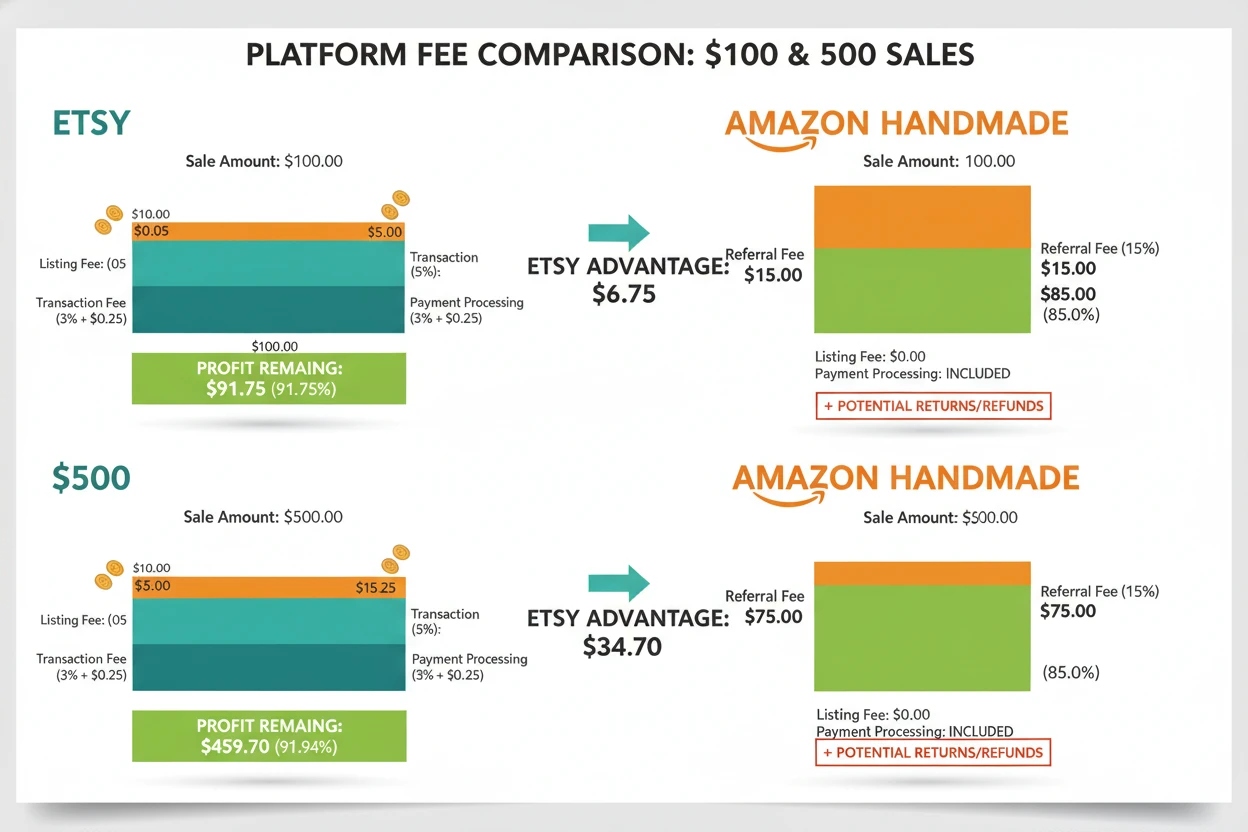
On a $500 sale:
- Etsy: $41.25, leaving $458.75
- Amazon Handmade: $75.00, leaving $425.00 + return risk
Etsy’s fee advantage compounds significantly at higher sale prices. Amazon’s 15% fee nearly doubles Etsy’s cost.
Fulfillment, Shipping, and Returns
Etsy Fulfillment and Return Policies
Seller-controlled returns: You define return windows (0-90 days) and conditions. Most Etsy sellers offer 14-30 day returns. Buyers rarely return handmade items.
Average return rate: 5-10% (industry standard)
Seller advantage: Handmade items are treated differently. Buyers expect higher prices and respect craftsmanship investment. Returns are minimal because buyers understand items are custom-made.
Amazon Handmade Fulfillment and Return Policies
Amazon-enforced returns: 30-day return window (non-negotiable). Amazon defaults to buyer-friendly policies. Items can be returned for any reason.
Average return rate: 15-30% (significantly higher)
Seller disadvantage: Amazon’s “customer-centric” approach means customers can return used items for full refunds. Artisans absorb return shipping and restocking costs. Return fraud is common on handmade items.
Real example: Seller receives $100 sale. Amazon takes $15. Buyer returns item 25 days later. Seller refunds $100, eats return shipping ($5), loses $5 processing fee = Net loss on transaction.
Traffic, Visibility, and Marketing Tools
Etsy SEO and Advertising Tools
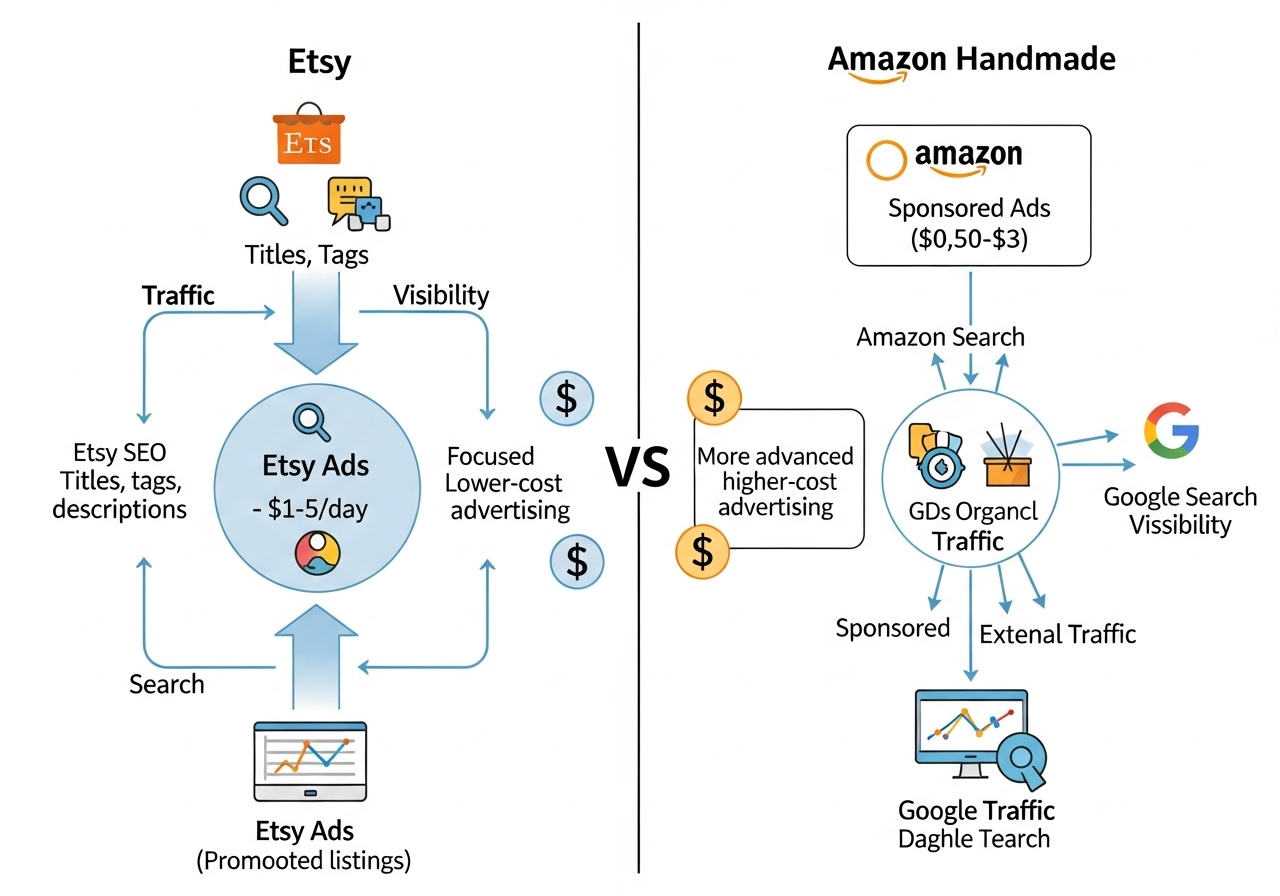
Etsy SEO: Optimize titles, tags, descriptions for Etsy’s internal search. Good SEO drives discoverability within Etsy’s 90 million buyer ecosystem.
Etsy Ads: Promoted listings within Etsy search. Cost-effective ($1-5/day). Low CPC. Attracts qualified buyers already shopping Etsy.
Limitations: External traffic driving is limited. All traffic comes from Etsy ecosystem.
Amazon Handmade Advertising and Exposure
Amazon search visibility: Amazon’s algorithm-driven search is powerful. Well-optimized listings rank for relevant searches.
Sponsored Ads: Pay-per-click advertising. Higher CPC ($0.50-$3.00+). More sophisticated targeting. Requires budget.
Advanced tools: Analytics, A/B testing, keyword research integrated into Amazon’s seller tools.
Advantage: Amazon’s massive traffic and advanced advertising enable serious marketing. However, high CPC requires substantial advertising budget.
Pros and Cons of Amazon Handmade vs Etsy
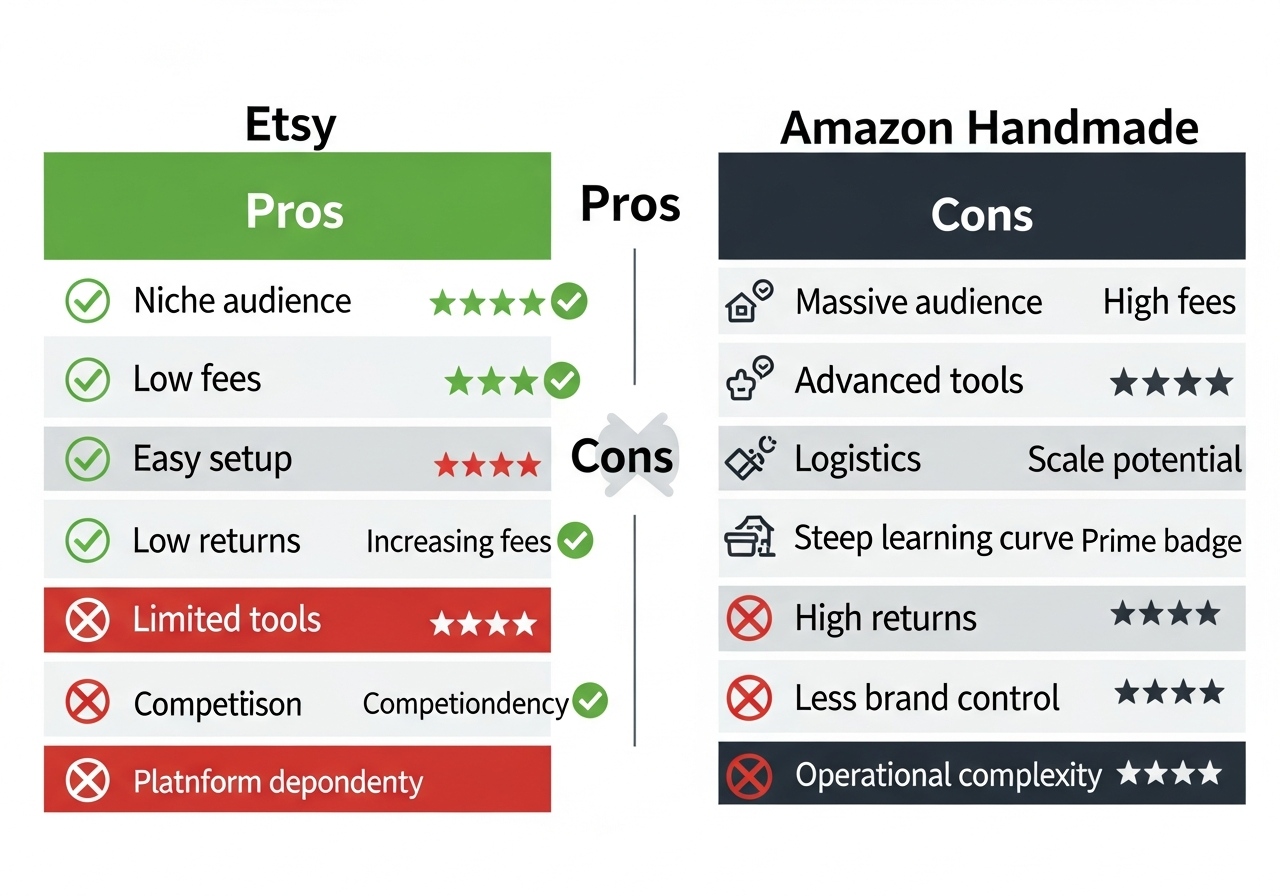
Pros and Cons of Selling on Etsy
Pros:
- Niche-focused audience actively seeking handmade items
- Low fees (8.25% vs 15%)
- Low return rates (buyer respect for handmade)
- Easy setup and quick launch
- Complete brand control
- Supportive seller community
- Lower advertising costs
Cons:
- Smaller customer base (90M vs 380M+)
- Increasing fees over time
- Limited marketing tools
- High competition in popular categories
- Platform dependency
Pros and Cons of Selling on Amazon Handmade
Pros:
- Massive customer base (380+ million)
- Advanced advertising and analytics tools
- Amazon’s logistics infrastructure
- Strong search visibility potential
- Prime badge eligibility
Cons:
- High fees (15%)
- Lengthy approval process (2-4 weeks)
- High return rates (15-30%)
- Limited brand identity control
- Strict operational requirements
- Return fraud risk
- Complex platform learning curve
Amazon Handmade vs Etsy for Different Seller Types
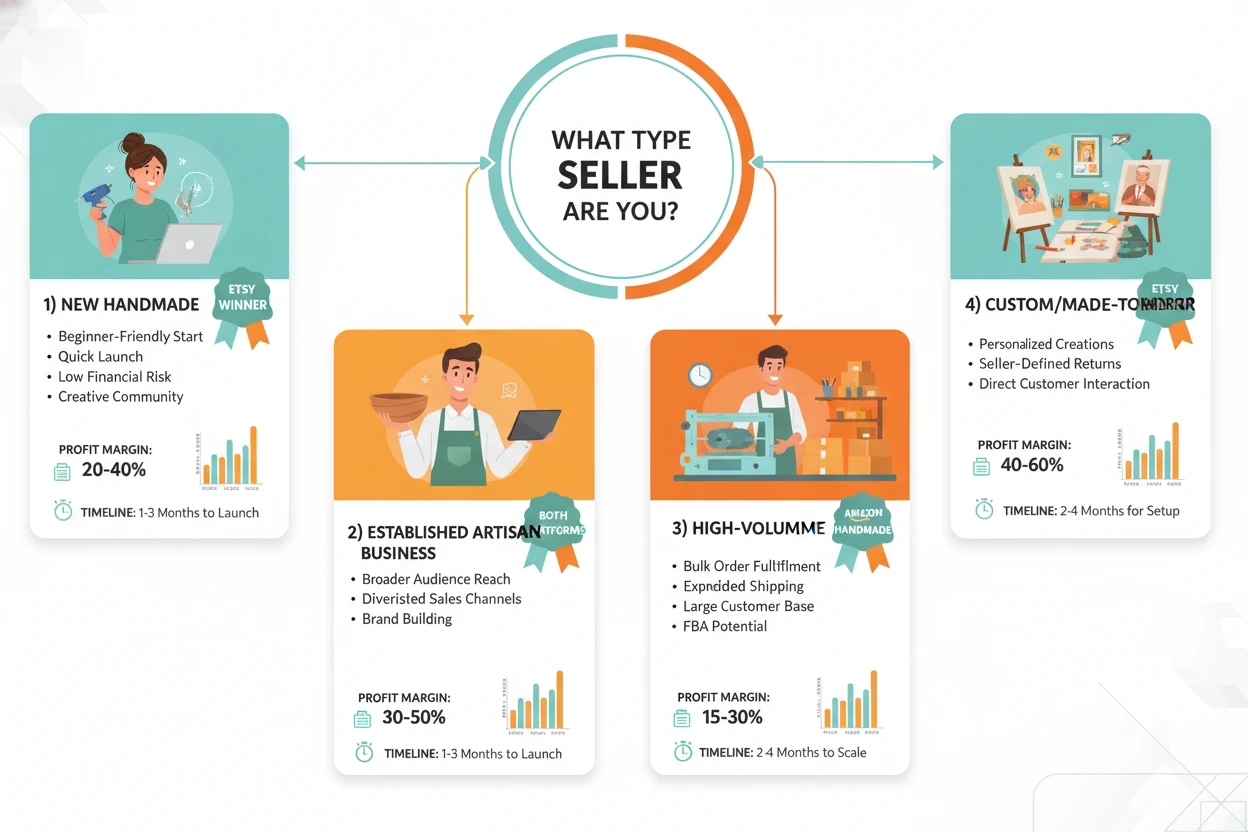
New Handmade Sellers and Small Artisans
Etsy advantage: Lower barriers to entry, instant approval, minimal setup complexity, low financial risk, supportive community. Start selling immediately, test demand, build confidence.
Amazon Handmade disadvantage: Approval uncertainty, lengthy wait, high learning curve, requires operational infrastructure.
Recommendation: New sellers should start with Etsy. Launch in 30 minutes, validate demand, build track record. Add Amazon Handmade later once sales volume justifies the operational complexity.
Established Handmade Businesses
Amazon Handmade advantage: Scaling potential, larger customer base, advanced tools supporting volume growth, Prime badge benefits.
Etsy advantage: Higher profit margins, proven customer loyalty, established brand.
Recommendation: Established sellers benefit from dual-platform strategy. Leverage Etsy for consistent, profitable revenue. Use Amazon Handmade for volume growth despite lower margins.
High Volume vs Custom Made Sellers
High-volume makers: Amazon Handmade suits sellers producing batches. Inventory-based model aligns with Amazon’s operational expectations.
Custom/made-to-order: Etsy suits custom makers. Seller-defined return policies accommodate customization. Buyers expect longer lead times.
Amazon Handmade vs Etsy vs Other Marketplaces
Amazon Handmade vs Etsy vs Main Amazon Marketplace
Amazon main marketplace: Dominated by resellers and mass-produced goods. Price competition is extreme. Handmade Marketplace provides protected category for artisans, but still operates within Amazon’s strict environment.
Amazon Handmade vs Etsy vs Facebook Marketplace
Facebook Marketplace: Local selling, low fees, minimal brand building. Best for bulk local sales, not scaling nationally.
Etsy vs Amazon: Global platforms with professional infrastructure. Facebook suits side hustles; Etsy/Amazon suit serious businesses.
Is It Better to Sell on Etsy or Amazon Handmade?
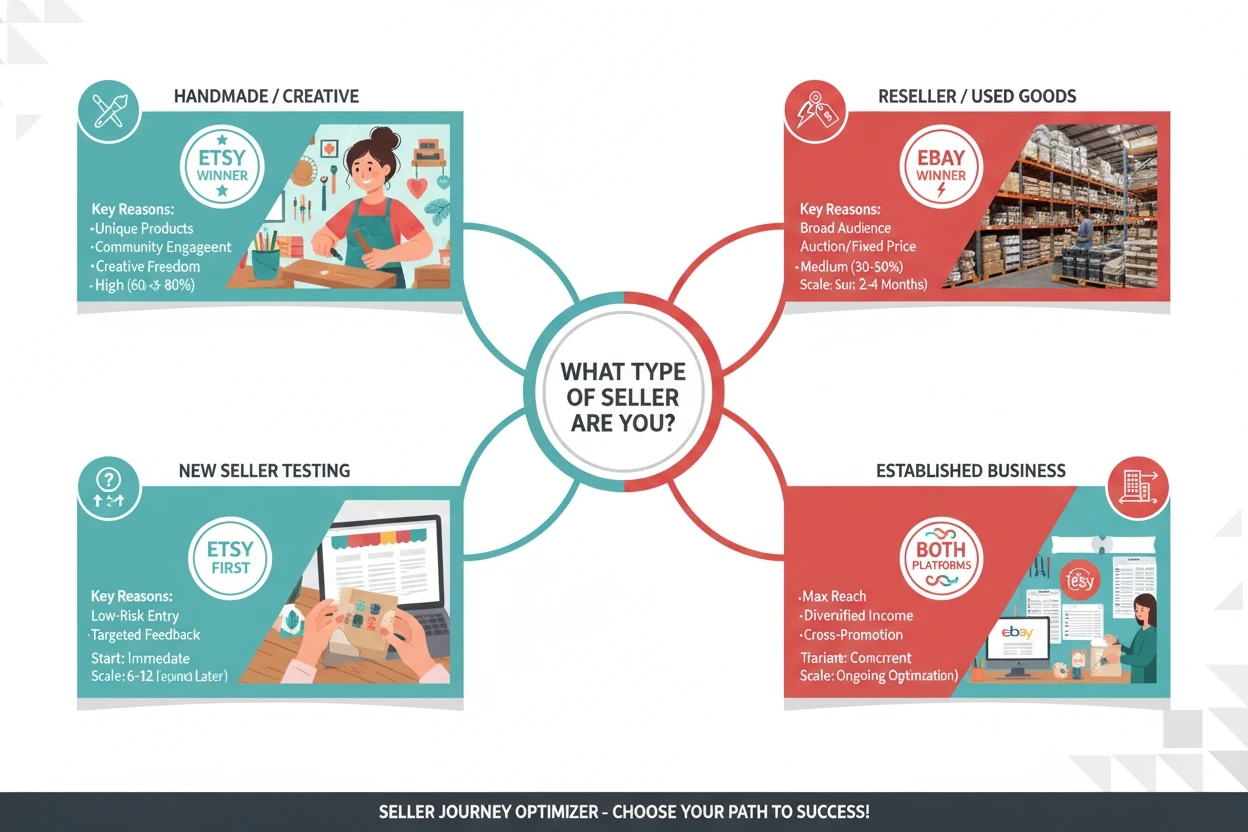
For most handmade sellers, Etsy is better.
Etsy wins because:
- Lower fees protect profit margins
- Low return rates reduce financial risk
- Easier onboarding reduces entry barriers
- Supportive culture attracts artisan buyers
- Better suited for custom/made-to-order models
- Brand building is straightforward
Amazon Handmade wins only when:
- You have production capacity for volume
- You accept lower margins
- You can handle operational complexity
- You want access to massive customer base
- You have budget for advertising
Best strategy: Launch on Etsy, build momentum and brand, add Amazon Handmade once sales are consistent and you have operational confidence.
Can You Make $10,000 a Month Selling on Amazon Handmade?
Yes, but with caveats.
Math on Amazon Handmade:
- $10,000 monthly revenue
- Minus 15% Amazon fees: -$1,500
- Minus 20% average returns/refunds: -$2,000
- Minus shipping costs (if self-fulfilling): -$500
- Net profit: $6,000 (60% of gross revenue)
Requirements:
- 50-100+ average orders monthly
- $100+ average order value
- 20-30% return rate acceptance
- Advanced advertising skills
- Operational infrastructure
On Etsy:
- $10,000 monthly revenue
- Minus 8.25% fees: -$825
- Minus 10% average returns: -$1,000
- Minus shipping costs: -$500
- Net profit: $7,675 (76.75% of gross revenue)
Etsy achieves higher profitability at lower revenue thresholds.
Who Is Etsy’s Biggest Competitor?
Short answer: Amazon Handmade, though Etsy’s community moat is substantial.
Amazon Handmade is the primary threat. Amazon’s customer base dwarfs Etsy’s. However, Amazon’s return policies and operational complexity limit appeal to true artisans.
Shopify-based brands are emerging competitor. Direct-to-consumer handmade brands bypass marketplaces entirely, building owned audiences.
Facebook Marketplace and TikTok Shop are growing but lack professional infrastructure.
Reality: Etsy’s strongest advantage is community and culture. Buyers choose Etsy because it champions handmade creators. This cultural moat is difficult for Amazon to replicate.
Frequently Asked Questions About Amazon Handmade vs Etsy
Is Etsy or Amazon better for selling handmade items?
Etsy is generally better for most handmade sellers due to lower fees (8.25% vs 15%), low return rates, easier setup, and supportive community. Amazon Handmade suits high-volume makers with operational infrastructure and larger marketing budgets.
What is the best website to sell handmade items?
Etsy is the best starting platform. It has the most handmade-focused audience, lowest barriers to entry, and best profit-to-effort ratio. Add Amazon Handmade once you have sales momentum.
Is Amazon Handmade profitable?
Yes, but less than Etsy. 15% fees plus high return rates (15-30%) reduce net profit significantly. Profitability requires volume, operational efficiency, and advertising expertise.
Is Amazon Handmade cheaper than Etsy?
No, Amazon is more expensive. Amazon’s 15% referral fee versus Etsy’s 8.25% total fees makes Etsy significantly cheaper. Add return costs and Amazon’s fee advantage disappears.
What percentage does Amazon Handmade take?
15% referral fee on all sales. This includes transaction and payment processing. Additional fulfillment costs apply if using FBA.
Can I sell on both Etsy and Amazon Handmade?
Yes, absolutely. Many successful artisans sell on both platforms. Etsy provides consistent, profitable revenue. Amazon provides volume-based growth. Diversification reduces platform dependency.
Which platform has fewer returns for handmade sellers?
Etsy has significantly fewer returns (5-10%) vs Amazon Handmade (15-30%). Etsy’s buyer culture respects handmade craftsmanship. Amazon’s customer-centric policies favor returners.
Conclusion: Amazon Handmade vs Etsy in 2026
For independent artisans, Etsy remains superior. Lower fees, supportive community, low returns, and easier onboarding create a better experience for makers prioritizing profit and creative freedom.
Amazon Handmade suits high-volume makers with production capacity, operational infrastructure, and marketing budgets who prioritize customer volume over profit margins.
The optimal strategy for serious artisans: Launch on Etsy to validate demand and build brand with minimal risk. Once sales are consistent and profitable, add Amazon Handmade to access additional customers. Use both platforms simultaneously, leveraging Etsy for brand building and Amazon for volume growth.
The choice isn’t either/or. It’s about starting where conditions are most favorable (Etsy), then expanding to reach maximum market potential (both platforms).
Your handmade items deserve a platform that values artisanship, respects your profit margins, and champions maker success. Etsy does this better. But the best strategy uses both platforms complementarily, capturing the strengths of each.